 Feature
One Shared Login vs A Seat Per Person: Five Rounds
Almost every small team has done it: one account, one password, everybody uses it. The alternative is a named seat for each person and a bill that grows with the payroll. This duel scores the two approaches round by round — cost, friction, whether the contract allows it, knowing who did what, and the day somebody leaves. No vendor is in this fight and no price is quoted, because the answer does not depend on which tool you picked.
The rules of this duel
Every duel on this site is scored round by round, with the rounds fixed before the fighters walk out, so nobody wins by piling up advantages that do not matter.
This one puts two account policies in the corners rather than two products. In the navy corner, the shared login: one set of credentials, one line on the invoice. In the red corner, a seat per person: every human has their own account and their own line on the bill.
No prices appear below and no vendor's terms are quoted. Pricing pages and contract wording change often enough that a number or a clause printed here would be out of date before you read it — open your own vendor's pricing page and your own signed agreement and check them against the rounds. The rubric is on the editorial policy page; the round format is explained in how a duel is scored.
What this duel can do is tell you which questions decide it, in what order, and what flips each round. That part does not expire.
- The shared login is best for a very small team, a tool nobody edits anything in, and a budget with no slack.
- A seat per person is best for any tool that holds customer data, changes money, sends mail from your domain, or will outlive the current staff.
- On points: a seat per person, three rounds to two.
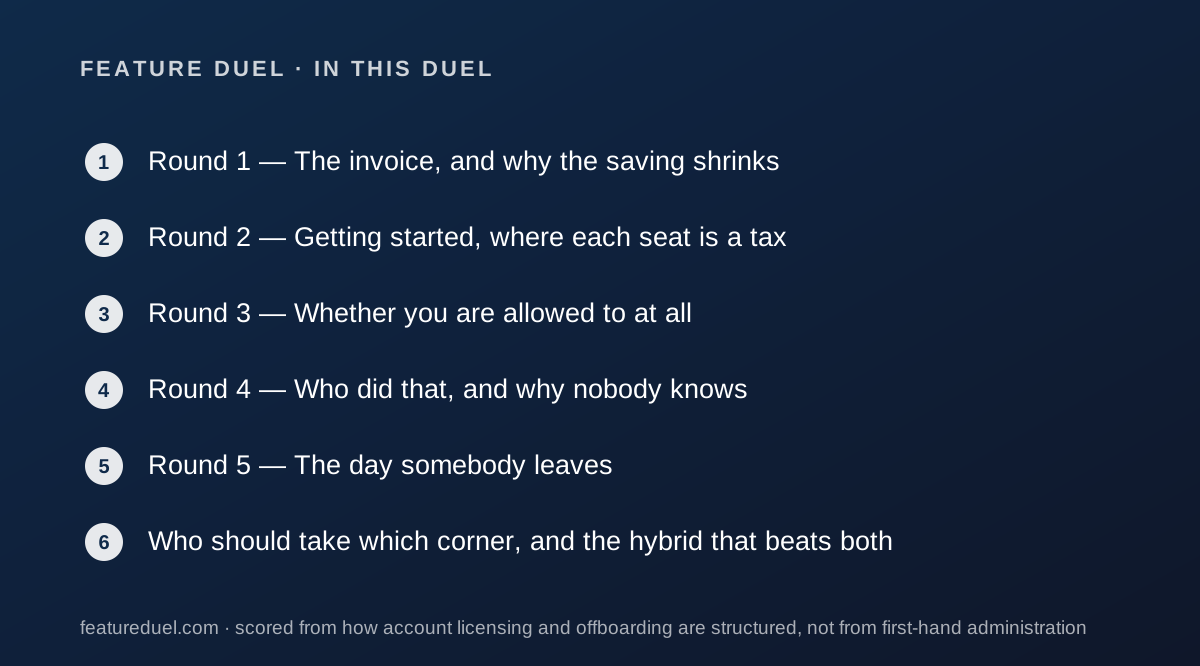
Round One — The invoice, and why the saving shrinks
The shared login comes out swinging, because this is the round that made anyone consider it in the first place.
One account means one subscription. Five people sharing it means one fifth of the bill a seat-per-person policy would produce, and on a tool used occasionally by four of those five, that arithmetic is hard to argue with. For a team choosing between one shared account and no account at all, the shared account wins by default.
The seat-per-person corner has two counters, and they are better than they first sound.
The first is that per-seat pricing is rarely linear. Vendors commonly publish volume discounts, bundle a number of seats into a tier, or set a seat minimum you pay for whether or not you fill it. Where a tier already includes seats you have not used, additional named accounts can cost nothing at all. That is a thing to check on the pricing page rather than assume in either direction.
The second is that the saving is a gross figure, not a net one. Passing a password around, resetting it after a scare, and working out which of five people broke something is not free. It appears as somebody's afternoon rather than a line on an invoice.
The call: the shared login takes Round One, clearly. It is cheaper on the invoice and the invoice is what gets approved.
This round flips when the tool's cheapest tier already includes more seats than you are using, or when a seat minimum means you are paying for named accounts you have not created. In both cases the saving is imaginary and you are taking the costs of sharing for nothing.
Round Two — Getting started, where each seat is a tax
Round Two is about friction, and the shared login wins it for reasons that have nothing to do with money.
A shared account is provisioned once. One sign-up, one email verification, one set of settings configured the way the team wants, one password in whatever the team uses to store passwords. A new joiner is productive in the tool the moment somebody tells them the credentials.
A seat per person is a small administrative process repeated forever. Somebody has to invite each person, assign a role, and chase them when they ignore the invitation — for every new hire, in every tool. On a team with no dedicated administrator this is the work that quietly does not happen, and the result is people locked out of a tool the company pays for.
The seat corner's honest answer is that this friction is front-loaded and shrinking. Directory-based sign-in and automated provisioning exist to remove it. But those capabilities tend to sit on higher tiers, and a team arguing about one shared password is usually not on a higher tier.
The call: the shared login takes Round Two. Nothing beats zero onboarding steps.
This round flips the moment the tool is one people log into every day. Daily use turns a shared password into a daily negotiation, and a session that logs one person out when another logs in stops being a minor irritation within a week.
- Shared login advantage: provisioned once, no invitation flow, no per-person admin.
- Seat advantage: automated provisioning removes the friction, if your tier includes it.
- Flip condition: daily use, or concurrent sessions that evict each other.
Round Three — Whether you are allowed to at all
Here the duel turns, and it turns on a document most teams have never opened.
Software is licensed, not bought, and the licence says who may use the account. Terms vary: some agreements define a user as a named individual, some sell capacity that may be shared, some are silent and leave the vendor room to decide later. Seat counting is how most per-seat vendors make money, so it is the part of the agreement they tend to write carefully.
This page cannot tell you which of those applies to you, and will not guess. Nobody here has read your contract. What matters is that the answer exists in writing, is specific to the vendor, and is findable in about ten minutes: open the agreement you accepted at sign-up and search it for the word *user*.
The consequences of being wrong are not symmetrical, which is the real finding of this round. A seat-per-person policy cannot breach a sharing clause. A shared login can, and the failure mode is not a warning email — it is a true-up invoice, a suspended account during your busy week, or an audit question you cannot answer.
The call: a seat per person takes Round Three, decisively. It is the only corner that cannot lose this fight.
This round flips where the vendor sells sharing on purpose. Floating, concurrent and site licences are real products, and under one of those a shared account is not a workaround but the thing you paid for. Read before you assume either way.
- Seat advantage: cannot breach a clause about account sharing, whatever the clause says.
- Shared login exposure: a true-up bill or a suspension, not a polite warning.
- Flip condition: a licence that sells concurrent or site-wide use deliberately.
Round Four — Who did that, and why nobody knows
Round Four is the one buyers think about least and regret most, because it only matters after something has gone wrong.
Under a shared login, the activity log is useless. It shows the account, which is everybody, so every entry resolves to the same name. When a record is deleted, a setting is changed, a message goes out to the wrong list or a figure in a report moves, there is no way to find out who did it — not to punish anyone, but to work out what they were doing and whether anything else was affected. The investigation becomes a conversation, and conversations about mistakes are slow and unpleasant.
It degrades more than the log. Notifications go to one inbox nobody owns. Comments and edits appear under one name, so the trail of a decision cannot be reconstructed. Anything personal to an account — saved views, drafts, two-factor settings — becomes communal and gets overwritten.
Named seats fix all of that without anyone doing extra work. Attribution is a side effect of logging in as yourself.
The call: a seat per person takes Round Four, and not narrowly. The audit trail is worth more than the licence costs, and you only learn that on the day you need it.
This round flips where there is nothing to attribute. A read-only dashboard, a tool used to look things up rather than change them, has no destructive actions and no comment threads, so a shared log loses nothing. Check that the tool is genuinely read-only before relying on that, because most tools grow an edit button eventually.
- Seat advantage: attribution, per-person notifications, and personal settings that survive.
- Shared login exposure: every log entry names the same account, so incidents become interviews.
- Flip condition: a genuinely read-only tool with no destructive actions.
Round Five — The day somebody leaves
The last round is the one nobody evaluates while hiring, and it is where the shared login's bill finally arrives.
Removing a named seat is one action in an admin panel. Access ends, their work stays where it is, attribution remains intact, nobody else notices. The same is true when access only needs reducing.
Removing a shared login is not removal at all. The departing person knows the password, so the only remedy is to change it — then redistribute the new one everywhere it is stored, including the places you have forgotten. Until that is finished, a former colleague retains access to a live company account. Teams routinely discover during this exercise that they never knew who had the credentials.
The risk is not usually malice. It is a password sitting in a personal manager, on a home machine, in an old message thread — outside your control and outside your knowledge. Multiply that by every shared tool and every person who has ever left.
The call: a seat per person takes Round Five. Not close.
This round flips only on a time horizon: if nobody will ever leave, offboarding costs nothing. Teams say this about themselves far more often than it turns out to be true.
The scorecard
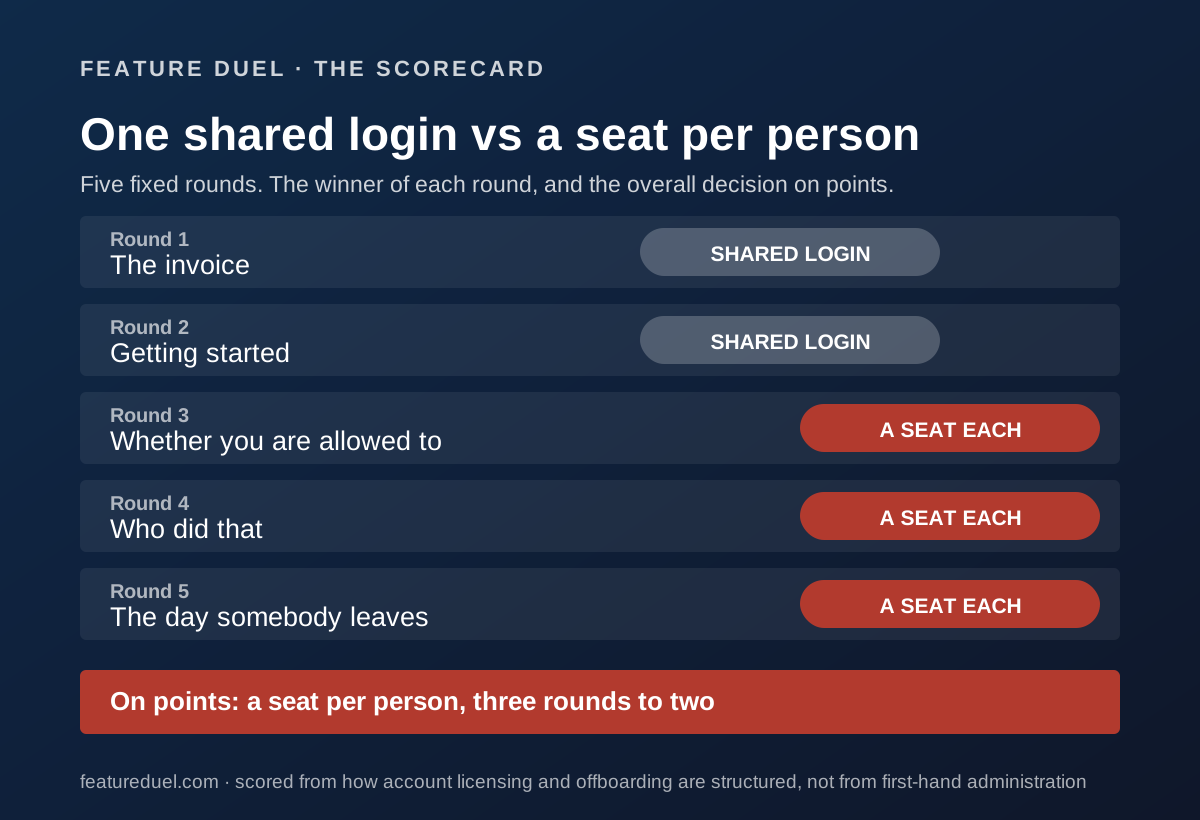
Three rounds to two for a seat per person. The split is not random, and the pattern is the actual finding of this duel.
The shared login wins the early rounds — the invoice and the first afternoon. A seat per person wins the late ones — the contract, the audit trail, and the exit. In other words, the shared login wins the rounds you can see while you are deciding, and named seats win the rounds you only experience once the decision is already old.
Which is precisely why so many teams start with one password and discover the cost of it during a week when they have no spare attention.
- Round One, the invoice: shared login.
- Round Two, getting started: shared login.
- Round Three, whether you are allowed to: a seat per person.
- Round Four, who did that: a seat per person.
- Round Five, the day somebody leaves: a seat per person.
- On points: a seat per person, three rounds to two — holding the three rounds that get more expensive the longer you wait.
Who should take which corner
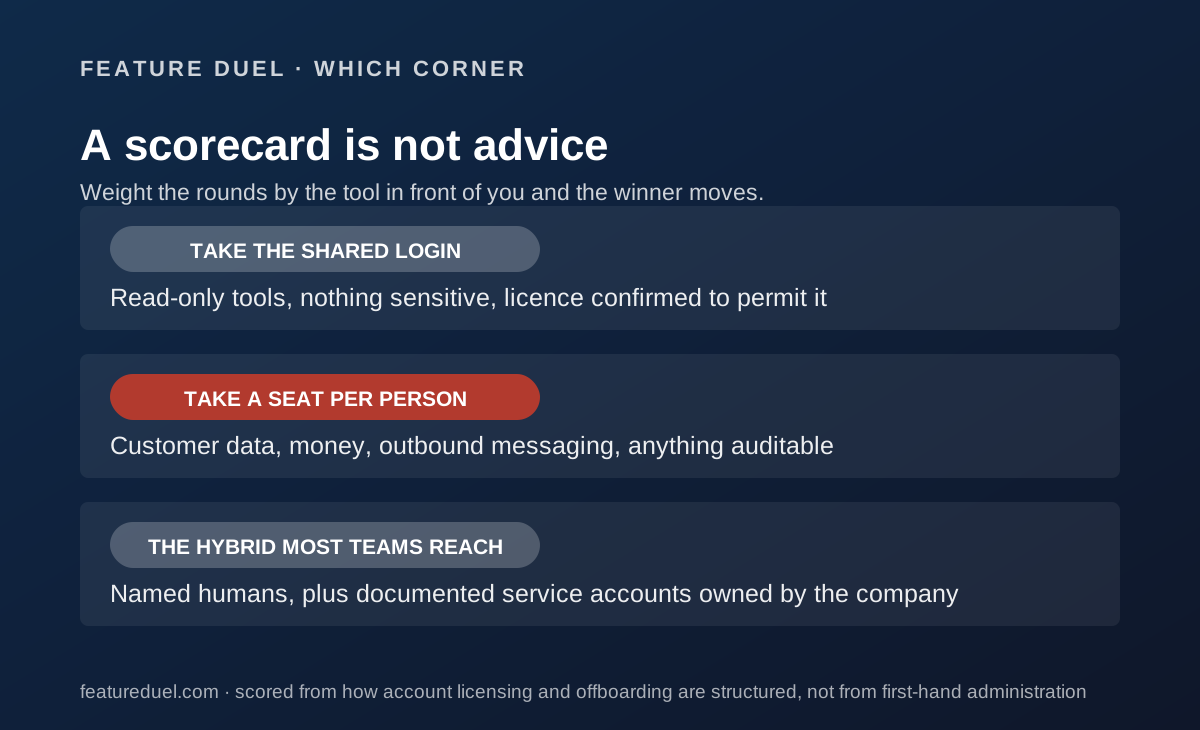
A scorecard is not advice. Weight the rounds by the tool in front of you and the winner changes.
Take the shared login for a tool that holds nothing sensitive, changes nothing, and is read rather than used — a stock photo library, a reference database, a dashboard nobody can edit. Confirm the licence permits it, then stop thinking about it.
Take a seat per person for anything that holds customer records, moves money, sends messages under your name, or stores work the company will still need after the person who made it has gone. Also take it whenever a client contract or a regulator makes you answerable for who did what, because a shared log cannot answer that question at any price.
And the common answer, which is neither corner: named seats for every human, plus a few deliberately shared service accounts owned by the company rather than a person — for integrations and scheduled jobs, documented, credentials in a vault, an owner on the org chart. That hybrid loses Round One and wins the rest. It is what most well-run small teams converge on, usually after an incident.
- Shared login: read-only tools, no sensitive data, licence confirmed to permit it.
- Seat per person: customer data, money, outbound messaging, anything auditable.
- Hybrid: named humans plus documented service accounts for machines, owned by the company.
Frequently asked
Is sharing a login against the rules? It depends entirely on the agreement you accepted, and the wording differs by vendor. Some define a user as a named individual, some sell capacity that may be shared. The answer is in your contract, so search it for the word *user* rather than relying on anybody's general claim.
What does a shared login actually cost us? Not money, at first. It costs an audit trail you cannot reconstruct, an offboarding step that is never fully finished, and exposure to a licence clause you may not have read. Those costs arrive together, usually during an incident.
We are only three people. Does this matter? Rounds Three and Five do, because they do not scale with headcount. A contract clause applies at three people, and the first person to leave creates the same password problem whether the team is three or thirty.
Is a shared password manager entry good enough? It fixes distribution, not attribution. The vault records who retrieved the credential; the vendor's log still shows one account doing everything. It also does not remove the need to rotate the password when somebody leaves.
What about service accounts for integrations? Those are the legitimate shared accounts, and they should be deliberate: owned by the company rather than a named employee, documented somewhere findable, with credentials in a vault and permissions scoped to the job. The failure mode to avoid is an integration running under a departed employee's personal seat.
How do we work out the real cost of switching to named seats? Open the pricing page and check three things: whether your current tier already includes unused seats, whether a seat minimum applies, and whether the discount structure changes at the headcount you expect next year. Prices move often enough that this is a check to run now, not a figure to take from an article.
What this duel cannot settle
Worth marking the limits, because a confident scorecard invites more weight than it can carry.
It cannot tell you what your vendor's agreement says about sharing. Nobody here has read it, contract wording varies, and a general claim about how software is usually licensed is not a substitute for the document you signed.
It cannot quote a cost. Whether named seats are meaningfully more expensive for your team depends on your headcount, the tier structure in front of you, any seat minimum, and which prices are current on the day you sign. Pricing and licence terms change often enough that a figure printed here would be wrong by the time you read it — open the vendor's own pricing page and check.
It cannot judge a specific tool's permission model. Whether a per-seat plan can express the access levels you need is a product question, and belongs in a duel between named products with their documentation open.
And it has no first-hand account behind it. This reading is drawn from how account licensing, audit logging and offboarding are structured — a legitimate thing to reason about, and not the same as having administered both policies through a staff change. The about page states which kind of evidence sits behind which page, and the broader version of this decision — one vendor or several — is argued in all-in-one suite vs best-of-breed stack.
Frequently asked
Is sharing a software login against the rules?
It depends on the agreement you accepted, and the wording differs by vendor. Some define a user as a named individual; some sell capacity that may be shared. Search your own contract for the word user rather than relying on a general claim.
We are only three people. Does a shared login still matter?
Rounds Three and Five do, because neither scales with headcount. A licence clause applies at three people, and the first person to leave creates the same password-rotation problem as the thirtieth.
Is a shared password manager entry good enough?
It fixes distribution, not attribution. The vault logs who retrieved the credential, but the vendor's own activity log still shows one account doing everything, and the password still has to be rotated when somebody leaves.
What about service accounts for integrations?
Those are the legitimate shared accounts. Keep them deliberate: owned by the company rather than an employee, documented, credentials in a vault, permissions scoped to the job. Never run an integration on a departing employee's personal seat.
How do we cost out moving to named seats?
Check three things on the pricing page: whether your tier already includes unused seats, whether a seat minimum applies, and whether the discount changes at next year's headcount. Prices move, so run the check rather than trusting a printed figure.