 Feature
Annual Billing vs Monthly Billing: Five Rounds
The checkout page offers you the same software at two prices, and the cheaper one asks for a year. Most people take the discount because it is presented as free money, and most people are not asked what they are paying for it with. This duel scores the two billing cycles round by round - the headline saving, what flexibility is worth, the refund you probably will not get, who has leverage at renewal, and how each one behaves when the tool turns out to be wrong. No vendor is in this fight and no price is quoted, because the answer does not depend on which tool you picked.
The rules of this duel
Every duel on this site is scored round by round, with the rounds fixed before the fighters walk out, so nobody wins by piling up advantages that do not matter.
This one puts two payment terms in the corners rather than two products. In the navy corner, annual billing: one payment, twelve months, a discount on the sticker. In the red corner, monthly billing: a higher rate per month and the ability to stop at any time.
No prices appear below and no vendor's terms are quoted. Discount levels and refund policies vary by company and change often enough that a number printed here would be stale before you read it - open your own vendor's pricing page and the cancellation and refund clauses of its terms, and check them against the rounds below.
What this duel can do is tell you which questions decide it, in what order, and what flips each round. That part does not expire. The round format is explained in how a duel is scored.
- Annual billing is best for a tool you have already run for a full cycle, a stable team, and a cost you would keep paying anyway.
- Monthly billing is best for anything new, anything whose headcount or need might change, and any tool you have not yet watched survive a busy month.
- On points: monthly billing, three rounds to two.
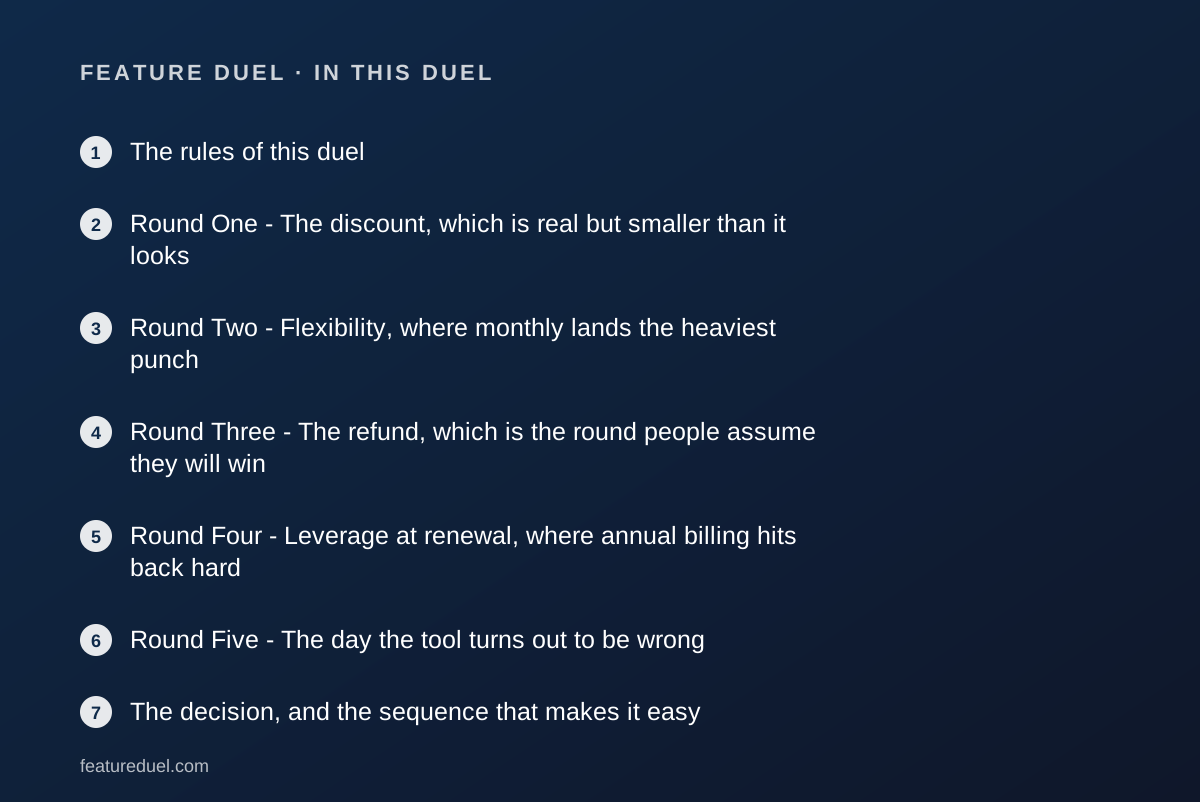
Round One - The discount, which is real but smaller than it looks
Annual billing opens strong, because this is the round that makes anyone consider it at all.
The saving is genuine. Paying for a year up front costs less than twelve monthly payments at essentially every vendor that offers both, and for a tool you were always going to keep, declining that discount is simply paying more for nothing. The annual corner wins this round, and it should.
But monthly has two counters that shrink the margin.
The first is that the discount is usually quoted against the monthly rate rather than against what you would actually spend. If there is any real chance you would have stopped paying in month seven, the comparison is not twelve months versus twelve discounted months. It is twelve discounted months versus seven monthly ones, and seven monthly payments are often less money than a discounted year.
The second is that the saving is paid in cash now. Money committed twelve months ahead is money unavailable for anything else, which matters more the smaller the operation. A discount funded by your own working capital is not free.
Still: for a tool you are certain about, the arithmetic is the arithmetic.
- Round One: annual billing. The discount is real and declining it is irrational for a tool you will definitely keep.
Round Two - Flexibility, where monthly lands the heaviest punch
Monthly billing comes into this round holding the thing annual billing sold in exchange for its discount, and this is where the duel turns.
The flexibility is not mainly about cancelling. It is about every smaller adjustment a year makes necessary. Headcount changes. A project ends. A cheaper competitor appears. A feature you bought the plan for gets moved to a higher tier. A monthly subscription absorbs all of that within thirty days; an annual one absorbs none of it until the term runs out.
There is a specific trap worth naming: seat counts on annual plans. Many annual agreements let you add seats mid-term, at pro rata cost, and do not let you remove them until renewal. So the commitment is not merely to twelve months of what you bought - it can be twelve months of the largest size you ever grew to. A team that expands in month three and contracts in month five may pay the peak for the rest of the year.
The annual corner's counter is that flexibility you never use is worth nothing, and that is fair. A stable five-person team running a tool it has used for two years is buying an option it will not exercise.
But unused flexibility is cheap insurance, while needed flexibility you do not have is expensive. This round is not close.
- Round Two: monthly billing. Thirty days of exposure instead of twelve months, and no seat count locked at its peak.
Round Three - The refund, which is the round people assume they will win
This round is decided almost entirely by a document most buyers do not read until they need it, and it goes badly for annual billing.
The common assumption is that cancelling an annual plan halfway through returns half the money. Frequently it does not. A widespread arrangement is that cancellation stops the renewal rather than the current term: access continues to the end of the period you paid for, and the unused months are not refunded. Another is a short refund window at the start, after which the term is final. Another is credit toward future use rather than money back.
None of these are hidden - they are in the terms, under cancellation or refunds - and all of them are invisible at checkout, where the only thing on screen is the discount.
Monthly billing has nothing to refund, which is precisely why it wins the round. The most you can lose is the month you are in.
The annual corner's honest defence is that this round only matters if you cancel, and that a buyer who has read the clause and accepted it has not been treated unfairly. True. But the round is scored on exposure, and the exposure here is a year of fees recoverable at the vendor's discretion.
The practical instruction is short: before accepting any annual discount, find the cancellation clause and read what happens to the unused months. If you cannot find it, that is the answer.
- Round Three: monthly billing. Annual exposure is defined by a refund clause that is rarely as generous as buyers assume.
Round Four - Leverage at renewal, where annual billing hits back hard
Annual billing comes back in this round, and the reason is not obvious until you have been through a renewal.
A monthly subscription renews silently, twelve times a year, with no moment that forces a decision. That sounds like freedom and functions as inertia. The charge is small enough to ignore, there is no date in anyone's calendar, and the tool stays on the bill for years after it stopped earning its place. The flexibility is real but it is never used, because nothing ever prompts anyone to use it.
An annual renewal creates exactly one moment a year when somebody has to look at a meaningful number and decide. That moment is also the only point at which you have any negotiating position: a year's commitment is worth something to the vendor, and a buyer who is visibly deciding is treated differently from one who is visibly automatic.
There is a second, quieter advantage. Price increases on annual plans are typically applied at renewal, so the rate is fixed for the term. Monthly plans can move sooner, and a small increase on a small charge is the easiest thing in the world not to notice.
Monthly's counter is that a disciplined buyer can diarise reviews without a billing cycle forcing them. That is true and it is also what everybody says before they do not do it.
- Round Four: annual billing. One forced decision a year, a fixed rate for the term, and the only real negotiating moment you get.
Round Five - The day the tool turns out to be wrong
The last round asks what happens when the purchase was a mistake, because a billing cycle is really a bet on your own judgement.
Most software disappointments do not surface in the trial. They surface in the first properly busy month, which is usually somewhere between week six and week twelve - after the trial ended, after the annual payment cleared. The specific failures that arrive late are the ones that matter most: the tool does not hold up under real volume, the team quietly stops using it, the integration moves the wrong field, the workflow it was bought for turns out not to fit.
On monthly billing, that discovery costs one more payment and a migration. On annual billing, it costs the remainder of the year plus the migration, and it introduces the worse problem: a sunk cost arguing against the right decision. Teams keep using tools they have already paid a year for, long past the point of usefulness, because abandoning them feels like waste. The commitment does not just cost money - it distorts the next judgement.
Annual's counter is the strongest version of its whole case: commitment produces adoption. A team that knows the tool is paid for until next autumn invests in learning it, and a tool nobody commits to often gets abandoned for reasons that have nothing to do with its quality.
That is a real effect. But it argues for committing to tools you have already validated - which is an argument about sequence, not about billing cycles. Monthly takes the round.
- Round Five: monthly billing. A late discovery costs one month instead of a year, and does not leave a sunk cost arguing against the right call.
The decision, and the sequence that makes it easy
Monthly billing wins three rounds to two, but the scorecard is less useful than the pattern underneath it. Monthly won every round that turned on uncertainty. Annual won every round that turned on certainty.
So the honest answer is not a cycle, it is an order. Start monthly. Run the tool through at least one genuinely busy period, with everyone who is supposed to use it actually using it. Then, at the point where you can say what the tool does for you and would keep paying regardless, take the annual discount - because at that point you are being paid for a commitment you had already made.
Inverted, it is the most common billing mistake there is: taking the discount at the moment of least information, which is checkout.
Three cases override the default. If the vendor only offers annual, the round about refunds becomes the whole decision, so read the cancellation clause before anything else. If the discount is steep enough that even an early exit beats the monthly path, the arithmetic wins - do it deliberately, with the number written down. And if your team has no habit of reviewing subscriptions at all, annual billing's forced annual decision may genuinely serve you better than a flexibility you will never exercise.
The related question of what you are committing to per person rather than per month is argued in one shared login versus a seat per person, and the question of how many vendors to commit to at once in an all-in-one suite versus a best-of-breed stack.
- Default: monthly first, annual once validated. Buy the discount with information, not with hope.
- Before any annual plan, read the cancellation clause and find out what happens to unused months.
- Check whether seats can be removed mid-term, not just added.
- If you take annual, diarise the renewal a month early - that date is your only leverage.
Frequently asked
Is the annual discount worth taking?
It is worth taking for a tool you have already validated and would keep paying for anyway. Taken at checkout on a tool you have not yet run through a busy month, it is a discount bought with a year of exposure you cannot assess yet.
Can I get a refund if I cancel an annual plan halfway through?
Often not. A common arrangement stops the renewal rather than the current term, so access continues and the unused months are not returned. Find the cancellation and refund clauses in your vendor's terms before you commit.
Can I reduce the number of seats on an annual plan?
Frequently you can add seats mid-term but not remove them until renewal. That means a team which grows and then shrinks may pay its peak size for the rest of the year. Confirm the rule before you expand.
Which is better for a brand new tool?
Monthly, in almost every case. Most disappointments appear in the first genuinely busy month, which usually falls after a trial has ended. Monthly caps that discovery at one payment.
Does monthly billing really cost more in the end?
Only if you keep the tool for the full year. If there is a real chance you stop partway, several monthly payments can total less than one discounted annual payment, because the comparison is against what you would actually spend.