 Feature
Pipedrive vs HubSpot Sales Hub (2026): five rounds, 3-2
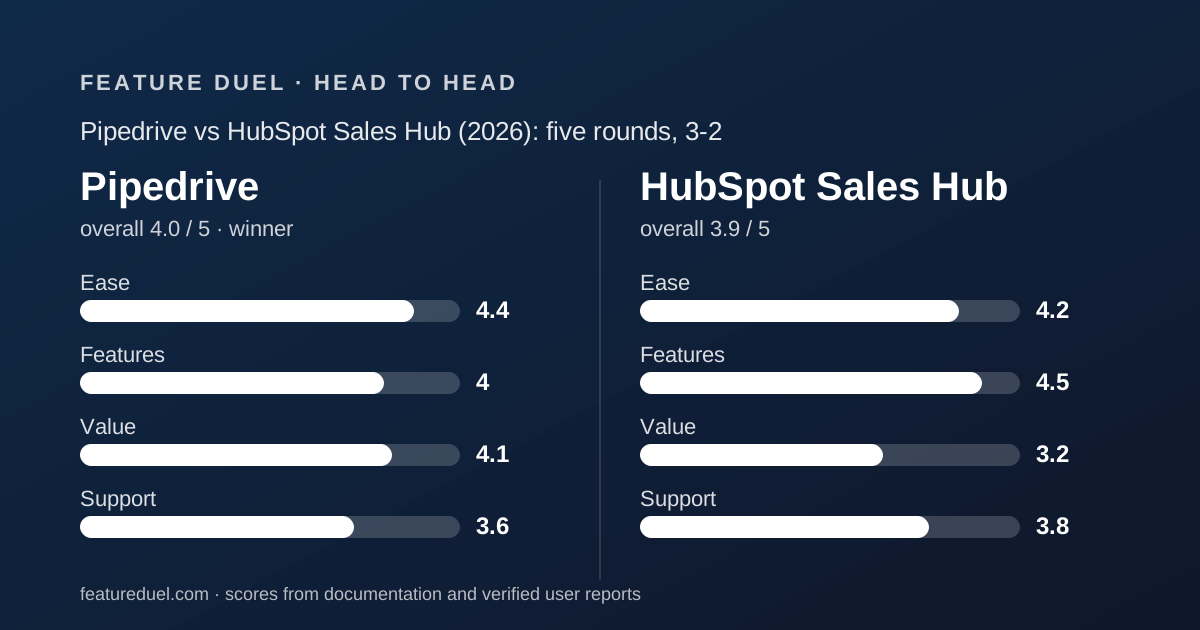
Pipedrive and HubSpot Sales Hub are the two CRMs small sales teams shortlist together, and they are opposite bets. Pipedrive is a pipeline sold alone. HubSpot is a pipeline sold as one hub of a platform that starts free. This duel scores them over the five fixed rounds used on every page here: onboarding, core workflow, integrations, pricing and support. Pipedrive takes three rounds, HubSpot takes two, and the two HubSpot wins are the ones that matter most to a team that wants to start at $0 or that already runs marketing on HubSpot. Everything below comes from the two vendors' pricing pages and public knowledge resources, checked October 10, 2026. No staged demos, no claims of testing we did not do.
 4.0Pipedrive
 3.9HubSpot Sales Hub
Specification by specification
| Spec | Pipedrive | HubSpot Sales Hub |
|---|---|---|
| Free tier | None; 14-day trial, no card | Free tools for up to 2 users, no time limit |
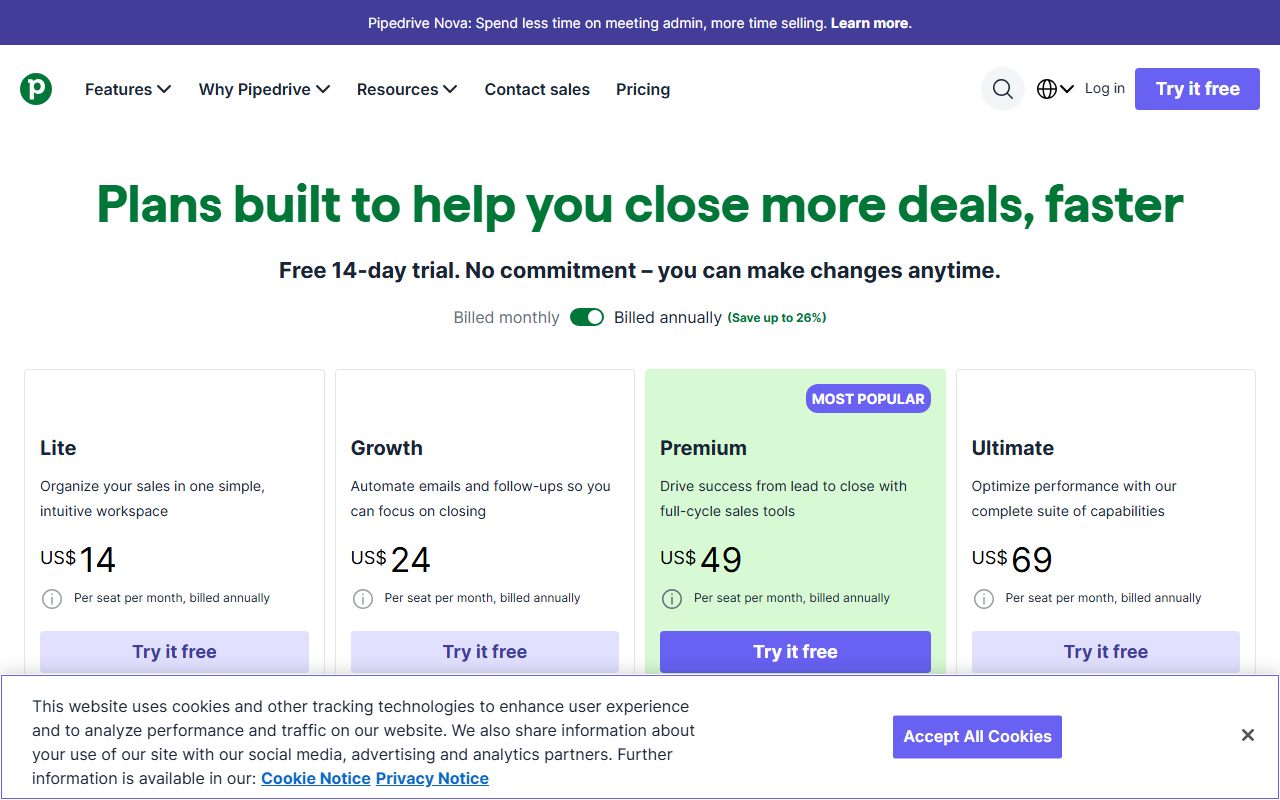
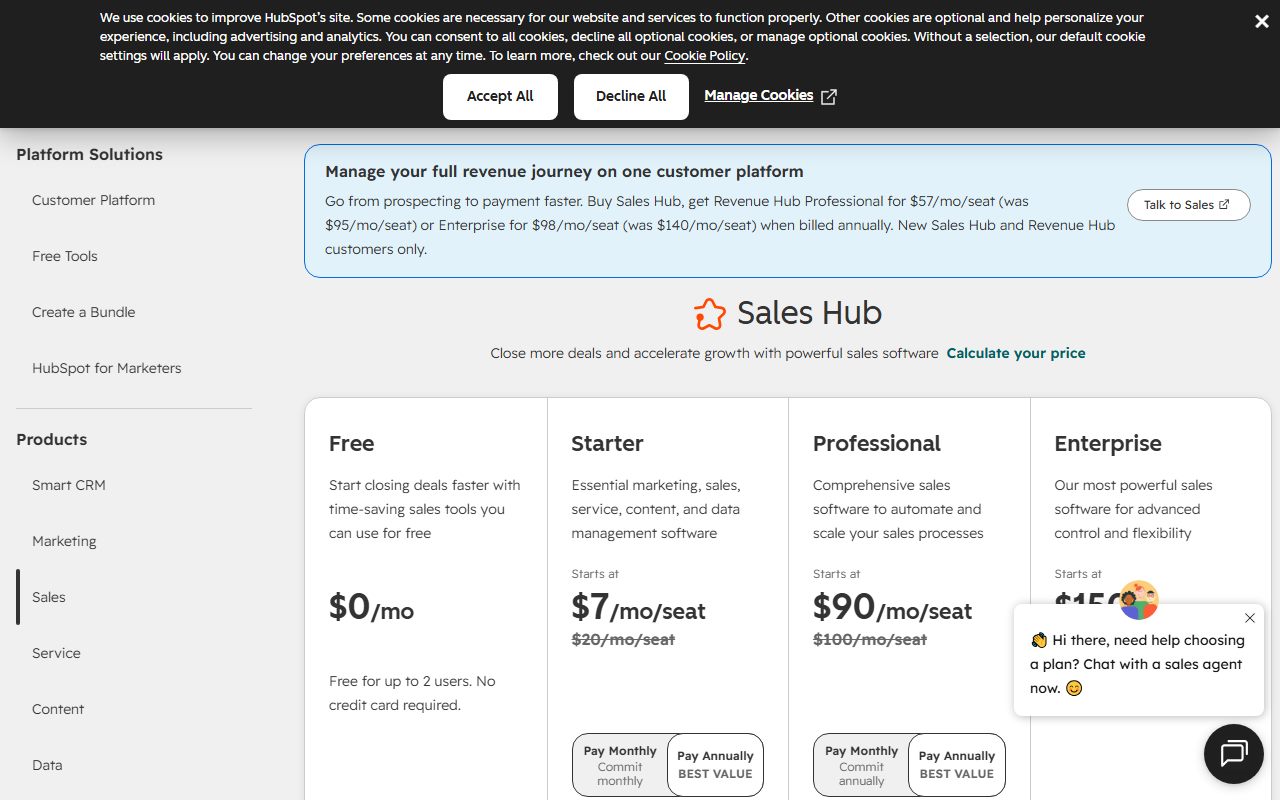
| Cheapest paid tier (annual, per seat) | Lite $14 ($168 per seat per year printed) | Starter displayed at $7 and $20 on one card, unlabelled |
| Tier with email sync, automations and sequences | Growth $24 | Professional, starts at $90, plus $1,500 one-time onboarding |
| Top published tier | Ultimate $69 | Enterprise $150 plus $3,500 onboarding |
| Onboarding or setup fee | None; implementation free above $400 a year | $1,500 Professional; $3,500 Enterprise; required |
| Usage meter | None on the pricing page | HubSpot Credits: 500 / 3,000 / 5,000 included; $0.010 per extra credit, no rollover |
| Seat minimum | None stated | None stated; view-only seats free |
| Monthly billing | Behind a toggle; annual saves up to 26% per the page | Starter Pay Monthly available; Professional monthly option still commits annually |
| Pipelines | Not counted on the pricing page | 15 Starter / 100 Professional / 350 Enterprise |
| Workflows | From Growth; quota not printed | 50 restricted Starter / 300 Professional / 1,000 Enterprise |
| Integrations stated | 500+ | Over 2,000 apps |
| Add-ons | Per company: LeadBooster from $32.50, Projects $16, Campaigns $13.33, Web Visitors $41, Smart Docs $32.50 | Other hubs at Starter $7 per month each; Revenue Hub cross-sell at $57 or $98 per seat |
| Published support | Ultimate: phone Monday to Friday 7:00 to 23:00 CET; lower tiers not printed | Email on Starter; email and phone on Professional and Enterprise; no response times |
| Team of 10, tier with sequences, year one | Growth: $2,880 | Professional: $10,800 plus $1,500 = $12,300 |
| Ease / Features / Value / Support | 4.4 / 4.0 / 4.1 / 3.6 | 4.2 / 4.5 / 3.2 / 3.8 |
The short answer
Pipedrive wins this duel 3 rounds to 2. It takes core workflow at matched price, pricing, and support; HubSpot takes onboarding and integrations. The overall winner is whoever takes the rounds that matter for your team, so read the bullets before the scorecard.
- Pipedrive is best for sales teams of 2 to 30 whose work is deals in a pipeline, who need email sync, automations and sequences at a small-team price, and who run marketing somewhere else
- HubSpot Sales Hub is best for teams of 1 to 2 that want a CRM for $0 with no deadline, teams whose marketing already lives on HubSpot, and teams that will fund Professional for its depth and its directory
- Winner on rounds: Pipedrive takes core workflow, pricing and support; HubSpot takes onboarding and integrations
- Disclaimer: this is a documentation review. Scores come from the two pricing pages and public resources checked October 10, 2026, not from staged demos
Round 1, onboarding: HubSpot's free tools beat a 14-day clock
HubSpot wins. Its free tools cover up to 2 users with no credit card and no time limit, per the Customer Platform page checked October 10, 2026. A founder can run a real pipeline, with 3 templates, 3 snippets and 10 dashboards, for as long as it takes to decide.
Pipedrive has no free plan. It offers a 14-day trial on any tier with full access and no card, and colleagues can be invited. That is a generous trial and a hard deadline.
The round is closer than it looks because HubSpot's pricing is harder to onboard into than its product. The Starter card shows $7 and $20 per seat together with no label, and the only clue is a 'save up to 65%' banner on another page. A buyer learns the real Starter bill at checkout. Pipedrive prints $14 beside 'one payment of $168 per seat per year' and leaves nothing to decode except the monthly toggle.
On balance, no deadline beats clear arithmetic for a team that has not yet decided it needs a CRM. Round to HubSpot. How a duel is scored explains why a free plan that contains the core behaviour outranks a trial in this round.
Round 2, core workflow: Pipedrive gives a working sales motion at $24
Pipedrive wins, on price-matched capability. At Growth, $24 per seat on annual billing, the page lists full Gmail, Outlook or company email sync with open and click tracking, automations, nurturing sequences, subscription and forecast reports, a meeting scheduler and the contacts timeline. That is the daily motion of a small sales team in one tier.
HubSpot's equivalent set sits at Professional. Sequences, forecasting, conversation intelligence, 300 customisable workflows and 1,000 meeting links are Professional features, starting at $90 per seat plus a required $1,500 onboarding fee. Starter at $7 or $20 has 50 workflows with restricted triggers, one branded meeting link and no sequences.
At the top, HubSpot is deeper. Professional's playbooks, lead scoring, call transcription hours and custom reports with event limits, and Enterprise's deal splits, pipeline approvals and sandbox, outrun Pipedrive's Premium and Ultimate on the published lists. The HubSpot review scores core workflow 4.5 for that reason.
But the round asks what a team gets for the price it will actually pay. A 5-person team that automates follow-ups buys Growth at Pipedrive and Professional at HubSpot. The gap between $24 and $90 plus $1,500 decides it. Round to Pipedrive.
Round 3, integrations: HubSpot prints 2,000 and Pipedrive prints 500
HubSpot wins. Its pricing page states over 2,000 leading apps and web services, naming Amplitude, Jira, Adobe Express, Aircall, LinkedIn and Microsoft Teams. Pipedrive's page states 500+ integrations, naming Zapier, Zoom and Lemlist, and links to a marketplace without a count.
Both gate some connectors by tier. HubSpot holds LinkedIn Sales Navigator and CRM Sync to Professional. Pipedrive's integrations are listed at Lite and above, though its own add-ons, Campaigns, Projects, Web Visitors, are extra per company.
On the published numbers the ecosystem is four times larger on HubSpot's side, and for a team whose stack includes a billing system, a support desk and a data warehouse, that is the safer directory. For a team whose stack is email, calendar, Zoom and Zapier, 500 covers it and the round barely registers. Round to HubSpot.
Round 4, pricing: Pipedrive costs a quarter at the tier that matters
Pipedrive wins, and it is the widest margin of the duel. By our arithmetic from the two pricing pages, a 10-person team with email sequences pays $2,880 a year on Pipedrive Growth and $12,300 in year one on HubSpot Professional at the $90 figure, falling to $10,800 in year two once the $1,500 onboarding fee is gone.
At the entry level HubSpot is cheaper or free. Free tools for 2 users cost nothing; Starter for 10 is $840 at the $7 figure or $2,400 at $20. Pipedrive Lite for 10 is $1,680. A team that fits inside Starter's limits pays HubSpot less.
The structural differences matter as much as the totals. Pipedrive prints an annual total per seat, has no onboarding fee, no seat minimum and no usage meter, and lists free implementation above $400 a year. HubSpot has an unlabelled Starter card, required onboarding fees of $1,500 and $3,500, and HubSpot Credits that meter the AI agents at $0.010 each with no rollover.
Both hide a monthly rate: Pipedrive behind a toggle this read did not capture, HubSpot behind the unlabelled card. Our annual versus monthly billing duel covers how to read either. Round to Pipedrive.
Round 5, support: Pipedrive includes setup; HubSpot charges for it
Pipedrive wins narrowly, and the reason is the onboarding fee. HubSpot's page prints a clearer channel split: email on Starter, email and phone on Professional and Enterprise. Pipedrive prints phone hours only for Ultimate, Monday to Friday 7:00 to 23:00 CET/CEST, and the word 'extended' implies shorter hours below without stating them.
But HubSpot's setup help is a required, separate charge of $1,500 at Professional and $3,500 at Enterprise, not included in the seat price. Pipedrive's page lists implementation as free for any plan over $400 a year, which a 2-seat Growth plan clears, and lets a whole team join the trial with support available.
Neither page prints a response time. For a 10-person team moving to the tier with sequences, HubSpot's support round costs $1,500 before the first ticket and Pipedrive's costs nothing. That tips it. Round to Pipedrive, with the note that HubSpot's channel disclosure is better.
The seat maths at 2, 5, 10 and 25 people
Editorial calculations from the two pricing pages as of October 10, 2026, for 12 months, excluding tax, add-ons and purchased credits. HubSpot Starter is shown at both displayed figures because the page does not label them. They are not quotes.
- 2 people, cheapest working CRM: HubSpot free tools $0; Pipedrive Lite $336
- 2 people, with sequences: Pipedrive Growth $576; HubSpot Professional $2,160 plus $1,500 = $3,660
- 5 people, inside Starter's limits: HubSpot Starter $420 or $1,200; Pipedrive Lite $840
- 5 people, with sequences: Pipedrive Growth $1,440; HubSpot Professional $5,400 plus $1,500 = $6,900
- 10 people, with sequences: Pipedrive Growth $2,880; HubSpot Professional $10,800 plus $1,500 = $12,300
- 10 people, top sales tier: Pipedrive Ultimate $8,280; HubSpot Enterprise $18,000 plus $3,500 = $21,500
- 25 people, with sequences: Pipedrive Growth $7,200; HubSpot Professional $27,000 plus $1,500 = $28,500
Where AI sits in each plan
Pipedrive bundles AI by tier with no meter on the page: AI report creation and Nova meeting intelligence from Lite, AI email writing and summarising from Premium. No credit line appears.
HubSpot meters it. Agent Hub, the Prospecting, Data and Customer agents and the Notetaker appear from Starter, running on HubSpot Credits: 500 a month on Starter, 3,000 on Professional, 5,000 on Enterprise, then $0.010 per credit, reset monthly, no rollover.
For a team that will lean on AI agents daily, HubSpot's budget has a variable line Pipedrive's does not. For a team that wants a meeting brief and a transcript, Pipedrive's bundled Nova at $14 is the cheaper documented path.
How the five rounds weigh for three kinds of team
A founder alone or with one colleague should weight onboarding and pricing. HubSpot's free tools at $0 win both at that headcount, and the duel flips to HubSpot until the third user or the first sequence.
A sales team of 5 to 25 with no marketing on HubSpot should weight core workflow and pricing. Pipedrive Growth at $24 wins both by a wide margin, and the duel's 3-2 result understates it.
A company whose marketing already runs on HubSpot should weight integrations and the shared contact record, which this duel scores inside integrations. HubSpot wins that, and the extra cost of Professional is the price of one database. Our all-in-one versus best-of-breed duel is the argument underneath this case.
Add-ons and the second-year bill
The headline seat is not the whole invoice on either side, and the two vendors add to it in different shapes.
Pipedrive's add-ons are flat per company: LeadBooster from $32.50 a month, Projects from $16, Campaigns from $13.33, Web Visitors from $41, Smart Docs from $32.50. A 10-person team on Growth that adds Campaigns pays $2,880 plus roughly $160, or about $3,040 a year by our arithmetic, and the add-on does not grow with headcount. Premium at $49 already includes lead generation and routing, so a team at that tier may drop LeadBooster.
HubSpot's additions are per seat and per credit. Other hubs are sold at Starter for $7 per month each, so a sales team that adds Marketing Hub Starter pays another seat line. Credits beyond the included allowance cost $0.010 each, reset monthly and do not roll over, which makes the AI line a variable cost. The Revenue Hub cross-sell at $57 or $98 per seat on annual billing is a further per-seat line.
Year two changes the HubSpot picture more than the Pipedrive one. The $1,500 onboarding fee is one-time, so 10 seats on Professional fall from $12,300 to $10,800. Pipedrive has no one-time fee to shed, so year two on Growth is the same $2,880. The gap narrows from a factor of 4.3 to a factor of 3.75 by our arithmetic, and it stays wide.
Neither page prints a volume discount for 10 to 25 seats. A team at 25 should expect to negotiate on HubSpot, where the list total is $28,500 in year one, and may not need to on Pipedrive, where it is $7,200.
What users report
We have not yet compiled dated samples of G2, Capterra or Reddit reports for either product, and this duel does not summarise impressions we have not collected. When those samples exist, both reviews and this page will be updated with sourced, dated findings. Until then the scorecard rests on what the vendors publish.
Choose Pipedrive if
Four conditions point to Pipedrive.
- Your team sells and the CRM does nothing else, because every tier is built around the pipeline
- You need email sync, automations and sequences at a small-team price, which Growth delivers at $24 with no onboarding fee
- You want the annual total per seat printed before you commit and no usage meter afterward
- You have 3 to 30 people and marketing runs elsewhere, so a shared platform database buys you nothing
Choose HubSpot Sales Hub if
Four conditions point to HubSpot.
- You are 1 or 2 people and want a CRM for $0 with no deadline
- Marketing, service or content already runs on HubSpot and sales should read the same contact record
- Your stack is wide and you want the largest printed integration directory, at over 2,000 apps
- You will fund Professional for sequences, forecasting, call intelligence and playbooks in one place, and can absorb $1,500 up front
Frequently asked
Short answers to the questions people type into a search box.
Bottom line
Pipedrive wins 3-2, and the two rounds it wins by the most, core workflow at matched price and pricing, are the rounds a working sales team feels every month. Growth at $24 per seat, $2,880 a year for 10 people by our arithmetic, buys the motion that HubSpot sells at $90 plus $1,500.
HubSpot wins where the team is tiny or already on the platform. Free tools for 2 users and a 2,000-app directory are real advantages, and a marketing team on HubSpot makes the shared record worth the premium.
Teams that want a third corner should read the Zoho CRM review, which undercuts both on the entry tier, and our guide to the best CRM for a small sales team, which ranks all three. All figures checked October 10, 2026.
Frequently asked
Which is cheaper for a 10-person sales team, Pipedrive or HubSpot?
With email sequences, Pipedrive by a wide margin: Growth at $24 per seat on annual billing is $2,880 a year, against HubSpot Professional at $90 per seat plus a $1,500 onboarding fee, $12,300 in year one, by our arithmetic from both pricing pages checked October 10, 2026. Inside Starter's limits, HubSpot at $840 or $2,400 can be cheaper than Pipedrive Lite at $1,680.
Does HubSpot have a free plan and does Pipedrive?
HubSpot's free tools cover up to 2 users with no credit card and no time limit. Pipedrive has no free plan; it offers a 14-day trial on any tier with full access and no card. For a founder who has not decided to pay, HubSpot's free tools are the only indefinite option between the two.
Can I switch from HubSpot to Pipedrive?
Pipedrive's pricing page lists import from a spreadsheet or another CRM at every tier including Lite, and describes implementation as free for plans over $400 a year. Neither page describes a HubSpot-specific migration path, so a team should confirm what the import covers, deals, activities and email history, during the 14-day trial.
Why is HubSpot Professional so much more expensive than Pipedrive Growth?
Different scope at that tier. HubSpot Professional includes sequences, forecasting, conversation intelligence, 300 workflows, playbooks, lead scoring and 3,000 HubSpot Credits, and carries a required $1,500 onboarding fee. Pipedrive Growth includes email sync, automations, sequences, forecasts and a scheduler at $24. The question is whether the extra depth is used.
Which has better support, Pipedrive or HubSpot?
HubSpot publishes the clearer split: email on Starter, email and phone from Professional. Pipedrive prints phone hours only for Ultimate. Pipedrive wins the round in this duel because its implementation help is free above $400 a year while HubSpot requires a $1,500 or $3,500 onboarding fee. Neither prints a response time.
Visit Pipedrive
We have no affiliate relationship with this vendor. Link goes to the official site.
Visit HubSpot Sales Hub
We have no affiliate relationship with this vendor. Link goes to the official site.