 Feature
HubSpot Sales Hub
The platform CRM that starts at $0 for 2 users, shows Starter at $7 and $20 a seat on one card, and asks $90 a seat plus a $1,500 fee for the tier where sequences live
Scored on the published rubric, from documentation, pricing and verified user reports.
Best for: Teams of 1 to 10 that want to start a CRM for nothing and keep marketing, sales and service on one contact record, and that can either stay on Starter's limits or budget five figures a year for Professional.
Verdict
HubSpot Sales Hub is the most capable product in this cluster and the hardest to price from its own page. This is a documentation review: scores come from HubSpot's Sales Hub and Customer Platform pricing pages checked October 10, 2026, not from staged demos. The free tools cover up to 2 users with no time limit, which wins the onboarding round outright. Starter is where the page gets slippery: one card reads 'Starts at $7/mo/seat' and '$20/mo/seat' with a Pay Monthly and Pay Annually toggle, and a banner on the Customer Platform page says 'Save up to 65% on Starter'. The page does not label which figure is which, so the editors read $7 as the discounted annual figure and $20 as the monthly one, and flag that reading as ours. Professional 'starts at' $90 and $100 per seat, carries a required one-time $1,500 onboarding fee, and is where sequences, forecasting and conversation intelligence live. Enterprise is $150 per seat plus $3,500. On top sit HubSpot Credits, included per tier and sold at $0.010 each, which meter the AI agents. A 10-person team on Starter pays $2,400 a year at $20 or $840 at $7 by our arithmetic; the same team on Professional pays at least $12,300 in year one. Value scores 3.2 because the capability jump from Starter to Professional costs more than four times the seat. Start here if you want free. Stay here only if Starter's limits hold.
Visit HubSpot Sales Hub
We have no affiliate relationship with this vendor. Link goes to the official site.
Where it is strong
- Free tools for up to 2 users with no credit card and no time limit, the best entry in this cluster
- Over 2,000 apps in the integration directory, printed on the pricing page
- View-only seats are free on every tier, so managers and finance can read the CRM without a paid seat
- Starter includes 15 pipelines, 50 workflows, 500 calling minutes, 10,000 email templates and 5,000 snippets, per the feature table
- Marketing, service, content and data hubs share the same contact record, each with a Starter edition shown at $7 per month
Where it falls short
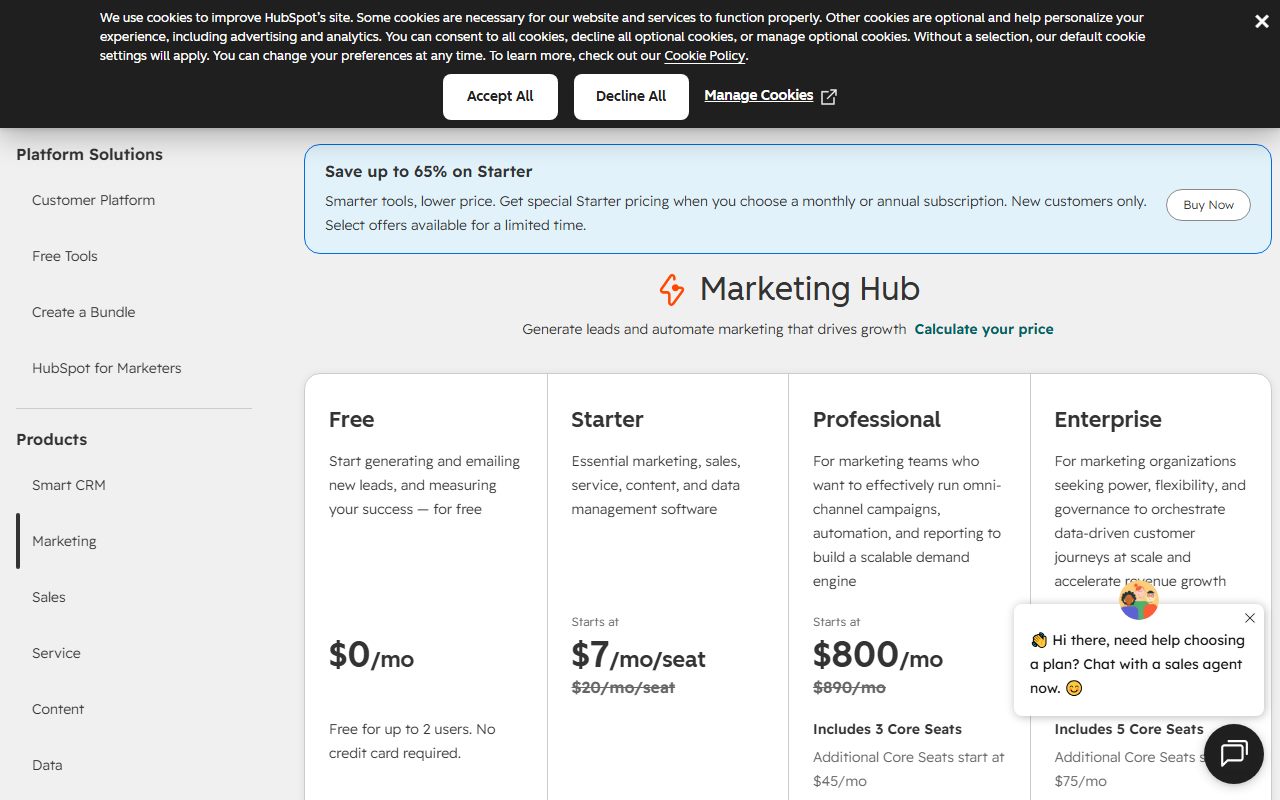
- The Starter card shows $7 and $20 per seat together without labelling which is monthly and which is annual
- Professional carries a required one-time $1,500 onboarding fee and Enterprise $3,500, on top of the per-seat price
- Sequences, forecasting and conversation intelligence are Professional features, from $90 per seat
- HubSpot Credits meter the AI agents: 500 on Starter, 3,000 on Professional, 5,000 on Enterprise, then $0.010 per credit with no rollover
- Starter's meeting link is limited to one personal link with HubSpot branding, and workflows carry restricted triggers and actions
At a glance
| Starting price | Free for 2 users; Starter displayed at $7 and $20/mo/seat; Professional from $90/mo/seat plus $1,500 onboarding; Enterprise $150 plus $3,500 |
|---|---|
| Pricing note | Free for 2 users; Starter displayed at $7 and $20 per seat per month; Professional from $90 per seat plus $1,500 onboarding (pricing page, checked October 10, 2026) |
| Free plan | Yes: free marketing, sales, service, content, data and revenue tools for up to 2 users, no time limit |
| Seat minimum | Not stated on the pricing page |
| Trial | Not stated; the free tools serve as the trial |
| Support channels | Email on Starter; email and phone on Professional and Enterprise, per the pricing FAQ |
| Automations | 50 workflows with restricted triggers on Starter; 300 on Professional; 1,000 on Enterprise |
| AI | Agent Hub, Prospecting, Data and Customer agents on Starter and above, metered in HubSpot Credits |
What HubSpot Sales Hub actually is
HubSpot Sales Hub is one hub on a platform. The CRM underneath is shared with Marketing Hub, Service Hub, Content Hub, Data Hub and Revenue Hub, and the Sales Hub tiers add pipeline, outreach and forecasting tools on top of that shared contact record. Buying Sales Hub buys a slice of a suite, which is the whole appeal and the whole cost.
That makes it the all-in-one corner against Pipedrive, which sells the pipeline alone, and a cousin of Zoho CRM, which also sits inside a suite but prices its editions far lower. Our all-in-one versus best-of-breed duel is the argument this review lands inside.
This review scores Sales Hub on the five fixed rounds used across the site: onboarding, core workflow, integrations, pricing and support. The scoring logic is explained in how a duel is scored. All evidence comes from the Sales Hub, Customer Platform and Starter pricing pages checked October 10, 2026. No staged demos, no claims of testing we did not do.
Who HubSpot Sales Hub is best for
The free tools and the platform shape favour a particular kind of buyer. Read the list against your own.
- Founders and 2-person teams who want a real CRM for $0 with no deadline
- Companies where marketing already runs on HubSpot and sales should read the same contacts
- Teams of 3 to 10 whose needs fit inside Starter: a few pipelines, basic automation, calling minutes, templates
- Teams that lean on integrations and want the largest published directory
- Companies that will fund Professional, from $90 a seat plus $1,500, because they need sequences, forecasting and call intelligence in one place
- Teams with many read-only stakeholders, since view-only seats are free
Who should skip it
Three profiles pay more than they need to with HubSpot.
- Sales teams that need email sequences and automations at a small-team price, which Pipedrive Growth delivers at $24 and HubSpot holds to Professional at $90 plus onboarding
- Buyers who need to read their annual seat price off the card, because the Starter card prints two figures without labels
- Teams that will not budget a metered AI line, since the agents run on credits that reset and do not roll over
What the free tools include (as of October 2026)
The free tier is listed at $0 per month, free for up to 2 users, no credit card required. It includes free marketing, sales, service, content, data and revenue tools, and the Customer Platform FAQ states the free access has no time limit.
From the Sales Hub feature table, the free column shows 1-to-1 email with HubSpot branding, up to 3 canned snippets, up to 3 email templates, live chat with HubSpot branding, conversational bots with limited features, a reporting dashboard of 10 dashboards with 50 reports each, and the mobile app.
That is a working CRM for 2 people with a visible ceiling: 3 templates and 3 snippets are a trial of outreach, not a tool for it. The free tier's job is to win the onboarding round and hand the team to Starter, and on the published terms it does both.
No separate trial length is stated for paid tiers; the free tools are the trial.
How the pricing is structured
Sales Hub is per-seat pricing with three paid tiers, two billing periods, two onboarding fees and a usage meter. Reading it requires more care than any other page in this cluster.
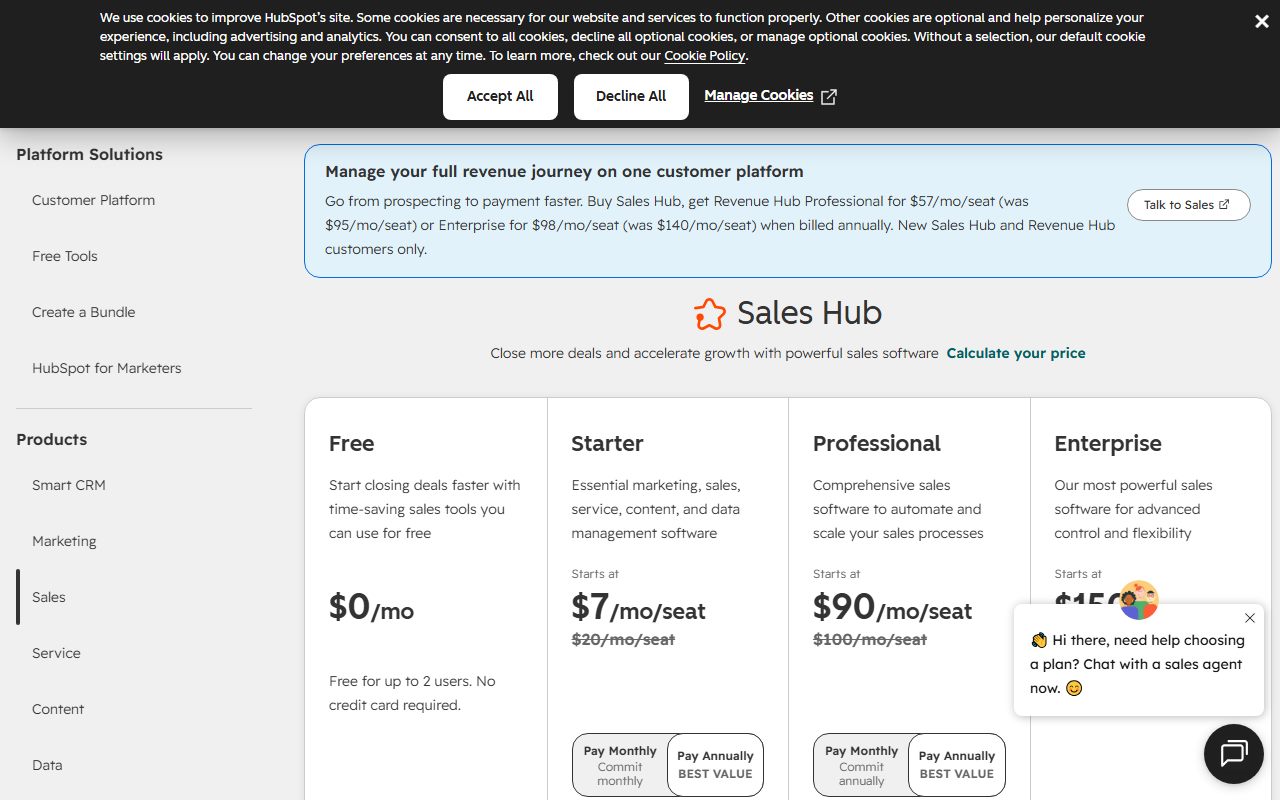
Starter's card reads 'Starts at $7/mo/seat' and '$20/mo/seat' with a billing toggle of Pay Monthly, commit monthly, and Pay Annually, Best Value. The Customer Platform page adds a banner: 'Save up to 65% on Starter'. Sixty-five percent off $20 is $7, so the editors read $7 as the discounted annual figure and $20 as the monthly list figure. The page does not say so, and this review flags the reading as editorial. Starter seats are Core Seats.
Professional's card reads 'Starts at $90/mo/seat' and '$100/mo/seat' with a toggle of Pay Monthly, commit annually, and Pay Annually. A footnote states the cost does not include the required one-time Professional Onboarding fee of $1,500. Professional and Enterprise are priced per Sales Seat.
Enterprise reads 'Starts at $150/mo/seat' with no billing split shown and a required one-time Enterprise Onboarding fee of $3,500.
HubSpot Credits are the meter. Starter includes 500, Professional 3,000, Enterprise 5,000. The Starter page prices purchased credits at $0.010 each, says they reset monthly and that unused credits do not roll over. Credits power the Customer, Prospecting and Data agents.
View-only seats are free on every tier per the FAQ. Additional paid seats cost extra per month at a rate the page says depends on edition but does not print for Starter. Our shared-login versus seat-per-person duel is worth reading before deciding how many Core Seats a small team really needs.
What sits behind each tier
Starter, per the feature table, includes 15 pipelines per account, up to 50 workflows with restricted triggers and actions, 1 personal meeting link with HubSpot branding, 500 calling minutes and 1 HubSpot-provided phone number, up to 10,000 email templates and 5,000 snippets, 30 dashboards with 50 reports each, live chat with branding removed, Agent Hub with a simple Agent Builder, Prospecting, Data and Customer agents on credits, task queues, intent signals and the Notetaker.
Professional adds sequences, which the table lists at 5,000 per account with 500 to 1,000 email sends per user per day depending on tier, forecasting with default and custom reports, Deal Progression and Deal Plans in Beta, conversation intelligence with tracked terms, 100 pipelines, 300 fully customisable workflows, lead scoring with up to 5 scores, 1,000 personal and team meeting links without branding, 3,000 calling minutes and 3 phone numbers, 750 hours of call transcription per month, up to 100 custom reports, 5 playbooks and ABM tools.
Enterprise adds deal splits, deal journey analytics, pipeline approvals, lead form routing, a standard sandbox, 350 pipelines, 1,000 workflows with quote-based workflows and health monitoring, 10 lead scores, 12,000 calling minutes and 5 phone numbers, 1,500 transcription hours, 500 custom reports, 5,000 playbooks, forecasting across team hierarchies and custom goals.
Some rows in the table show fewer values than there are columns, so a few mappings above are inferred from layout. Where the table is ambiguous, this review says so rather than guessing.
A promotion sits at the top of the page: new Sales Hub customers can add Revenue Hub Professional for $57 per seat (was $95) or Enterprise for $98 (was $140) when billed annually. It is a cross-sell, not a Sales Hub discount.
The seat maths at 2, 5, 10 and 25 people
Editorial calculations from the figures on the pricing page as of October 10, 2026, for 12 months, excluding tax and purchased credits. Starter is shown at both displayed figures because the page does not label them. They are not quotes.
- 2 seats: Free tools $0; Starter $168 at $7 or $480 at $20; Professional $2,160 at $90 plus $1,500 onboarding, $3,660 in year one
- 5 seats: Starter $420 or $1,200; Professional $5,400 plus $1,500, $6,900 in year one
- 10 seats: Starter $840 or $2,400; Professional $10,800 plus $1,500, $12,300 in year one; Enterprise $18,000 plus $3,500, $21,500
- 25 seats: Starter $2,100 or $6,000; Professional $27,000 plus $1,500, $28,500 in year one
- Any tier plus 10,000 purchased credits a month at $0.010: add $1,200 a year
- Year two on Professional at 10 seats: $10,800, with the onboarding fee gone
Ease of use: what the onboarding score is built from
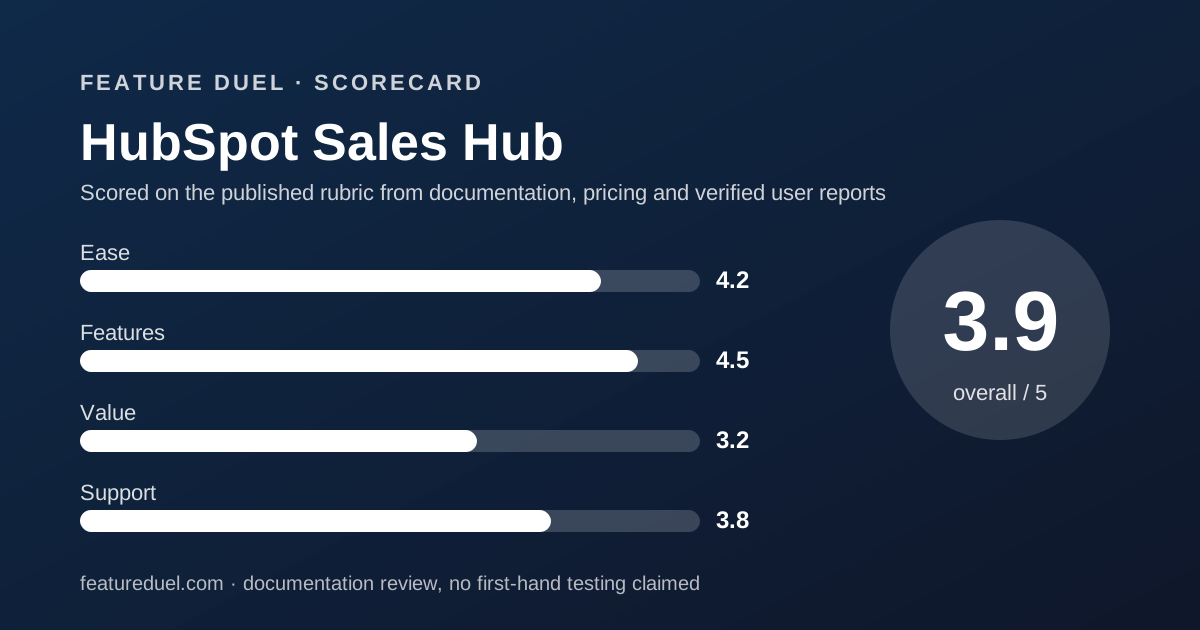
4.2 out of 5. This round scores how much stands between a new account and a working pipeline, from the vendor's documentation. HubSpot's free tools for 2 users with no card and no deadline are the lowest barrier in this cluster, and Starter's limits are printed as numbers.
The deduction is for the pricing card itself. A team that cannot tell whether Starter is $7 or $20 from the page has to click through to checkout to learn its bill, and the 65% banner on a different page is the only clue. Onboarding into the product is easy; onboarding into the price is not.
Features: what the core workflow score is built from
4.5 out of 5. The heaviest round, and the one HubSpot wins on paper. At Professional the documented set is the deepest here: sequences with daily send limits, forecasting, conversation intelligence, playbooks, lead scoring, custom reports with event volumes, and AI agents across prospecting, data and customer work.
The deduction is for where that depth starts. Starter's workflows carry restricted triggers, its meeting link is branded and singular, and sequences are absent. A 5-person sales team that automates follow-ups is a Professional buyer at HubSpot and a Growth buyer at Pipedrive, and the gap between $24 and $90 plus $1,500 is the price of this round.
Integrations: over 2,000 apps, printed on the page
The pricing page states over 2,000 leading apps and web services, naming Amplitude, Jira, Adobe Express, Aircall, LinkedIn and Microsoft Teams. That is the only integration count printed on any pricing page in this cluster: Pipedrive says 500+, Zoho's CRM page prints no CRM-specific number.
Two integrations are gated by tier in the feature table: LinkedIn Sales Navigator and CRM Sync at Professional, and sequences' LinkedIn actions require a Sales Navigator subscription. ABM tools also start at Professional.
For a team whose stack is wide, HubSpot's directory is the safest bet on the published numbers. This round goes to HubSpot in the Pipedrive versus HubSpot duel.
Value: what the pricing score is built from
3.2 out of 5. The arithmetic drives this score. The free tools and Starter at either displayed figure are competitive or better than anything in this cluster for a team that fits inside them. The problem is the step after.
Professional at $90 per seat plus $1,500 onboarding is more than four times Starter's higher figure and nearly four times Pipedrive Growth at $24, which includes the sequences and automations that force most teams up. For 10 people the year-one gap between Pipedrive Growth and HubSpot Professional is $2,880 against $12,300 by our arithmetic.
Add the credit meter for AI, the unlabelled Starter card and the onboarding fees, and the page is the least predictable bill in the cluster. Our annual versus monthly billing duel is relevant here because Professional's monthly option still requires an annual commitment per the toggle text. The score reflects a team of 5 to 10 that will outgrow Starter.
Support: what the score is built from
3.8 out of 5. The pricing FAQ states email support on Starter and email and phone support on Professional and Enterprise. The free tools have community and knowledge base resources. No response times are printed.
That is a clearer split than Pipedrive's page, which prints hours only for Ultimate, and clearer than Zoho's, which names Classic support and paid plans without hours. The deduction is for the required onboarding fee, which turns setup help into a mandatory $1,500 or $3,500 line rather than an included service, and for the absence of any response-time target.
What verified users report
This review is built from vendor documentation. We have not yet compiled a dated sample of G2, Capterra or Reddit reports for HubSpot Sales Hub, and we will not summarise impressions we have not collected. This section will be updated with sourced, dated findings when that sample exists.
The questions worth asking other teams are specific: what their Starter invoice showed per seat on annual billing, how quickly 500 credits ran out with agents enabled, and what the $1,500 onboarding fee actually delivered.
Limits stated by the vendor
From the pricing pages, checked October 10, 2026: free tools 2 users, 3 templates, 3 snippets, 10 dashboards; Starter 15 pipelines, 50 restricted workflows, 1 branded meeting link, 500 calling minutes, 1 phone number, 10,000 templates, 5,000 snippets, 30 dashboards, 500 credits; Professional 100 pipelines, 300 workflows, 1,000 meeting links, 3,000 minutes, 3 numbers, 750 transcription hours, 100 custom reports, 5 lead scores, 5 playbooks, 3,000 credits, $1,500 onboarding; Enterprise 350 pipelines, 1,000 workflows, 12,000 minutes, 5 numbers, 1,500 transcription hours, 500 custom reports, 10 lead scores, 5,000 playbooks, 5,000 credits, $3,500 onboarding; purchased credits $0.010 each, monthly reset, no rollover.
Not stated on the page: which Starter figure is annual and which monthly, the price of additional Starter seats, a seat minimum, a trial length for paid tiers, response times for support, and the exact tier mapping of several table rows that show fewer values than columns. Buyers should confirm the Starter rate at checkout before relying on either figure.
Alternatives
Two products overlap with Sales Hub enough to be duelled directly.
Pipedrive
Choose Pipedrive if your team sells and does nothing else in the CRM, and you want email sync, automations and sequences at $24 per seat with no onboarding fee. Otherwise choose HubSpot if you need the free tier, the shared contact record across marketing and service, or the larger directory. The Pipedrive versus HubSpot duel scores all five rounds.
Zoho CRM
Choose Zoho CRM if you want suite breadth at a fraction of HubSpot's Professional price, with forecasting and workflows at $14 per user and a free edition for 3 users. Otherwise choose HubSpot if the integration directory and the agent tooling matter more than the seat price. Our guide to the best CRM for a small sales team ranks all three.
Bottom line
HubSpot Sales Hub wins onboarding and integrations and arguably core workflow, and it loses pricing badly. The free tools are the best way to start a CRM in this cluster. Starter is a fair deal at either displayed figure if its limits hold. Professional at $90 plus $1,500, $12,300 in year one for 10 people by our arithmetic, is where a small sales team should stop and read the Pipedrive review.
The page should label its Starter figures. Until it does, confirm the rate at checkout. All figures from the pricing pages checked October 10, 2026.
Buy it if
- You want a CRM for $0 with no deadline and have 2 or fewer people who need a login
- Marketing, service and sales must share one contact record, because every hub reads from the same CRM
- You want the largest published integration directory, at over 2,000 apps
- You can live inside Starter's limits: one branded meeting link, restricted workflows, 15 pipelines, 500 calling minutes
Skip it if
- You need email sequences at a small-team price, since they are Professional features from $90 per seat plus $1,500 onboarding and Pipedrive includes them at $24
- You need to know your annual seat price from the card, because the Starter card shows two figures without labels
- You will not budget for metered AI, since the agents run on credits that reset monthly and do not roll over
Frequently asked
Is HubSpot Sales Hub free?
The free tools are, for up to 2 users with no credit card and no time limit, per the pricing page checked October 10, 2026. They include free marketing, sales, service, content, data and revenue tools. Paid tiers begin with Starter, displayed at $7 and $20 per seat per month on the same card.
How much does HubSpot Sales Hub cost for 10 people?
On Starter, $2,400 for 12 months at the $20 figure or $840 at the $7 figure, by our arithmetic; the page does not label which is annual. On Professional at $90 per seat, $10,800 plus the required $1,500 onboarding fee, $12,300 in year one. These are editorial calculations, not quotes, and view-only seats are free.
Why does HubSpot show $7 and $20 for Starter?
The Starter card reads 'Starts at $7/mo/seat' and '$20/mo/seat' with a Pay Monthly and Pay Annually toggle, and the Customer Platform page carries a banner reading 'Save up to 65% on Starter'. The page does not label the two figures. The editors read $7 as the discounted annual rate and $20 as monthly, and flag that reading as ours.
What is the HubSpot Professional onboarding fee?
A required, one-time fee of $1,500 for Sales Hub Professional and $3,500 for Enterprise, stated in a footnote under each tier's price and not included in the per-seat figure. A 5-person team moving to Professional at $90 pays $5,400 a year plus $1,500 in the first year, by our arithmetic.
What are HubSpot Credits?
A usage meter for AI agents and credit-based features. Starter includes 500 credits a month, Professional 3,000 and Enterprise 5,000. Purchased credits cost $0.010 each, per the Starter page; credits reset monthly and unused credits do not roll over. The page lists Customer, Prospecting and Data agents as running on credits.
Does HubSpot Sales Hub include phone support?
From Professional. Per the pricing FAQ, Starter gets email support, and Professional and Enterprise get email and phone support. The free tools rely on the community and knowledge base. No response times are printed for any tier.
Sources
- HubSpot Sales Hub pricing page - checked October 10, 2026
- HubSpot Customer Platform pricing page (free tools, Starter banner) - checked October 10, 2026
- HubSpot Sales Hub Starter page (credits price, Starter limits) - checked October 10, 2026
- Pipedrive pricing page (for comparison figures) - checked October 10, 2026
Update history
- October 10, 2026 - First published from the Sales Hub, Customer Platform and Starter pricing pages as of October 10, 2026. Starter's $7 and $20 figures are unlabelled on the page; the annual-versus-monthly reading is editorial.
Visit HubSpot Sales Hub
We have no affiliate relationship with this vendor. Link goes to the official site.