 Feature
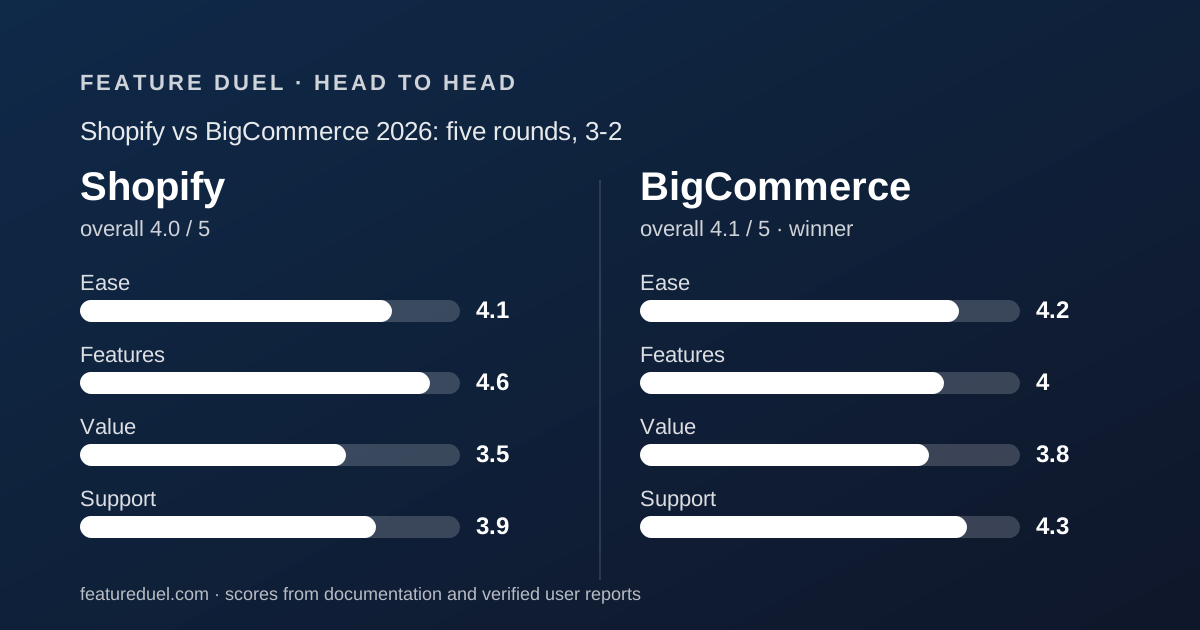
Shopify vs BigCommerce 2026: five rounds, 3-2
Shopify and BigCommerce sell the same thing and price it on opposite principles. Shopify charges a flat subscription, lets you sell as much as you like on any tier, and does not print what a card payment costs. BigCommerce prints every fee it charges, including the card rate, and then attaches a sales ceiling to each self-service plan that moves you up a tier without asking. Both pages were read on October 22, 2026 in US dollars via rendered DOM. BigCommerce takes 3 rounds to 2, and the margin is narrow enough that one number in your own accounts can overturn it.
 4.0Shopify
 4.1BigCommerce
Specification by specification
| Spec | Shopify | BigCommerce |
|---|---|---|
| Entry price | $19/mo on Basic paid yearly ($25 monthly) | $29/mo on Core billed annually ($39 monthly) |
| Middle tier | Grow $49 yearly, $65 monthly | Growth $79 annual, $105 monthly |
| Upper self-service tier | Advanced $299 yearly, $399 monthly | Scale $299 annual, $399 monthly |
| Top tier | Plus, Starts at $2,300 USD/mo, no yearly rate shown | Performance, custom from $1,499/mo billed annually |
| Free trial | 3 days free, then $1/month for 3 months | 15-day fully functional trial, no credit card required |
| Free plan | None | None |
| Contract required | None on standard tiers; 1- or 3-year terms named for Plus | None on Core, Growth or Scale; contracts on Performance |
| Products | Unlimited on every tier | Unlimited products and users per the Core card |
| Sales cap | None stated on any tier | $30K TTM GMV on Core, $100K on Growth, $33,333/mo on Scale |
| What happens at the cap | Not applicable | Plan auto-upgrades; Scale charges 0.9% on GMV above cap |
| Card processing rate | Not printed on the pricing page | From 2.89% + $0.29 per transaction; Amex 3.50%, no fixed fee |
| Platform fee on payments | 2% Basic, 1% Grow, 0.6% Advanced, 0.2% Plus on third-party providers | $0 through 21 named embedded providers; otherwise 2.0%, 1.0%, 0.6% |
| Staff accounts | No number on Basic; 5 on Grow, 15 on Advanced, Unlimited on Plus | Unlimited products and users stated on the Core card |
| Inventory locations | 10 on the three standard tiers, 200 on Plus | Up to 4 Core, 5 Growth, 8 Scale, Custom on Performance |
| Abandoned cart recovery | Listed on Basic | Dash on Core; starts at Growth |
| Customer groups and segments | Customer segments listed on Basic | Dash on Core; starts at Growth |
| Product filtering | Not broken out by tier on the page | Dash on Core and Growth; starts at Scale |
| Extra storefronts | Free expansion stores up to 9, Plus only | $30/mo max 3 on Core, $50/mo max 5 Growth, $100/mo max 8 Scale |
| API access | Limited data access on Basic; full from Grow; 10x limits on Plus | API support marked Performance only |
| Marketplace channels | Free to 50 synced orders a month, then 1% up to $99/mo | Amazon, eBay, Walmart on every plan |
| Point of sale | POS Pro add-on $89/mo per location | POS integrations to Square, Vend, Clover, Heartland on every plan |
| Chat or email support | 24/7 live chat on every tier | 24/7 chat and email on every plan |
| Phone support | Priority 24/7 phone support, Plus only, from $2,300/mo | 24/7 phone included from Growth at $79/mo; add-on coming for Core |
| Published app count | Integrate with 1000s of apps, no number given | Over 1,200 apps per the site navigation |
| Security claim on the page | Certified Level 1 PCI DSS compliant | Platform Trust Center linked; no PCI level printed on this page |
The short answer
BigCommerce wins 3 rounds to 2. It takes onboarding, pricing and support. Shopify takes core workflow and integrations.
Read the bullets before the scorecard, because the pricing round is the closest one we have scored in this cluster and it flips at a specific sales figure we calculate below.
- Shopify is best for a store whose sales will grow past roughly $100,000 a year, that will use Shopify Payments, and that wants abandoned cart recovery, customer segments and 10 inventory locations at $19 a month
- BigCommerce is best for a store that wants every fee printed before signing, that already uses Stripe, PayPal, Adyen or Klarna so the platform fee is $0, that needs a 24/7 phone line, and whose sales will stay inside its tier's ceiling
- Neither page prints a response-time commitment, an uptime figure or a service level agreement
- Both figures sets were read from rendered DOM on October 22, 2026 in US dollars, not from search snippets or summaries
The scorecard, round by round
Five fixed rounds, the same five used on every duel on this site, scored only from what each vendor publishes. The method is set out in how a duel is scored.
- Round 1, onboarding: BigCommerce. A 15-day fully functional trial with no credit card beats 3 days followed by an introductory price
- Round 2, core workflow: Shopify. Four features a working store needs are marked with a dash in the BigCommerce Core column
- Round 3, integrations: Shopify. Full API data access arrives at $49; BigCommerce marks API support as Performance only
- Round 4, pricing: BigCommerce, on disclosure. It prints the card rate and a route to a $0 platform fee; Shopify prints no card rate at all
- Round 5, support: BigCommerce. A 24/7 phone line costs $79 a month here and $2,300 a month there
BigCommerce lets you try the product; Shopify lets you rent it cheaply
Round 1 goes to BigCommerce on the trial alone.
The BigCommerce page describes a fully functional 15-day free trial, says no credit card is needed, and confirms a store can launch and take payments during it once a payments partner is connected.
If you decline to upgrade, data is kept for 90 days before deletion.
Shopify offers 3 days. The banner reads Try 3 days free, then $1/month for 3 months. The FAQ confirms no credit card is required for the three days.
The $1 offer that follows is cheap, but it is a price, not a trial, so day four is a billing relationship.
Both sides make cancellation easy on self-service tiers. Shopify names 1- or 3-year Plus subscriptions that lock until the term expires. BigCommerce requires contracts only on Performance.
The tie-breaker is that twelve days is the difference between evaluating a platform and guessing. See our Shopify review and our BigCommerce review for the full onboarding notes.
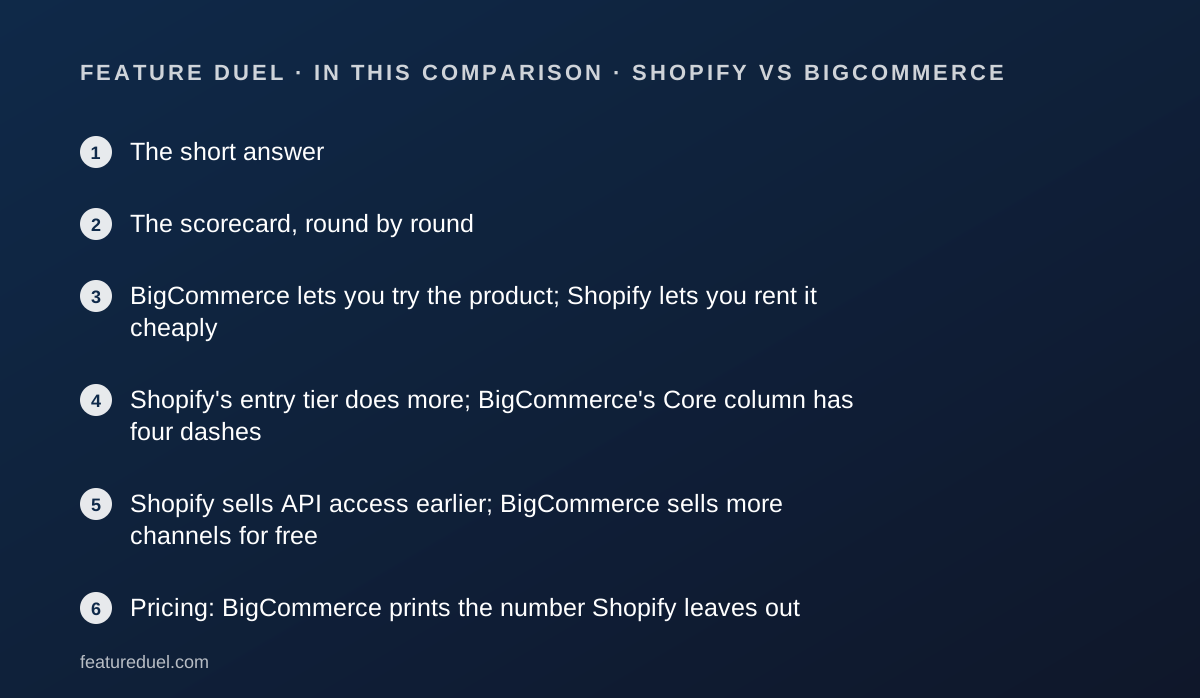
Shopify's entry tier does more; BigCommerce's Core column has four dashes
Round 2 goes to Shopify, and it is the clearest round in the duel.
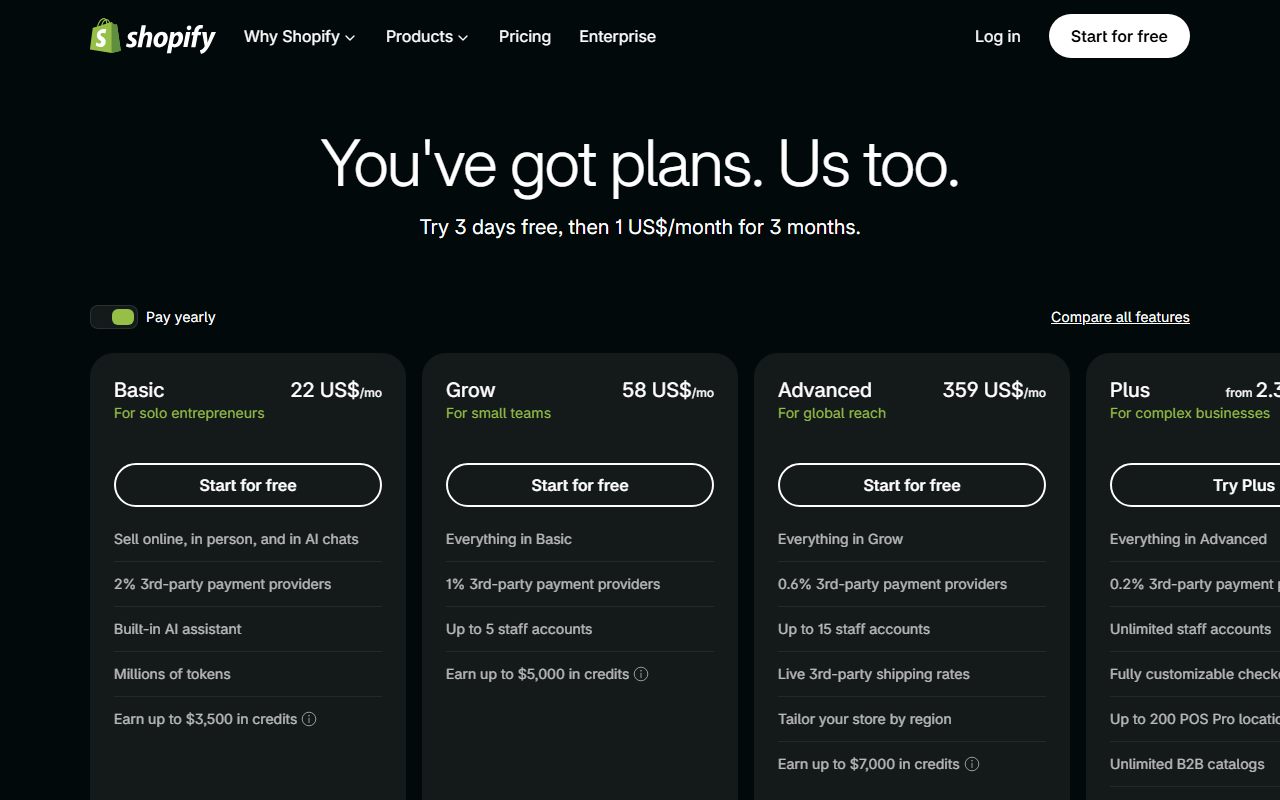
Shopify Basic at $19 a month paid yearly lists a full-featured online store, unlimited products, abandoned checkout recovery, customer segments, email campaigns, marketing automations, discount codes, gift cards, 10 inventory locations and selling on social, marketplaces and in AI chats.
The BigCommerce Core column shows a dash against customer groups and segmentation, abandoned cart saver, persistent cart and stored credit cards. All four start at Growth, $79 a month billed annually. Inventory locations on Core read Up to 4.
So the cheapest working store on BigCommerce is $79, not $29, for most sellers. By our arithmetic that is $948 a year against $228 for Shopify Basic.
Two rows go the other way. BigCommerce Core states unlimited products and users, while the Shopify table shows no staff account number in the Basic column at all. That matters, and it is the subject of our shared-login versus seat-per-person duel.
Shopify sells API access earlier; BigCommerce sells more channels for free
Round 3 goes to Shopify, narrowly, and the deciding row is one most buyers never read.
Shopify marks Basic as Limited data access with Standard API rate limits, then gives Full data access on Grow at $49. Advanced gets Up to 2x on select APIs and Plus Up to 10x. Headless storefronts run 1, 1, 1 and 25.
BigCommerce marks API support with a dash on Core, Growth and Scale, and a tick only on Performance, which starts at $1,499 a month billed annually. For a store planning custom development that is a hard wall rather than a rate limit.
BigCommerce wins the channel rows. Amazon, eBay and Walmart are on every plan. Google, Meta, TikTok, Microsoft and Pinterest run through Feedonomics Surface, which the page says is free with every plan for up to 100,000 SKUs.
Point of sale integrations to Square, Vend, Clover and Heartland Retail are included everywhere.
Shopify meters marketplaces instead: 50 synced orders a month free, then 1% up to $99/mo on every tier including Plus. On published app counts, BigCommerce prints Over 1,200 apps and Shopify prints 1000s of apps with no figure.
Pricing: BigCommerce prints the number Shopify leaves out
Round 4 goes to BigCommerce on disclosure, and it is the round a reader is most entitled to overrule.
The BigCommerce page prints its card rate: the processing fee for debit and credit cards begins at 2.89% + $0.29 per transaction for all BigCommerce plans, with American Express at 3.50% and no fixed fee.
The Shopify page prints nothing equivalent. Its FAQ states that Shopify charges a small fee to accept major credit cards and that these fees vary depending on the plan that you choose, then gives no rate at any tier.
Both charge a platform fee for payments, and only one of them is avoidable. Shopify charges 2% on Basic, 1% on Grow, 0.6% on Advanced and 0.2% on Plus whenever you use a third-party payment provider.
BigCommerce charges $0 on orders through any of 21 named embedded providers, a list that includes Stripe, PayPal Braintree, PayPal Complete Payments, Adyen, Klarna, Worldpay, Checkout.com, Affirm, Afterpay, Sezzle and Amazon Pay.
A merchant who already uses Stripe therefore pays a 2% surcharge on Shopify Basic and nothing on BigCommerce Core.
That is the whole round in one sentence. Our annual versus monthly billing duel covers the other half of the structure, since both ladders quote the discounted rate first.
Where the verdict flips: the arithmetic a reader should run
The pricing round is won on disclosure and lost on totals above a certain volume. Here is the crossover, calculated by us from the rates both pages displayed on October 22, 2026.
These are editorial calculations, not quotes, and they exclude tax and the processor's own fee.
At $25,000 of annual sales through Stripe: Shopify Basic costs $228 in subscription plus 2% of sales, roughly $500, for about $728. BigCommerce Core costs $348 and nothing more, because Stripe is on the embedded list. BigCommerce is roughly $380 cheaper.
At $120,000 of annual sales through Stripe: Shopify Basic is still $228 plus roughly $2,400 on the 2% fee, about $2,628.
BigCommerce reduces gross order value by 10% to get GMV, so $108,000 crosses the $100K Growth ceiling and the account upgrades to Scale at $299 a month, which is $3,588 a year. BigCommerce becomes roughly $960 more expensive.
Switch Shopify to its own payment product and the 2% disappears entirely, which removes the surcharge but leaves the card rate unknown.
So the honest rule from these two pages: below roughly $100,000 of annual sales with an outside processor, BigCommerce costs less. Above it, Shopify costs less and keeps costing less, because nothing on its page moves you up a tier.
- Shopify twelve-month subscription, by our arithmetic: Basic $228, Grow $588, Advanced $3,588
- BigCommerce twelve-month subscription, by our arithmetic: Core $348, Growth $948, Scale $3,588
- BigCommerce GMV is gross order value minus 10%, and the page warns it may differ from your own records
- BigCommerce Scale charges 0.9% on GMV above $33,333 a month rather than jumping a tier
- Shopify adds $89/mo per POS Pro location and 1% up to $99/mo on marketplace orders past 50 a month
Both pages contradict themselves, and we print both sides
Neither page is internally consistent, and in each case the gap sits on a number a buyer would use.
On Shopify, the Plus card advertises Up to 200 POS Pro locations. The POS Pro row in the comparison table reads Includes 20 locations. for the same Plus column.
Both strings were in the markup on October 22, 2026, a tenfold gap with no way to tell which is current.
On BigCommerce, the Scale card is sold to Fast-growing businesses with $1M in annual sales while the same card caps GMV at $33,333 a month. That is $399,996 a year by our arithmetic, so the described customer would run permanently in overage at 0.9%.
BigCommerce also announces a feature without a price. The footnote says Core plan customers can add phone support when they need it, that pricing and timing will be shared separately, and that the add-on is coming soon for Core.
We quote all three rather than resolving them. Get each one into the order form before signing.
Support: a phone line costs $79 here and $2,300 there
Round 5 goes to BigCommerce by the widest margin in the duel.
BigCommerce marks 24/7 tech support by chat and email as included on all four plans, and 24/7 phone support as included on Growth, Scale and Performance. Growth is $79 a month billed annually.
Shopify names support per tier too, which is more than most pricing pages do: Live chat on Basic and Grow, Enhanced live chat on Advanced, Priority support on Plus.
The phone line appears only on the Plus card, as Priority 24/7 phone support, at a tier that starts at $2,300 a month.
By our arithmetic that is $948 a year against $27,600 a year for the cheapest plan on each platform that prints a phone channel.
Both sides then go quiet. Shopify does not define enhanced or priority. BigCommerce lists express routing and priority support as Add-on available on Growth and Scale without a price, and keeps a Customer Success Manager for Performance.
Neither page prints a response time, an uptime figure or a service level agreement.
What users report
Nothing yet, and we will not invent it. We have not compiled a dated sample of G2, Capterra, Trustpilot or Reddit reports for either platform, so this duel is decided on published documentation only.
This section will carry sourced, dated findings when that sample exists.
The questions worth asking other merchants are narrow: what card rate each plan actually produced, whether the BigCommerce auto-upgrade arrived with notice, and how far the vendor's GMV figure diverged from the merchant's own sales records.
Choose Shopify if
Four conditions, each tied to a line printed on the page.
- Your sales will pass roughly $100,000 a year, because no Shopify tier states a ceiling and no plan upgrades itself
- You will use Shopify Payments, which is the only way the 2% third-party provider fee on Basic never reaches your invoice
- You need abandoned cart recovery and segments at the entry price, both listed on Basic rather than at $79
- You plan custom development on a mid tier, since full API data access arrives at $49 rather than at $1,499
Choose BigCommerce if
Four conditions, each tied to a line printed on the page.
- You will not sign until every fee is printed, which here includes the card rate at 2.89% plus $0.29 and Amex at 3.50%
- Your processor is on the embedded list, bringing the platform payment fee to $0 rather than 2%
- You want a 24/7 phone line without a four-figure plan, which is included from Growth at $79 a month
- Several people need admin access cheaply, since Core states unlimited products and users while Shopify Basic shows no staff number
The rows that decide it, side by side
Shopify first, BigCommerce second, every value read from the two pricing pages on October 22, 2026 in US dollars.
- Entry price: $19/mo on Basic paid yearly, $25 monthly · $29/mo on Core billed annually, $39 monthly
- Free trial: 3 days free, then $1/month for 3 months · 15-day fully functional trial, no credit card
- Sales cap: none stated on any tier · $30K TTM GMV on Core, $100K on Growth, $33,333/mo on Scale
- Card processing rate: not printed · from 2.89% + $0.29 per transaction, Amex 3.50%
- Platform payment fee: 2% on Basic for third-party providers · $0 through 21 named embedded providers
- Staff accounts: no number on Basic, 5 on Grow, 15 on Advanced · unlimited products and users on Core
- Inventory locations: 10 on the three standard tiers, 200 on Plus · up to 4 Core, 5 Growth, 8 Scale
- Abandoned cart recovery: listed on Basic at $19 · dash on Core, starts at Growth at $79
- Cheapest tier with a phone line: Plus, from $2,300/mo · Growth, $79/mo billed annually
- API data access: limited on Basic, full from Grow at $49 · API support marked Performance only
Frequently asked
Short answers with the figure and the date attached. The longer versions sit in our Shopify review, our BigCommerce review and in the all-in-one versus best-of-breed duel.
- Which is cheaper for a small store? BigCommerce with an outside processor. At $25,000 of annual sales through Stripe, Shopify Basic is roughly $728 for the year by our arithmetic and BigCommerce Core is $348
- Does BigCommerce force an upgrade? Yes. Core reads Up to $30K TTM GMV; plan auto-upgrades to Growth. Growth reads Up to $100K TTM GMV; plan auto-upgrades to Scale
- What does Shopify charge per transaction? The page does not say. It prints the 2%, 1%, 0.6% and 0.2% third-party provider fees but no card rate at any tier
- Which trial is better? BigCommerce, by twelve days: 15 days fully functional with no credit card against 3 days followed by $1 a month
- Which is cheaper for phone support? BigCommerce. A 24/7 phone line is included from Growth at $948 a year by our arithmetic, against $27,600 for Shopify Plus
- Does either have a free plan? No. Neither page showed a free tier on October 22, 2026
Bottom line
BigCommerce takes this duel 3-2 because it tells you what it costs. It prints the card rate, publishes the twenty-one providers that make its platform fee zero, and puts a 24/7 phone line at $79 a month instead of $2,300.
Shopify wins the two rounds about the product itself. Its $19 tier sells more store than BigCommerce's $29 tier, its API opens at $49 rather than $1,499, and nothing on its page caps how much you may sell.
The decision is therefore arithmetic, not preference. Run your own twelve months of sales through both ladders. Below roughly $100,000 a year with an outside processor, BigCommerce is cheaper and more honest.
Above that figure the ceiling makes Shopify cheaper, and the missing card rate becomes the price you pay for that. The method behind the five rounds, and a similar split verdict, is in our best CRM for a small sales team guide.
All figures checked October 22, 2026.
Frequently asked
Is Shopify or BigCommerce cheaper for a small store?
BigCommerce, if you use an outside processor. At $25,000 of annual sales through Stripe, Shopify Basic is roughly $728 for the year by our arithmetic, counting $228 of subscription plus the 2% third-party provider fee. BigCommerce Core is $348, because Stripe is on its embedded list and carries a $0 platform fee.
Does BigCommerce really force you onto a more expensive plan?
Yes, and the page says so. Core reads Up to $30K TTM GMV; plan auto-upgrades to Growth, and Growth reads Up to $100K TTM GMV; plan auto-upgrades to Scale. Scale instead charges 0.9% on GMV above $33,333 a month. Reaching $2 million in trailing twelve-month GMV moves the account to Performance.
What does Shopify charge per transaction?
The pricing page does not say. It prints the third-party payment provider fee at 2%, 1%, 0.6% and 0.2% by tier, but no card processing rate at all. The FAQ states only that the fees vary depending on the plan that you choose. BigCommerce prints its own at 2.89% plus $0.29 per transaction.
Which one has the better free trial?
BigCommerce, by twelve days. It offers a fully functional 15-day trial with no credit card required and says a store can launch and take payments during it. Shopify offers 3 days free followed by $1 per month for 3 months, which is an introductory price rather than a trial.
Which platform is cheaper for phone support?
BigCommerce, by a wide margin. 24/7 phone support is marked included from Growth at $79 a month billed annually, which is $948 a year by our arithmetic. On Shopify the phone channel appears only on Plus, which starts at $2,300 a month, or $27,600 a year on the same calculation.
Can I move a store from Shopify to BigCommerce?
The BigCommerce site advertises migration from Shopify, WooCommerce, Salesforce and Magento, and sells Data Migration and Optimization as a paid service. Neither pricing page prints a migration cost or a timeline, so treat both as a sales conversation rather than a published figure.
Do either of them have a free plan?
No. Neither pricing page shows a free tier as of October 22, 2026. Shopify's cheapest paid plan is Basic at $19 a month paid yearly, and BigCommerce's is Core at $29 a month billed annually. Both prices exclude tax, and BigCommerce states this explicitly in a footnote.
Visit Shopify
We have no affiliate relationship with this vendor. Link goes to the official site.
Visit BigCommerce
We have no affiliate relationship with this vendor. Link goes to the official site.