 Feature

Shopify
Four cards from $19 to $2,300 per month on yearly billing, unlimited products on every tier, a third-party payment provider fee of 2% down to 0.2%, and no card processing rate printed anywhere on the pricing page
Scored on the published rubric, from documentation, pricing and verified user reports.
Best for: Stores that want no cap on sales volume or product count at the entry tier, that plan to sell in person as well as online, and that are willing to run payments through Shopify Payments so the third-party provider fee of 2% on Basic never applies.
Verdict
Shopify sells the most capable entry tier in this cluster and the least complete price card. This is a documentation review: every figure comes from the Shopify pricing page read on October 22, 2026 in US dollars, not from staged demos. Four cards appear under a toggle that opens on Pay yearly. Basic is $19 per month, Grow $49, Advanced $299, and Plus reads Starts at $2,300 USD/mo. The feature table underneath prints the monthly equivalents: $25, $65, $399, and the same $2,300 for Plus with no yearly rate given. Every tier sells unlimited products, carries a full-featured online store, abandoned checkout recovery, 10 inventory locations and 24/7 live chat. That matters, because rivals in this cluster hold abandoned cart recovery or a sales ceiling over the entry tier. What the page will not tell you is what a card payment costs. The FAQ states that Shopify charges a small fee to accept major credit cards and that these fees vary depending on the plan that you choose, then prints no rate. What it does print is the penalty for not using Shopify Payments: 2% on Basic, 1% on Grow, 0.6% on Advanced, 0.2% on Plus. Staff accounts are rationed, with no number in the Basic column, 5 on Grow and 15 on Advanced. Buy it for the headroom. Do not expect the page to add up to a monthly bill.
Visit Shopify
We have no affiliate relationship with this vendor. Link goes to the official site.
Where it is strong
- Unlimited products on every tier, including Basic at $19 per month paid yearly, with no sales-volume ceiling and no automatic plan upgrade
- Abandoned checkout recovery, discount codes, gift cards, customer segments and marketing automations are all listed on Basic rather than gated to a middle tier
- 10 inventory locations on Basic, Grow and Advanced, rising to 200 on Plus, which is the widest entry-tier allowance printed in this cluster
- Every tier prints a monthly as well as a yearly rate in the feature table, so both sides of the annual discount are readable for Basic, Grow and Advanced
- 24/7 support is named per tier: live chat on Basic and Grow, enhanced live chat on Advanced, priority support and 24/7 phone on Plus
- The page states there are no setup fees on any of our plans and that Shopify is certified Level 1 PCI DSS compliant
Where it falls short
- No credit card processing rate appears anywhere on the pricing page; the FAQ says only that these fees vary depending on the plan that you choose
- The third-party payment provider fee is 2% on Basic, so a store that wants to keep its own processor pays a surcharge on every order
- No number appears in the Basic column for additional staff accounts, so the cheapest tier looks like a single-operator plan
- The Plus card advertises Up to 200 POS Pro locations while the feature table row for POS Pro on Plus reads Includes 20 locations, a tenfold gap on the same page
- Plus prints no yearly rate at all, only Starts at $2,300 USD/mo, and the FAQ refers to a 1- or 3-year Plus subscription with no term pricing
- Marketplace order sync is free only to 50 orders a month, after which the page charges 1% up to $99/mo on every tier including Plus
- The free trial is 3 days, the shortest in this cluster, and the $1 per month offer that follows is an introductory price rather than a trial
At a glance
| Starting price | $19/mo on Basic paid yearly; Grow $49; Advanced $299; Plus from $2,300/mo |
|---|---|
| Pricing note | From $19/mo on Basic paid yearly, $49 on Grow and $299 on Advanced, with Plus starting at $2,300/mo (pricing page, checked October 22, 2026, in US dollars) |
| Monthly rates printed | Basic $25, Grow $65, Advanced $399; Plus shows Starts at $2,300 USD/mo on both toggles |
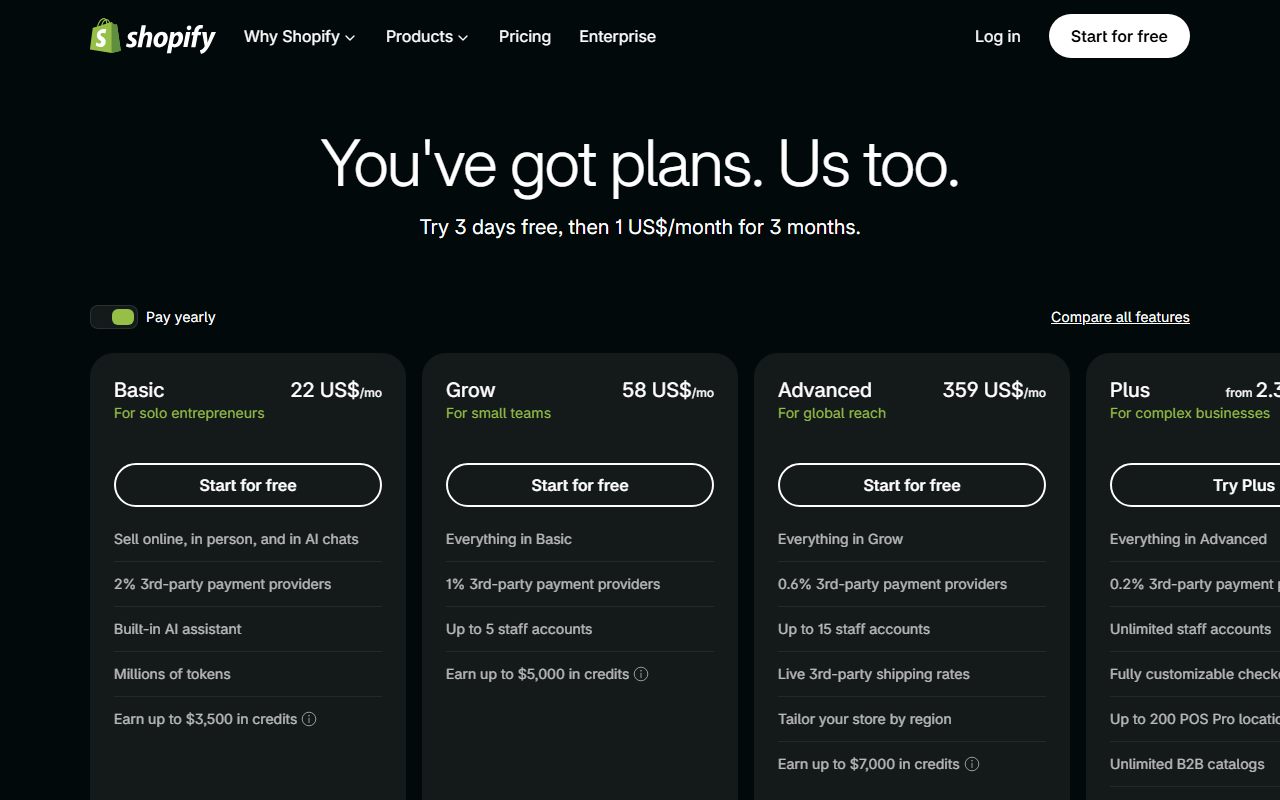
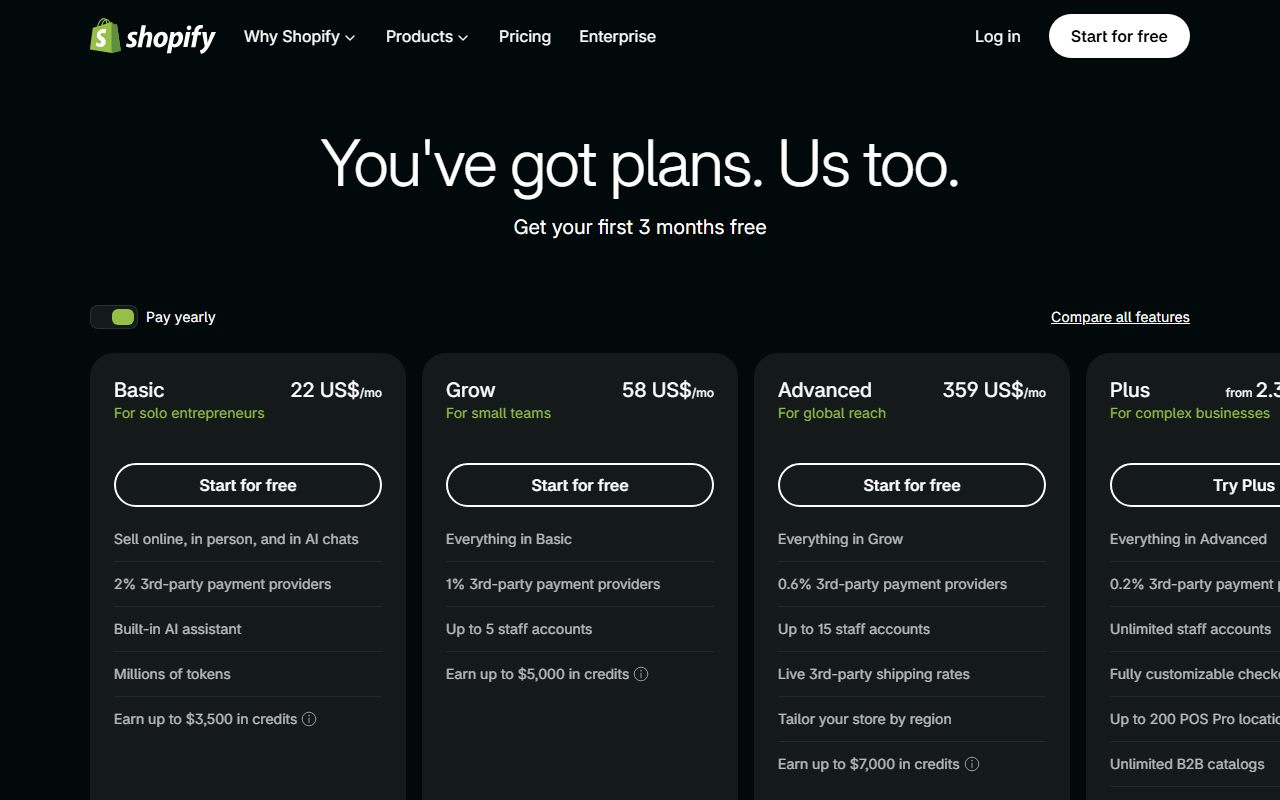
| Free plan | None; Try 3 days free, then $1/month for 3 months per the page banner |
| Products | Sell unlimited products on every tier |
| Sales cap | None stated on any tier |
| Third-party payment provider fee | 2% Basic, 1% Grow, 0.6% Advanced, 0.2% Plus |
| Card processing rate | Not printed on the pricing page; the FAQ says the fees vary by plan |
| Staff accounts | No number in the Basic column; 5 on Grow, 15 on Advanced, Unlimited on Plus |
| Inventory locations | 10 on Basic, Grow and Advanced; 200 on Plus |
| Point of sale | POS Pro add-on at $89/mo per location on the three standard tiers |
| Support | 24/7 live chat on Basic and Grow; enhanced live chat on Advanced; priority support plus 24/7 phone on Plus |
What Shopify actually is
Shopify is a hosted commerce platform sold as one ladder of four plans. The subscription covers the storefront, the checkout, hosting, an SSL certificate, inventory, orders and a marketing suite.
Payments are a separate commercial relationship, and that split is the whole story of this page.
Every tier is described as selling unlimited products, with unlimited web hosting and unlimited contacts. The page positions the platform as selling online, in person, and in AI chats, naming a channel that was not on anyone's pricing page a year ago.
That makes Shopify the single-vendor corner of the market, and our all-in-one versus best-of-breed duel is the argument underneath the choice.
This review scores Shopify on the five fixed rounds used across the site: onboarding, core workflow, integrations, pricing and support. The method is set out in how a duel is scored.
Every figure below was read off the pricing page on October 22, 2026, in US dollars.
Who Shopify is best for
The published ladder favours a particular shape of store. Read the list against your own before the prices.
- Stores whose sales are growing and that will not accept a volume ceiling, since no tier prints one
- Catalogues of any size, because unlimited products appears in every column including Basic
- Merchants who will use Shopify Payments and so never meet the 2% third-party provider fee
- Retailers selling in person as well as online, with POS Pro at $89 per month per location
- Stores holding stock in several places, where 10 inventory locations are included from Basic
- Teams that want abandoned checkout recovery, segments and automations at the entry price
Who should skip it
Three profiles will find the page silent on the number that decides their budget.
- Merchants locked to an outside processor, who pay 2% on Basic on top of the processor's own fee
- Buyers who must present a complete cost per order, since no card rate is printed at any tier
- Stores where two or more people need admin access on the cheapest plan, which lists no staff accounts
What each plan costs as of October 2026
Four cards sit under a toggle that opens on Pay yearly. Basic is $19 per month and is described as being for solo entrepreneurs. Grow is $49 for small teams. Advanced is $299 for global reach. Plus reads from $2,300 per month for complex businesses.
The comparison table lower down prints the other side of the toggle: Pay monthly at $25, $65 and $399. Plus shows Starts at $2,300 USD/mo on both rows, so the yearly rate for the top tier is absent.
By our arithmetic from those two rows, Basic is 24% below its monthly rate, Grow 25% and Advanced 25%. The page itself does not print a discount percentage, which is unusually restrained for this category.
One add-on is priced. POS Pro is +$89/mo, described in the table as $89/mo per location on Basic, Grow and Advanced. Our annual versus monthly billing duel is the relevant reading, because every headline figure here is a yearly-paid rate.
The number this page refuses to print
There is no credit card processing rate on the Shopify pricing page. Not a percentage, not a per-transaction amount, not a range. The gap is deliberate and the FAQ acknowledges it.
The exact wording, read on October 22, 2026: Shopify charges a small fee to allow you to accept major credit cards, such as Visa and Mastercard, as payment in your store. These fees vary depending on the plan that you choose.
For a store taking $4,000 a month, the difference between a 2.4% and a 2.9% card rate is $240 a year by our arithmetic. That is larger than the gap between Basic and Grow.
A pricing page that omits it is not a pricing page a buyer can finish.
What the page does print is the cost of refusing Shopify Payments. The third-party payment provider fee is 2% on Basic, 1% on Grow, 0.6% on Advanced and 0.2% on Plus. That is a platform surcharge on top of whatever your own processor charges.
Onboarding: what the score is built from
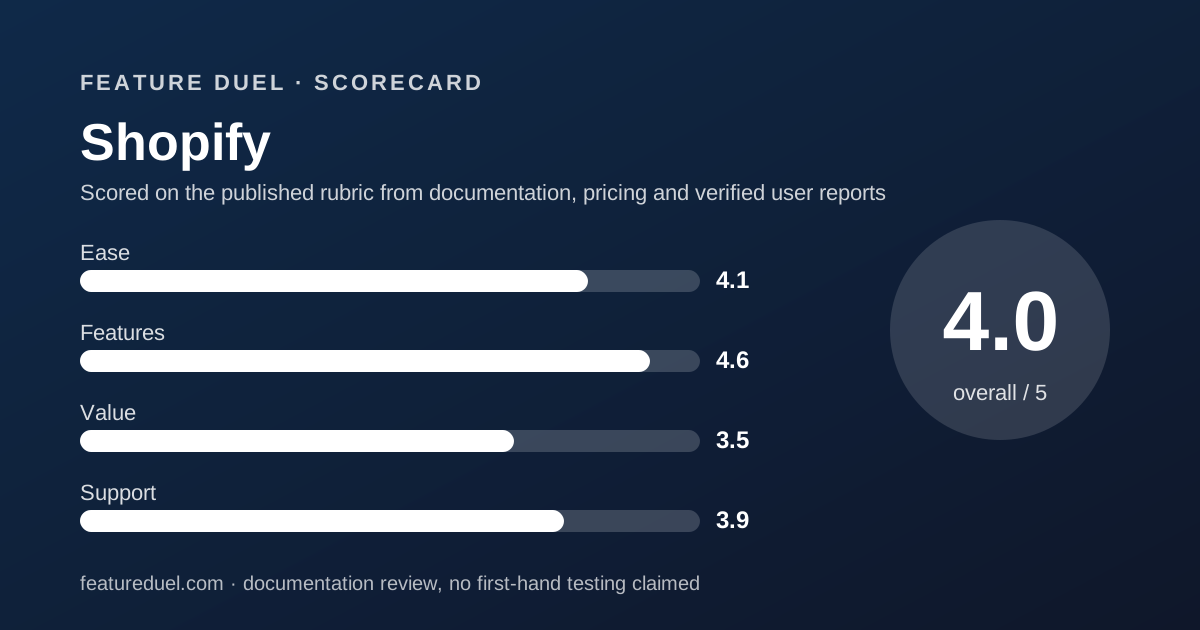
4.1 out of 5. This round asks how much stands between a new account and a store taking orders, judged only from what the vendor publishes.
The path is short. The banner reads Try 3 days free, then $1/month for 3 months. The FAQ confirms a free 3-day trial with no credit card required.
The page also says there are no setup fees on any of our plans and that cancellation is available at any time, except on a 1- or 3-year Plus subscription.
The deductions are about the three days. Three days is the shortest window in this cluster, and the $1 per month that follows is an introductory price, not a trial, so a merchant still evaluating in week two has already entered a billing relationship.
The second deduction is the missing card rate. A merchant cannot model a single month's cost from this page without opening a second one.
Core workflow: the strongest entry tier in this cluster
4.6 out of 5, and almost all of it is earned at the bottom of the ladder rather than the top.
Basic at $19 per month paid yearly lists a full-featured online store, unlimited products, the checkout, selling on social and marketplaces, selling in AI chats, 10 inventory locations, abandoned checkout recovery, customer segments, email campaigns, marketing automations, discount codes and gift cards.
Rivals in this cluster hold at least two of those behind a middle tier.
Shopify B2B appears from Basic at up to 3 catalogs, rising to unlimited catalogs on Plus. Headless storefronts are capped at 1 on the three standard tiers and 25 on Plus.
The deductions are the rationed seats and the Plus-only layer. Additional staff accounts show no number on Basic, 5 on Grow, 15 on Advanced.
High volume checkout, bot protection, custom functions and free expansion stores up to 9 are marked Just for Plus. Our shared-login versus seat-per-person duel is the live question for any store on Basic.
The POS contradiction, printed twice on one page
The Plus card lists Up to 200 POS Pro locations as a selling point. The POS Pro row in the comparison table, on the same page on the same day, reads Includes 20 locations. for the Plus column.
Both strings were in the markup we read on October 22, 2026. One of them is wrong by a factor of ten, and the page gives a buyer no way to tell which.
We print both rather than choosing. A retailer sizing a Plus contract around store count should get the number into the order form.
The Inventory locations row, a different quota, reads 10 for the three standard tiers and 200 for Plus.
That is consistent with the 200 on the card and may be the source of the confusion, but inventory locations and POS Pro locations are separate rows with separate values.
Integrations: a big ecosystem described in round numbers
4.4 out of 5. The page says Integrate with 1000s of apps on every tier and does not give a count.
API access is tiered, and this is the row that matters for anyone planning custom work. Basic is marked Limited data access with Standard API rate limits. Grow and Advanced get Full data access.
Advanced is listed at Up to 2x on select APIs and Plus at Up to 10x on select APIs.
Checkout customization reads Limited on Basic, Grow and Advanced, and Full on Plus. For a store whose differentiator is the checkout, that single row moves the decision to a $2,300 tier.
Marketplace sync has a meter: 50 synced marketplace orders per month are Free, and Over 50 synced marketplace orders costs 1% up to $99/mo on every tier.
The same metered pattern shows up in our monday.com review and our ClickUp review, where credits rather than orders are the unit.
Pricing: cheap at the sticker, metered at the edges
3.5 out of 5, the lowest round on the card, and the structure is the reason rather than the totals.
The totals are mild. By our arithmetic from the yearly rates displayed on October 22, 2026, Basic is $228 for twelve months, Grow $588 and Advanced $3,588.
That is the cheapest entry subscription in this cluster once you ignore volume caps, which Shopify does not impose.
The metered edges are where the bill moves. The third-party payment provider fee of 2% on Basic is charged on sales, not on the subscription, so it scales with success. POS Pro is $89 per month per location.
Marketplace sync past 50 orders is 1% up to $99 per month.
The page also prints a credit rather than a discount: Earn 1% back on all sales, capped at Up to $3,500 USD on Basic, $5,000 on Grow and $7,000 on Advanced.
A credit against future spend is not the same as a lower price, and the page does not say what it may be spent on.
The finance rows are similarly specific and similarly conditional: a 2.52% earnings rate on Shopify Balance for the three standard tiers, 3.54% on Plus, and Up to 3% cashback on the Shopify Credit card.
Support: named per tier, which is rarer than it sounds
3.9 out of 5, and it is the clearest support row in this cluster.
The table prints 24/7 support with a value in every column: Live chat on Basic, Live chat on Grow, Enhanced live chat on Advanced, Priority support on Plus. The Plus card adds Priority 24/7 phone support.
That is more than most pricing pages in our cluster commit to. The Zendesk page we read in October printed no support channel at any tier, as recorded in our Zendesk review.
The deductions are the undefined words. The page does not say what makes live chat enhanced, what priority means in queue minutes, or what response time any tier is entitled to. A phone line reaches only the $2,300 tier.
No uptime figure and no service level agreement appear on the page we read.
What verified users report
This review is built from vendor documentation. We have not yet compiled a dated sample of G2, Capterra, Trustpilot or Reddit reports for Shopify, and we will not summarise impressions we have not collected. This section will carry sourced, dated findings when that sample exists.
The questions worth putting to other merchants are specific. What card rate their plan actually produced. Whether the third-party provider fee appeared as a separate invoice line. Whether the 1% sales credit was ever spendable on anything they wanted.
Limits stated by the vendor
Printed on the page, checked October 22, 2026, in US dollars: Basic $19 paid yearly and $25 monthly; Grow $49 and $65; Advanced $299 and $399; Plus Starts at $2,300 USD/mo.
Also printed: third-party payment provider fees of 2%, 1%, 0.6% and 0.2%; POS Pro at $89 per month per location; 10 inventory locations on standard tiers and 200 on Plus; additional staff accounts 5, 15 and Unlimited.
And further down the same table: Shopify B2B up to 3 catalogs and unlimited on Plus; 1 headless storefront and 25 on Plus.
Also in that table: 50 free synced marketplace orders a month then 1% up to $99/mo; sales credits capped at $3,500, $5,000 and $7,000; certified Level 1 PCI DSS compliance.
Not printed: any credit card processing rate, a yearly rate for Plus, a staff account number for Basic, an uptime figure, a response-time commitment, or Plus term pricing for the 1- and 3-year subscriptions the FAQ names.
Showing prices in local currencies and accepting local payment methods both carry the footnote Requires Shopify Payments.
Alternatives
Two other platforms were read the same day for this cluster. Both are named here from their own pricing pages, not from any claim of use.
BigCommerce prints a complete ladder at $29, $79 and $299 per month billed annually, with monthly equivalents of $39, $105 and $399. It also prints its card rate: debit and credit card processing begins at 2.89% plus $0.29 per transaction.
The catch is the ceiling. Every self-service BigCommerce tier carries a sales cap and an automatic upgrade. Choose it if you want every fee disclosed and can live with that.
Ecwid, branded Ecwid by Lightspeed, prints Starter at $5, Venture at $29, Business at $49 and Unlimited at $119 per month on annual billing, with a transaction fee row reading 0 across all four tiers. Product counts are capped at 10, 100, 2,500 and unlimited.
Choose it if the store bolts onto a site you already run.
Otherwise choose Shopify when the ceiling matters more than the disclosure. The Pipedrive versus HubSpot Sales Hub duel shows the same trade in a different category, where the cheaper ladder also hid less.
Bottom line
Shopify wins core workflow in this cluster and loses pricing on structure rather than totals.
Basic at $19 per month paid yearly, $228 a year by our arithmetic, buys unlimited products, abandoned checkout recovery, 10 inventory locations and 24/7 live chat with no sales ceiling attached.
It is also a page that prints no card rate, charges 2% for using your own processor, lists no staff accounts on the cheapest tier, and states two different POS Pro location counts for Plus.
Shortlist it for the headroom, then get the processing rate in writing before you move a catalogue. All figures checked October 22, 2026.
Buy it if
- Your sales are growing and you will not accept a volume cap, because no tier on this page states a sales ceiling or an automatic upgrade
- You will run payments through Shopify Payments, which is the only way the printed third-party provider fee of 2% on Basic never reaches your invoice
- You sell in person as well as online, where POS Pro at $89 per month per location sits beside the same catalogue
- You want abandoned checkout recovery and marketing automations at the entry price, both of which are listed on Basic rather than held back
Skip it if
- You need the card rate before you commit, since the pricing page prints no processing percentage at any tier
- You are tied to an outside processor, where the 2% third-party fee on Basic lands on every order you take
- More than one person needs admin access on the cheapest plan, because no staff account number appears in the Basic column
- You want a real trial rather than an introductory price, since the offer is 3 days free followed by $1 per month for 3 months
Frequently asked
How much does Shopify cost per month?
Per the pricing page checked October 22, 2026, Basic is $19 per month paid yearly, Grow is $49 and Advanced is $299. Plus reads Starts at $2,300 USD/mo. The feature table prints the monthly rates as $25, $65 and $399, with Plus unchanged at $2,300.
Does Shopify have a free plan?
No free plan appears on the page read on October 22, 2026. The banner reads Try 3 days free, then $1/month for 3 months. The FAQ describes a free 3-day trial with no credit card required, after which most plans start at just $1 per month for the first 3 months.
What does Shopify charge per transaction?
The pricing page does not print a card processing rate at any tier. It states only that Shopify charges a small fee to accept major credit cards and that these fees vary depending on the plan that you choose. It does print the third-party payment provider fee: 2%, 1%, 0.6% and 0.2%.
How many staff accounts does Shopify include?
The feature table row for additional staff accounts shows 5 on Grow, 15 on Advanced and Unlimited on Plus. No number appears in the Basic column. The Grow card phrases it as Up to 5 staff accounts and the Plus card as Unlimited staff accounts.
Is there a limit on how much I can sell on Shopify?
None is printed. No card states a sales ceiling, a gross merchandise value cap or an automatic plan upgrade, and every tier is described as selling unlimited products. Marketplace order sync is the one metered line: free to 50 synced orders a month, then 1% up to $99/mo.
How much does Shopify cost for a year on Basic?
By our arithmetic from the yearly rate displayed on October 22, 2026, Basic is $228 for twelve months and the printed monthly rate of $25 would be $300. Grow is $588 against $780, and Advanced $3,588 against $4,788. These are editorial calculations, not quotes, and exclude tax and payment fees.
Does Shopify include point of sale?
Card payments with a phone or card reader are listed on every tier. POS Pro, which the page describes as adding staff roles and permissions, exchanges and flexible pickup and delivery, is a separate add-on at $89 per month per location on Basic, Grow and Advanced.
Sources
- Shopify pricing page - checked October 22, 2026
- BigCommerce pricing page (for cluster comparison figures) - checked October 22, 2026
- Ecwid pricing page (for cluster comparison figures) - checked October 22, 2026
Update history
- October 22, 2026 - First published from the Shopify pricing page as read on October 22, 2026 in US dollars via rendered DOM. No credit card processing rate was present anywhere in the markup; the page states only that the fees vary by plan. The Plus card string Up to 200 POS Pro locations and the table string Includes 20 locations. are both quoted rather than resolved.
Visit Shopify
We have no affiliate relationship with this vendor. Link goes to the official site.