 Feature
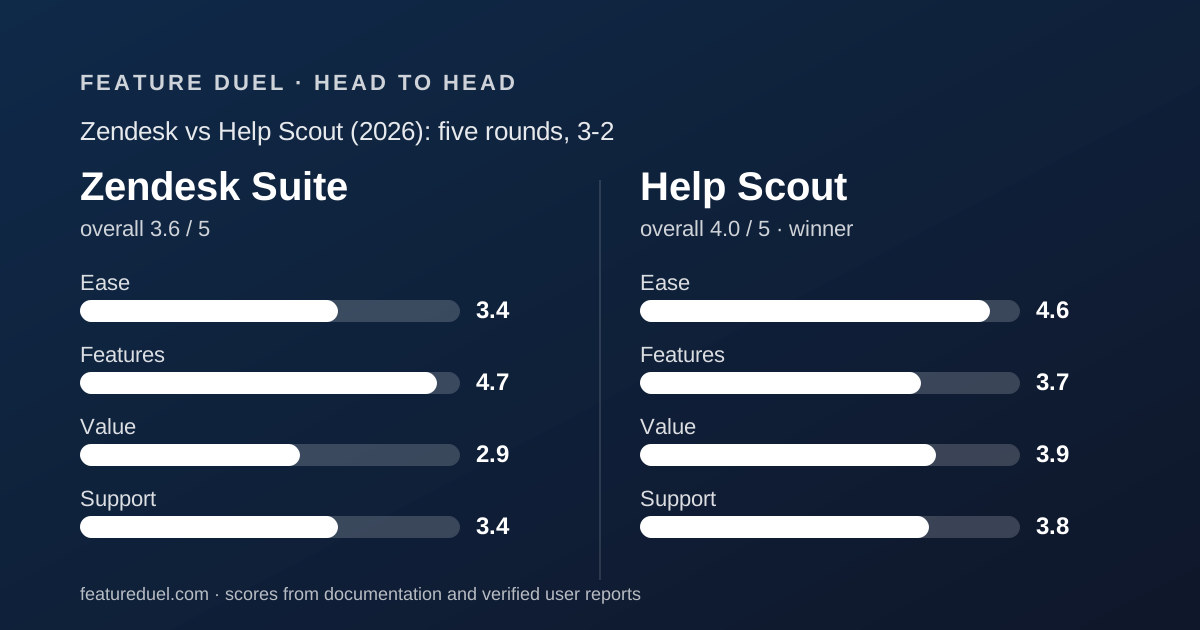
Zendesk vs Help Scout (2026): five rounds, 3-2
Zendesk and Help Scout are the two ends of the help desk market, and small teams shortlist them together anyway. Zendesk sells every channel a support organisation might one day need, with the top of its ladder behind a sales call. Help Scout sells an inbox, a help centre and the channels most small companies already use, with almost every plan limit printed as a number and a free tier underneath. This duel scores them over the five fixed rounds used on every page here: onboarding, core workflow, integrations, pricing and support. Help Scout takes three rounds, Zendesk takes two, and the two Zendesk wins are decisive for any desk that answers a telephone. Every figure below was read off the two pricing pages on October 20, 2026, in US dollars, by page fetch and by a full browser render of the feature tables where the fetch came back thin. This is a documentation review. No staged demos, no claims of testing we did not do.
 3.6Zendesk Suite
 4.0Help Scout
Specification by specification
| Spec | Zendesk Suite | Help Scout |
|---|---|---|
| Free plan | None | Yes: 5 users, 1 Inbox, 1 Docs site, 100 contacts a month |
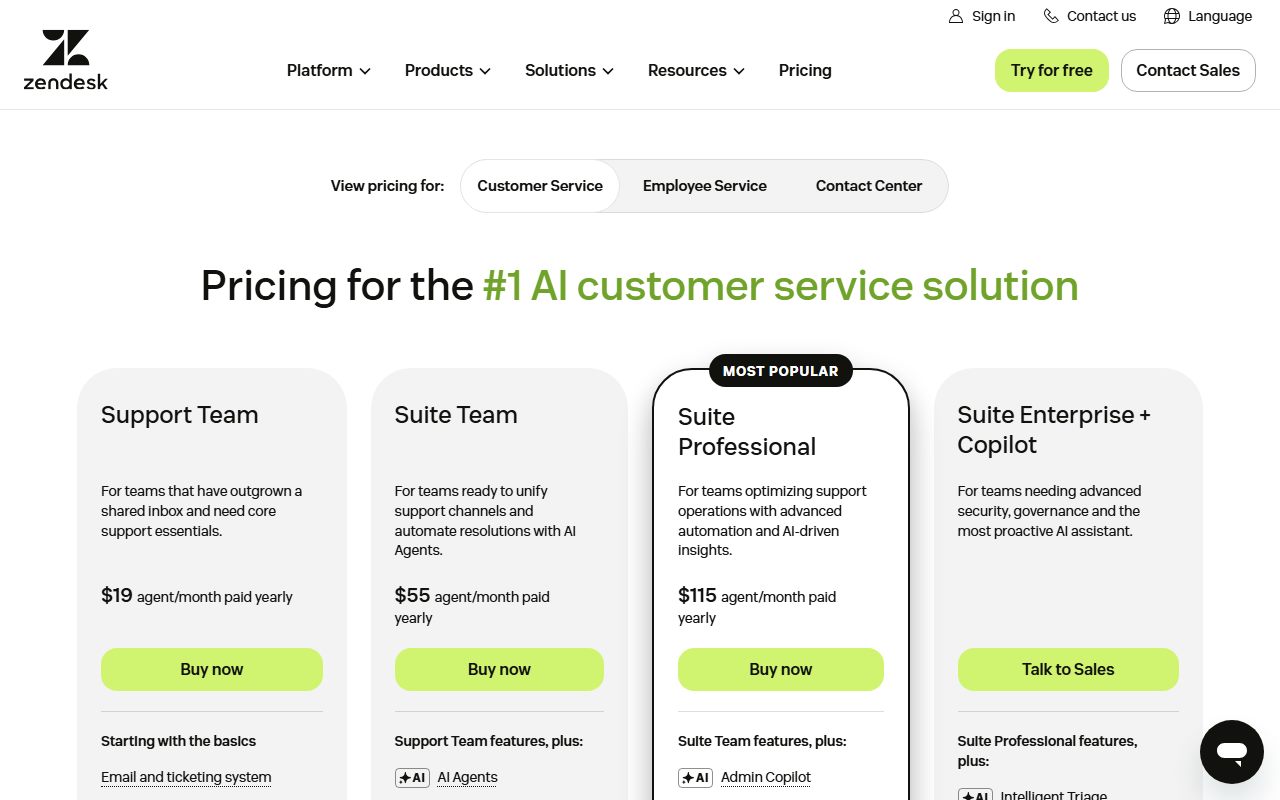
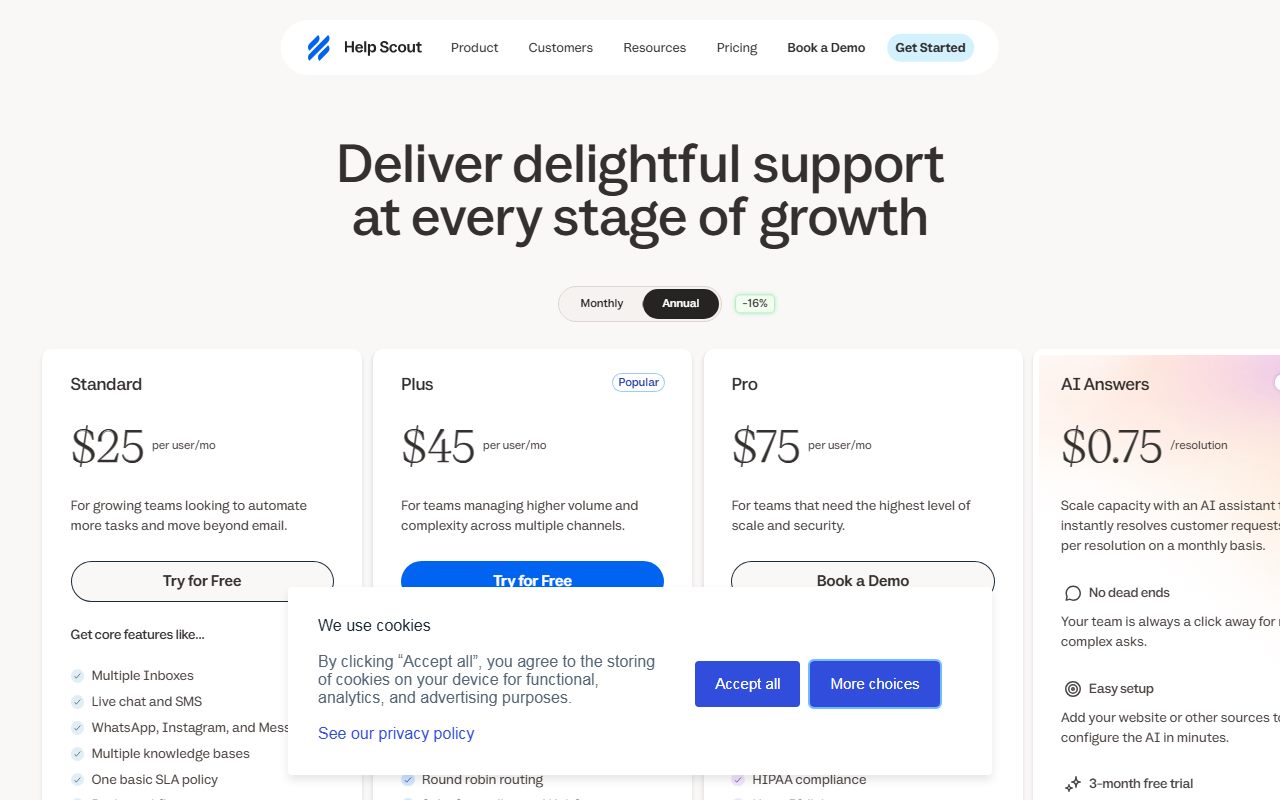
| Cheapest paid tier, per person per month | Support Team $19 paid yearly, $25 monthly | Standard, displayed at $25 |
| Middle tier | Suite Team $55 paid yearly | Plus, displayed at $45 |
| Top printed tier | Suite Professional $115 paid yearly | Pro, displayed at $75, unlimited users with a minimum of 10 |
| Tier with no price | Suite Enterprise + Copilot: Talk to Sales | None; Pro is trialled through sales but priced |
| Billing terms printed | Both for Support Team only, $19 against $25; badge reads 20% off annual | Displayed rates only; badge reads Annual -16% with no discounted figures in the markup |
| Phone or voice in the product | Telephony from Suite Team; IVR phone tree from Suite Professional; Contact Center add-on $83 | Via integration on all three paid tiers |
| Live chat and messaging | From Suite Team, $55 | From Standard, displayed at $25 |
| WhatsApp, Instagram, Messenger | Messaging and social channels from Suite Team | All three included on all three paid tiers |
| Free collaborator seats | Light agents add-on, no price and no quantity printed | Light users: 5 included on Plus, 15 on Pro, maximums 25 and 50 |
| AI billing unit | Automated resolution: 5 per agent a month included, up to 10k a year | AI Answers resolution, charged only when the customer does not escalate |
| AI unit price | $1.50 committed, $2.00 pay-as-you-go | $0.75 per resolution |
| AI spending control | None printed | Monthly cap that disables AI Answers automatically |
| Free AI to start | Copilot included during the 14-day trial | 3 months of free unlimited AI Answers resolutions |
| App directory printed | 1,800+ in the navigation; 1,000+ in the feature table | Access to 100+ apps; free plan limited to 1 |
| API limits printed | Add-on raises the rate limit to 2,500 requests a minute, 10+ agents required | 200 / 400 / 800 calls a minute by tier |
| Named add-on prices | Copilot $50 per agent a month on Professional and higher; Workforce Engagement $50; Contact Center $83 | Extra Inbox $10 a month paid annually; extra Docs site $20 |
| HIPAA | HIPAA enabled through a Business Associate Agreement; some restrictions apply | Add-on on Plus; included on Pro |
| Single sign-on | Not printed per tier on the page we read | Add-on on Standard and Plus; included on Pro |
| Trial | 14 days, Suite Professional with Copilot included | 15 days on Standard or Plus, no credit card; Pro through sales |
| Support stated on the page | Digital support during your business hours for highest severity issues; Premier plans for 24/7 as an unpriced add-on | Standard support on free, Priority on all three paid; onboarding specialist included on Pro |
| Uptime figure | 99.95% SLA, scoped to call usage only | 99.99% in the footer, beside the status page link |
| 10 people, 12 months, cheapest working desk | $2,280 on Support Team, email ticketing only | $3,000 on Standard, five channels included |
| 10 people, 12 months, tier with chat and social | $6,600 on Suite Team | $3,000 on Standard |
| Ease / Features / Value / Support | 3.4 / 4.7 / 2.9 / 3.4 | 4.6 / 3.7 / 3.9 / 3.8 |
The short answer
Help Scout wins 3 rounds to 2. It takes onboarding, pricing and support. Zendesk takes core workflow and integrations.
Read the bullets before the scorecard. Zendesk's two rounds are the heaviest in the set for one specific kind of desk.
- Zendesk is best for support organisations that answer telephone calls inside the help desk, route across four or more channels, and can fund $55 or $115 per agent per month plus a metered AI line
- Help Scout is best for teams of 2 to 50 on email, chat and social who want a free plan to start on, every quota printed, and the cheapest AI unit price in this cluster
- Winner on rounds: Help Scout takes onboarding, pricing and support; Zendesk takes core workflow and integrations
- Disclaimer: this is a documentation review. Scores come from the two pricing pages read on October 20, 2026, not from staged demos
Round 1, onboarding: Help Scout has no deadline and Zendesk has fourteen days
Help Scout wins, and the gap is the widest of the three help desk duels on this site.
Help Scout publishes a free plan: 5 users, 1 Inbox, 1 Docs site, 100 contacts a month, 10 saved replies, 10 tags, 10 articles and 30 days of reporting history. It does not expire.
Above it, Standard and Plus carry a 15-day trial with no credit card, and every new account gets 3 months of free unlimited AI Answers resolutions.
Zendesk has no free plan. Its trial is 14 days with every feature on Suite Professional and the Copilot add-on switched on by default, which is more product than Help Scout puts in front of a trial user.
The round is not scored on trial generosity. It is scored on how much stands between a new account and a working queue, and whether the reader can confirm fit before paying.
Zendesk's price card adds to the deduction. One of its four tiers carries no number at all, and only Support Team showed both billing terms in the markup we read.
Two Zendesk statements about the same startup programme also disagree: the navigation offers up to 2 years free for qualified startups, while a block on the same page describes a 6-month trial for up to 50 agents.
Round to Help Scout. How a duel is scored sets out why a free plan containing the core behaviour outranks a richer countdown.
Round 2, core workflow: Zendesk owns the telephone and Help Scout rents it
Zendesk wins, and this is the round that sells the product.
Suite Team at $55 per agent per month paid yearly lists telephony, messaging and live chat, omnichannel routing, an AI knowledge base, AI agents and action builder in one tier. Suite Professional at $115 adds skills-based routing and an IVR phone tree.
Help Scout's feature table marks phone and voice as via integration on Standard, Plus and Pro. There is no tier at which calls are native. Its Aircall row is an add-on on Standard and Plus, with preferred pricing on Pro.
For a desk whose customers dial a number, that single row decides the purchase, and no amount of printed quota compensates.
Help Scout wins the rows below voice, and wins them at a lower price. Live chat, WhatsApp, Instagram and Messenger are all included on Standard, displayed at $25 per user per month. Zendesk's equivalent set starts at Suite Team, $55.
It also prints the automation depth Zendesk mostly leaves unquantified: 150 basic workflows on Standard, 500 advanced on Plus, unlimited on Pro, with one, two and unlimited SLA policies alongside.
Above the voice line Zendesk is deeper again. Its unpriced Suite Enterprise card lists intelligent triage, auto assist, generative AI for voice, approval workflows, a sandbox and department spaces.
Round to Zendesk on channel depth, with the note that it costs $30 more per person per month to reach the chat and social tier that Help Scout sells at $25. Our all-in-one versus best-of-breed duel is the argument underneath this round.
Round 3, integrations: an order of magnitude, counted twice
Zendesk wins on the published numbers even though its own page cannot agree on them.
The Zendesk navigation reads Find 1,800+ apps, partners, and integrations. A feature row lower on the same page reads Tap into 1,000+ prebuilt apps and integrations available from the Zendesk Marketplace. Both strings were there on October 20, 2026.
Help Scout prints access to 100+ apps. Even against Zendesk's lower figure that is an order of magnitude smaller.
Help Scout also gates the apps a growing team asks for. The free plan is limited to 1 integration. Salesforce and Jira are marked absent on Standard and present from Plus.
What Help Scout publishes better is the ceiling on using them: API access at 200, 400 and 800 calls a minute by tier.
Zendesk's page sells an API volume add-on raising the limit to 2,500 requests a minute, noting 10+ agents are required, without printing a price. Its action builder row reads up to 40K actions a month on the Support Team column.
Round to Zendesk, with the deduction that a vendor giving two counts for its own marketplace on one page has told you something about how carefully that page is maintained.
Round 4, pricing: Help Scout sells the channel tier for less than half
Help Scout wins, and the margin depends entirely on which tier you compare.
Zendesk has the single cheapest line in the duel: Support Team at $19 per agent per month paid yearly, which is $2,280 a year for ten agents by our arithmetic. That tier is email ticketing with routing, dashboards, pre-written responses and automations, and nothing else.
The moment a chat widget is required, Zendesk moves to Suite Team at $55, which is $6,600 a year for ten agents. Help Scout sells chat, WhatsApp, Instagram and Messenger on Standard, $3,000 a year for ten people at the displayed rate.
That is $3,600 a year less for the same channel coverage, by our arithmetic from figures displayed on October 20, 2026. At the top printed tier it is $9,000 on Help Scout Pro against $13,800 on Suite Professional.
The AI line runs the same way. Help Scout charges $0.75 per AI Answers resolution and lets a team set a monthly spending cap that disables the feature rather than overspending.
Zendesk includes 5 automated resolutions per agent per month, then charges $1.50 committed or $2.00 pay-as-you-go, with no cap printed. For ten agents the included allowance is 50 resolutions a month.
A desk automating 500 issues a month buys 450 extra from Zendesk at $675 a month committed, or $8,100 a year. The same 500 on Help Scout is $375 a month, or $4,500 a year.
Neither page is clean about billing terms. Zendesk printed both for only one tier.
Help Scout's Annual -16% badge had no discounted figures in the markup we read; a 16% cut would be $21.00, $37.80 and $63.00 by our arithmetic. Our annual versus monthly billing duel covers both.
Round to Help Scout.
Round 5, support: Help Scout prints a level per tier and Zendesk sells 24/7 separately
Help Scout wins, narrowly, and both pages leave a response time unstated.
Help Scout's feature table prints a support row by tier: Standard support on the free plan, Priority on all three paid plans. An onboarding specialist is an add-on on Plus and included on Pro.
One line needs checking at purchase. The Pro card lists a strategic account manager, while the table's customer success manager row is marked as an add-on in its last column.
Zendesk's page carries a support and services block. Digital support is described as access to customer support during your business hours for your highest severity or business-impacting issues.
Anything beyond business hours is a separate purchase: Premier plans for 24/7 proactive support and engagement, with no price printed anywhere on the page.
On uptime, Zendesk's 99.95% is the only figure here framed as an SLA, but it is scoped to call usage and paid as usage credit rather than covering the desk. Help Scout's 99.99% sits in the footer as a status figure with no SLA language.
So one vendor publishes a tiered support level in the seat price, and the other publishes a business-hours floor with the real coverage sold on request.
Round to Help Scout. Get any response-time commitment into the contract from either vendor.
The seat maths at 5, 10 and 25 people
Editorial calculations from the figures displayed on the two pricing pages on October 20, 2026, for twelve months, excluding tax, call minutes, add-ons and purchased AI usage. They are not quotes.
- 5 people, cheapest working desk: Help Scout Free $0; Zendesk Support Team $1,140
- 10 people, email ticketing only: Zendesk Support Team $2,280; Help Scout Standard $3,000
- 10 people, with chat and social channels: Help Scout Standard $3,000; Zendesk Suite Team $6,600
- 10 people, top printed tier: Help Scout Pro $9,000; Zendesk Suite Professional $13,800
- 25 people, with chat and social: Help Scout Standard is capped at 25 users, $7,500; Zendesk Suite Team $16,500
- 25 people, top printed tier: Help Scout Pro $22,500; Zendesk Suite Professional $34,500
- 10 agents plus Zendesk Copilot at $50 per agent: another $6,000 a year, and Copilot is sold on Professional and higher
- 10 agents plus Zendesk Contact Center at $83 per agent: another $9,960 a year before call minutes
Where each vendor hides the rest of the invoice
Neither headline rate is the whole bill, and the two vendors add to it in different shapes.
Zendesk adds per agent. Copilot is $50 per agent per month paid yearly, and its own block says it can be added to Professional and higher plan levels.
The Workforce Engagement Bundle is another $50 and Contact Center is $83. So a ten-agent desk that wants intelligent triage is at Professional, $13,800 plus $6,000 a year.
Help Scout adds per object, and the objects are small. An extra Inbox is $10 a month paid annually or $12 monthly. An extra Docs site is $20 or $24.
Its tiers include 2, 5 and 10 Inboxes, so a team with four product lines on Standard pays roughly $240 a year more by our arithmetic, not another seat line.
Zendesk's extras scale with headcount; Help Scout's scale with the number of things you support.
One Zendesk add-on has no price at all. Light agents, its answer to a read-only collaborator seat, is sold as an add-on whose feature row refers to Suite Growth and above plans.
No Suite Growth card appears on the page. Our shared-login versus seat-per-person duel covers why that row matters.
What users report
We have not compiled a dated sample of G2, Capterra or Reddit reports for either product, and this duel does not summarise impressions we have not collected.
Both pages print their own claims instead. Zendesk's footer says 80,000+ companies choose Zendesk. Help Scout's navigation says 80% of customers stay for 4+ years.
Those are vendor statements about vendor products, read on October 20, 2026. No round is scored on them.
When a sourced sample exists, the Zendesk review and the Help Scout review will carry it.
Choose Zendesk if
Four conditions point to Zendesk.
- Customers reach you by telephone, which is native from Suite Team at $55 and extended with an IVR tree at $115, while Help Scout offers voice only via integration
- You route across four or more channels and need one routing engine across all of them
- Your stack is wide, where 1,000 or 1,800 prebuilt apps beats 100 even allowing for the contradiction
- You are buying a ladder you will climb, through skills-based routing, approval workflows, a sandbox and department spaces
Choose Help Scout if
Four conditions point to Help Scout.
- You are five people or fewer, where the free plan costs nothing and has no deadline
- Your channels are email, chat and social, all of which arrive at $25 per user per month rather than $55
- You need the AI bill to be predictable, at $0.75 per resolution with a monthly cap that shuts the feature off
- You want every plan quota printed before you commit, from Inboxes and Docs sites to workflows, SLA policies and reporting history
Frequently asked
Short answers to the questions people type into a search box, with the date they were read.
Bottom line
Help Scout wins 3-2 on the rounds most small desks weigh most: a free start, a lower bill at the tier that carries their channels, and a support level printed per tier.
For ten people with chat and social, it is $3,000 a year against $6,600 on Suite Team, by our arithmetic from the displayed figures. Its AI unit is half the price and comes with a spending cap.
Zendesk wins the two rounds that cannot be bought back later. A native phone channel at $55 and a marketplace an order of magnitude larger are not things a growing desk can approximate with integrations.
So the duel inverts on one question. If customers call you, the scorecard is advisory and Zendesk is the answer. If they do not, Help Scout does the same job for less than half and tells you more about what you are buying.
Teams wanting a cheaper email-only ladder should read the Freshdesk review, which prints all three tiers in both billing terms. All figures checked October 20, 2026.
Frequently asked
Is Zendesk or Help Scout cheaper for 10 people?
Zendesk, only if you need email ticketing alone: Support Team is $2,280 a year against Help Scout Standard at $3,000, by our arithmetic from the displayed figures on October 20, 2026. Once chat and social matter, Zendesk moves to Suite Team at $6,600 and Help Scout stays at $3,000.
Does Help Scout do phone support?
Not natively. Its feature table marks phone and voice as via integration on Standard, Plus and Pro, with Aircall an add-on on the first two and preferred pricing on Pro. Zendesk lists telephony natively from Suite Team at $55 per agent per month and an IVR phone tree at Suite Professional.
Which one has a free plan?
Help Scout. Its free plan covers 5 users, 1 Inbox, 1 Docs site, 100 contacts a month, 10 saved replies, 10 tags, 10 articles and 30 days of reporting, with no deadline. Zendesk published no free plan on October 20, 2026, only a 14-day Suite Professional trial with Copilot included.
Which AI is cheaper to run?
Help Scout's, on both price and predictability. AI Answers is $0.75 per resolution with an optional monthly spending cap. Zendesk includes 5 automated resolutions per agent per month, then charges $1.50 committed or $2.00 pay-as-you-go, and prints no cap. For 500 a month that is $4,500 against $8,100 a year.
Can I switch from Zendesk to Help Scout?
Help Scout's page names Zendesk only in a Switch to Help Scout footer link, and neither page describes what an import carries. Treat the migration as an unanswered question until you ask. The free plan and the 15-day no-card trial let a team run both desks side by side first.
Is Zendesk worth the extra money for a 10-person team?
Only if calls or four-plus channels are part of the job. For email, chat and social, Suite Team at $6,600 a year buys the same coverage Help Scout Standard provides at $3,000, by our arithmetic. The difference buys native voice, omnichannel routing and a far larger app directory.
Which page is more complete?
Help Scout's, by some distance on quotas, and neither is complete on billing. Help Scout prints Inboxes, Docs sites, workflows, SLA policies, user caps and API limits as numbers. Zendesk leaves one of four tiers unpriced and printed monthly rates for only one tier in the markup we read.
Visit Zendesk Suite
We have no affiliate relationship with this vendor. Link goes to the official site.
Visit Help Scout
We have no affiliate relationship with this vendor. Link goes to the official site.