 Feature

Help Scout
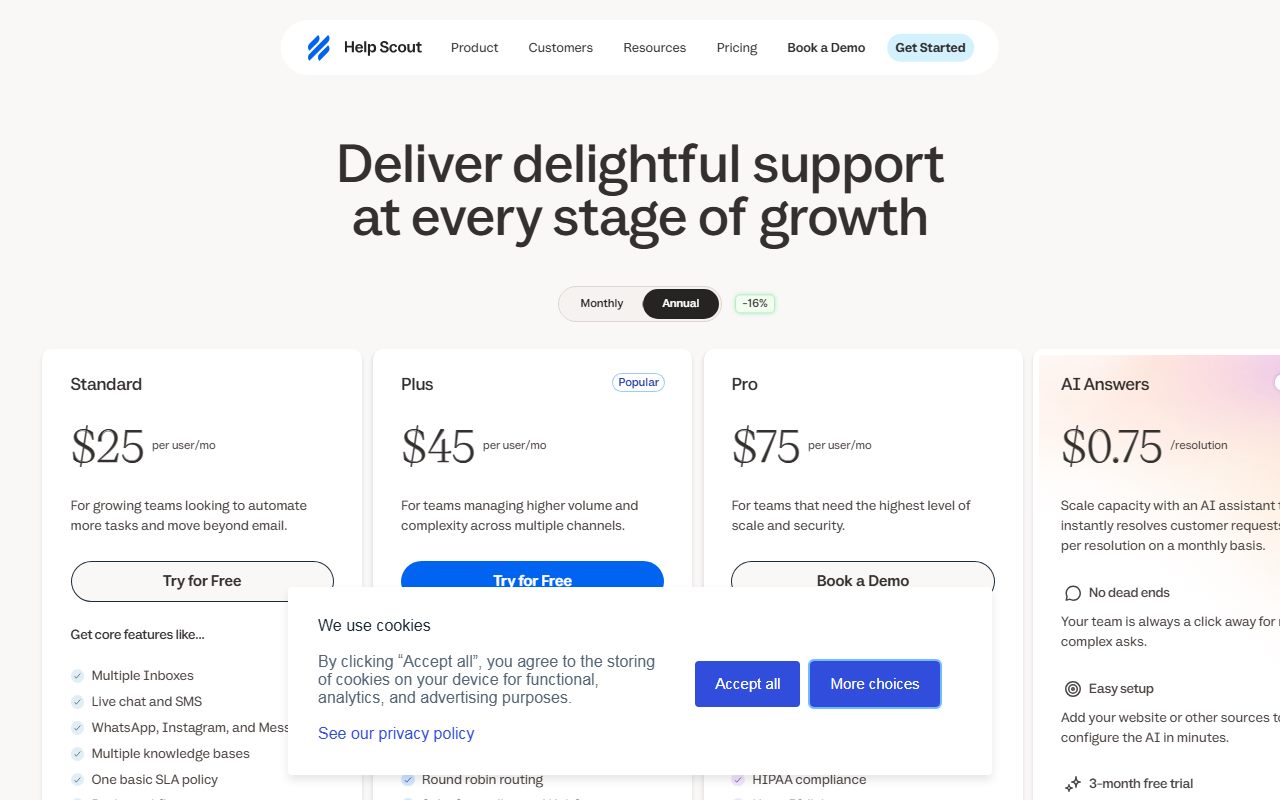
A free plan for five users, three paid tiers displayed at $25, $45 and $75 per user per month, and a comparison table that gives a number for almost every quota including a ten-user minimum on the top tier
Scored on the published rubric, from documentation, pricing and verified user reports.
Best for: Support teams of 1 to 25 whose work is email, live chat, a help centre and social messaging, and who would rather have every plan limit printed as a number than have a channel they will not switch on.
Verdict
Help Scout is the smallest-feeling desk in this cluster and the one whose pricing page hides the least. This is a documentation review: scores come from the Help Scout pricing page read on October 14, 2026, not from staged demos. A free plan covers up to 5 users with 1 Inbox, 1 Docs site, 100 contacts a month, 10 saved replies, 10 tags, 10 articles and 30 days of reporting history. Three paid tiers are displayed at $25, $45 and $75 per user per month. What sets this page apart is the comparison table, which gives a figure for nearly every quota a buyer would otherwise discover after signing: user caps of 5, 25 and 50 with Pro listed as unlimited but minimum 10; inboxes of 1, 2, 5 and 10 with additional inboxes at $10 a month; Docs sites of 1, 2, 3 and 5 with extras at $20; workflows of 150 basic, 500 advanced and unlimited; SLA policies of one basic, two advanced and unlimited; API rates of 200, 400 and 800 calls a minute. The gaps are also clear. SSO and SAML are add-ons until Pro at $75. HIPAA is an add-on below Pro. Standard caps at 25 users, so a growing desk changes tier for headcount rather than for features. And the billing-term reading is ambiguous: the Annual toggle carries the active state in the page markup while the page's own structured data labels $25 as a monthly figure. We print both and tell buyers to confirm at checkout.
Visit Help Scout
We have no affiliate relationship with this vendor. Link goes to the official site.
Where it is strong
- A free plan for up to 5 users with 1 Inbox and 1 Docs site, with every free-tier limit printed as a number
- The comparison table gives a figure for almost every quota: users, inboxes, Docs sites, articles, workflows, SLA policies, light users, API rate and reporting history
- Light users are included and counted, 5 on Plus and 15 on Pro, with stated maximums of 25 and 50, so collaborators do not need full seats
- Workflow quotas are published rather than described: 150 basic on Standard, 500 advanced on Plus, unlimited advanced on Pro
- A 15-day trial of Standard or Plus with no credit card, and a separate 3-month free trial of unlimited AI Answers resolutions
- The AI add-on bills at $0.75 per resolution and the page explains both how a resolution is counted and that a monthly spending cap can be set
- Published discount programmes for non-profits, B Corporations and early-stage startups
Where it falls short
- SSO and SAML are marked as an add-on on Standard and Plus and only included on Pro at $75 per user per month
- HIPAA compliance and IP restrictions are add-ons below Pro, and the page does not print their prices
- Pro is listed as unlimited users but with a stated minimum of 10, which puts a floor of $9,000 a year on it by our arithmetic
- Standard caps at 25 users and Plus at 50, so headcount alone can force a tier change
- The billing term behind the displayed figures is ambiguous: the Annual toggle is active in the markup while the structured data labels $25 as monthly
- The monthly per-user figures were not in the markup we read on October 14, 2026, so only the add-on pair of $10 against $12 shows the gap
- The page prints 100+ integrations, the smallest directory in this cluster, and the free plan is limited to 1 integration
- Phone and voice are only ever via integration, and SMS is via integration below Standard
At a glance
| Starting price | $0 for up to 5 users; Standard displayed at $25/user/mo; Plus $45; Pro $75 |
|---|---|
| Pricing note | Free for up to 5 users, then Standard displayed at $25/user/mo, Plus $45 and Pro $75 with a stated minimum of 10 users (pricing page, checked October 14, 2026) |
| Free plan | Yes: 5 users, 1 Inbox, 1 Docs site, 100 contacts a month, 10 saved replies, 10 tags, 10 articles, 30-day reporting history |
| Seat minimum | None below Pro; Pro is listed as unlimited users with a minimum of 10 |
| User caps | Free up to 5; Standard up to 25; Plus up to 50; Pro unlimited |
| Trial | 15 days on Standard or Plus with no credit card; Pro trial via sales; 3 months of free AI Answers |
| AI metering | AI Answers $0.75 per resolution, charged only when the customer does not escalate or ask again; monthly spend cap available |
| Add-on prices | Extra Inbox $10/mo paid annually or $12 monthly; extra Docs site $20/mo annually or $24 monthly |
| Integrations | Access to 100+ apps; free plan limited to 1; API 200, 400 or 800 calls per minute by tier |
| Published uptime | No uptime commitment on the pricing page; the footer shows 99.99% beside a link to the status page |
What Help Scout actually is
Help Scout is a shared inbox with a help centre attached, sold as four tiers on one page. The product set named on the page is Inbox, Docs sites for knowledge bases, Beacon for an embeddable help widget, Messages for in-app messaging, and an AI layer split between in-plan assistants and a metered AI Answers chatbot.
That makes it the best-of-breed corner of this cluster. It does not sell a contact centre, a workforce management bundle or a CRM alongside the desk, which is the trade our all-in-one versus best-of-breed duel exists to score.
This review scores Help Scout on the five fixed rounds used across the site: onboarding, core workflow, integrations, pricing and support. The method is in how a duel is scored. Every figure below came off the pricing page on October 14, 2026, in US dollars.
Who Help Scout is best for
The published caps define the fit more sharply than the feature list does. Read the list first.
- Teams of 5 or fewer that want a working shared inbox and a help centre at no cost
- Support teams of 6 to 25 whose channels are email, live chat, a help centre and social messaging
- Teams that want to know every quota, user cap, inbox count and workflow limit before paying
- Desks where engineers or managers need to read and comment but not own tickets, covered by counted light users
- Teams testing an AI chatbot who want a per-resolution price and a spending cap rather than a credit meter
- Non-profits, B Corporations and early-stage startups, each named in a published discount programme
Who should skip it
Three profiles will hit a wall that is published rather than hidden, which does not make it less of a wall.
- Teams with a single sign-on mandate below Pro, where SSO is an add-on with no printed price
- Desks handling protected health information outside the top tier, where HIPAA is also an add-on
- Teams expecting to pass 25 users on Standard or 50 on Plus within the year
What each plan costs as of October 2026
Four tiers appear. The free plan is described twice on the page, both times as 5 users, 1 Inbox and 1 Docs site.
Standard is displayed at $25 per user per month and covers multiple inboxes, live chat and SMS, WhatsApp, Instagram and Messenger, multiple knowledge bases, one basic SLA policy, basic workflows, unlimited tags and saved replies, and an AI Inbox assistant.
Plus is displayed at $45 and is marked Popular. It adds advanced workflows, two advanced SLA policies, a secure customer portal, unlimited AI Drafts, round-robin routing, Salesforce, Jira and HubSpot connectors, internal teams and company grouping.
Pro is displayed at $75. It adds unlimited workflows and SLA policies, multiple routing types, SSO and SAML, HIPAA compliance, up to 50 light users, a dedicated onboarding specialist, a strategic account manager and preferred Aircall pricing.
AI Answers sits beside them as an add-on at $0.75 per resolution. Our annual versus monthly billing duel matters more than usual here, for the reason in the next section.
Which billing term the displayed prices belong to is not clear
We read the page two ways and both readings were in the same markup, so we print both.
Reading one. The toggle holds a Monthly button and an Annual button, and in the markup we read the Annual button carries the active class. A badge reading -16% sits beside it. On that reading, $25, $45 and $75 are the annual-billing rates and monthly billing costs more.
Reading two. The page's own structured data describes the Standard offer at a price of 25 US dollars with a one-month billing period, with no separate annual offer. On that reading $25 is simply the monthly rate.
The only place the page prices both terms is an add-on. The FAQ states an additional Inbox is $10 a month paid annually or $12 a month, and an additional Docs site is $20 paid annually or $24 a month. Both pairs are 20% apart, not 16%.
We did not find per-user monthly figures in the markup on October 14, 2026. We are not saying Help Scout does not publish them, only that we could not read them that day. Confirm the term and the rate at checkout.
The quota table is the real product here
No other pricing page in this cluster prints this many numbers, and for a buyer it is worth more than a feature bullet.
Users: up to 5 free, up to 25 on Standard, up to 50 on Plus, unlimited on Pro with a minimum of 10. Inboxes: 1, 2, 5 and 10, with stated maximums of 1, 20, 50 and unlimited, and additional inboxes at $10 a month. Docs sites: 1, 2, 3 and 5, extras at $20 a month.
Workflows: 150 basic on Standard, 500 advanced on Plus, unlimited advanced on Pro. SLA policies: one basic, two advanced, unlimited. Reporting history: 30 days free, 2 years on Standard, all-time on Plus and Pro. API: 200, 400 and 800 calls a minute. Beacon widgets: 1, 5, unlimited, unlimited.
Free-plan limits are equally explicit: 100 contacts a month, 10 saved replies, 10 tags, 10 articles and a limit of 1 integration.
That is the opposite of how the other two pages in this cluster behave, and it is the main reason this review scores onboarding highest of the three.
The seat maths at 3, 5, 10 and 25 users
Editorial calculations from the displayed figures on October 14, 2026, for 12 months, excluding tax, extra inboxes, extra Docs sites and purchased AI resolutions. They are not quotes.
- 3 users: Free $0; Standard $900; Plus $1,620
- 5 users: Free $0; Standard $1,500; Plus $2,700; Pro not available, 10-user minimum
- 10 users: Standard $3,000; Plus $5,400; Pro $9,000 at the stated minimum
- 25 users: Standard $7,500 at its 25-user cap; Plus $13,500; Pro $22,500
- Any tier plus two extra inboxes at $10 a month: another $240 a year
- A desk resolving 300 conversations a month with AI Answers at $0.75: $2,700 a year by our arithmetic
- The same desk inside its first three months: $0, per the 3-month unlimited AI trial
Onboarding: the best in the cluster, by a clear margin
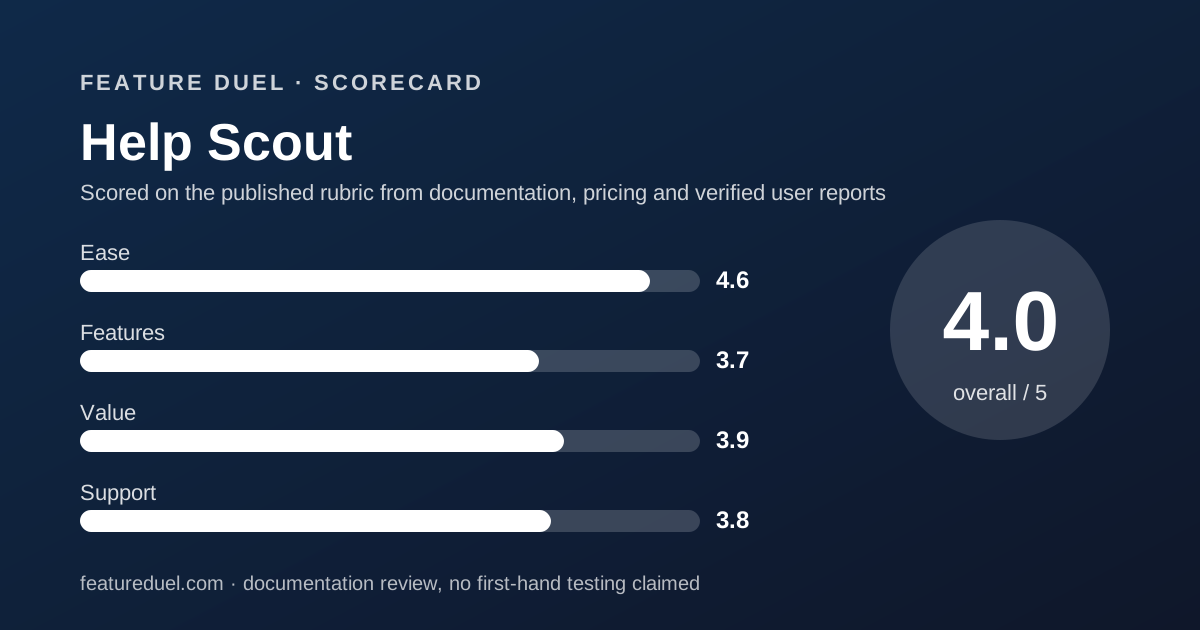
4.6 out of 5, the highest onboarding score this site has given a help desk.
The free plan is a working desk, not a demo. Five users, a shared inbox, a Docs site, saved replies, tags and 30 days of reporting let a small team run real tickets with no deadline and no card. The trial on Standard or Plus is 15 days, also with no card, and AI Answers is free and unlimited for the first three months of an account.
The quota table removes the usual post-purchase surprise. A buyer who reads it knows the user cap, the inbox count, the workflow quota and the API rate before paying.
Two deductions. Pro cannot be trialled without talking to sales. And the billing-term ambiguity described above means the one number a buyer most needs, the per-user monthly cost, is the one the page is least clear about.
Core workflow: the narrowest feature set, deliberately
3.7 out of 5, the lowest core workflow score in this cluster, and the gap is channels and routing rather than craft.
What is here is coherent. Email, live chat, Messenger, Instagram and WhatsApp from Plus. SLA policies that escalate from one basic to unlimited. Workflows that escalate from 150 basic to unlimited advanced. Round-robin routing on Plus and round-robin with load balancing on Pro. Custom fields capped at 10 per conversation and customer properties at 50, both printed.
What is missing matters for larger desks. Phone and voice are marked via integration at every tier. SMS is via integration below Standard. There is no skills-based routing row, no IVR, no sandbox, no audit log and no approval workflow for help-centre articles.
The AI split is clean: AI Assist, AI Drafts and AI Summarize are unlimited and in-plan; only the customer-facing AI Answers chatbot is metered. Several platform rivals meter the agent-facing assistants too, a pattern our monday.com review found in work management as well.
Integrations: the smallest directory, honestly counted
3.4 out of 5. The page prints Access to 100+ apps and Connect to 100+ tools, and it prints the same figure in both places, which is more than one rival in this cluster manages.
Named connectors in the table are Salesforce, HubSpot, Jira, Linear and Aircall, with Salesforce, HubSpot, Jira and Linear on Plus and above, and Aircall an add-on below Pro where it becomes preferred pricing. Custom apps and API access are available across paid tiers, with the API rate limit printed per tier at 200, 400 and 800 calls a minute. Webhooks and OAuth apps are listed. The free plan is limited to 1 integration.
Against Zendesk's printed 1,000+ or 1,800+ and a Freshdesk page that prints no count at all, 100+ is the smallest directory with a number attached. For a desk whose stack is email, a CRM and an issue tracker, 100 covers it. For a desk that needs a warehouse connector, check by name before buying.
Pricing: mid-range rates, published mechanics
3.9 out of 5. The rates are not the cheapest in this cluster and the mechanics are the clearest.
Ten users on Standard is $3,000 a year by our arithmetic, against $2,280 for the cheapest working tier at either rival. The premium buys published quotas and a free tier that runs indefinitely.
The mechanics are where this page earns the score. Extra inboxes and Docs sites have prices. Light users are included and counted rather than sold. AI is billed per resolution with a stated definition and a spending cap, and the page says a resolution is not charged if the customer escalates or asks again. Payment instruments are named, with wire or ACH available on some annual payments.
Two deductions. The 10-user minimum on Pro means the top tier starts at $9,000 a year whatever the headcount. And the per-user monthly rate is the figure the page leaves ambiguous. Our shared-login versus seat-per-person duel is the right companion read, because counted light users are the most honest answer to shared logins we have seen on a pricing page in this cluster.
Support: the clearest channel ladder of the three
3.8 out of 5, the highest support score in this cluster, and it is a low bar.
The table prints a support row: email on the free plan, Standard support on Standard, and Priority support on Plus and Pro. An onboarding specialist is an add-on below Pro and included on Pro. A customer success manager is an add-on below Pro and included on Pro. That is more than either rival prints.
No response time appears, at any tier. No uptime commitment appears on the pricing page either. The footer shows 99.99% next to a link to the status page, which is a status indicator rather than a contractual figure, and we do not treat it as an SLA.
The page also names its discount programmes, Help Scout for Good for non-profits and B Corporations and a startup plan for early-stage companies, which is unusual to find on a pricing page rather than buried in a form.
What verified users report
This review is built from vendor documentation. We have not yet compiled a dated sample of G2, Capterra or Reddit reports for Help Scout, and we will not summarise impressions we have not collected. This section will carry sourced, dated findings when that sample exists.
One vendor claim on the page is worth flagging as a claim rather than evidence: a navigation blurb states that 80% of customers stay for 4+ years. The page gives no method, sample or date for that figure, so we report it as published and do not score on it.
The useful questions for other teams are the AI resolution rate they actually saw, what the SSO add-on cost on Standard or Plus, and whether 150 basic workflows was enough.
Limits stated by the vendor
Printed on the page, checked October 14, 2026, in US dollars: free plan 5 users, 1 Inbox, 1 Docs site, 100 contacts a month, 10 saved replies, 10 tags, 10 articles, 30-day reporting, 1 integration.
Also printed: Standard $25, Plus $45, Pro $75 per user per month as displayed; user caps 25, 50 and unlimited with a 10-user minimum on Pro; inboxes 2, 5 and 10; Docs sites 2, 3 and 5; extra inbox $10 annually or $12 monthly; extra Docs site $20 or $24; workflows 150, 500 and unlimited; SLA policies 1, 2 and unlimited; light users 5 and 15 with maximums 25 and 50; API 200, 400 and 800 calls a minute; AI Answers $0.75 per resolution with an average resolution rate stated as 73%; 15-day trial; 3 months of free AI Answers.
Not printed: per-user monthly rates, the price of the SSO, HIPAA, IP restriction, onboarding specialist or CSM add-ons, any support response time, and any uptime commitment.
Alternatives
The two other help desks read the same day are named here from their own pricing pages, not from any claim of use. Neither has a review on this site yet.
Freshdesk prints Growth at $19, Pro at $55 and Enterprise at $89 per agent per month billed annually, with monthly equivalents in the markup, and marks SAML single sign-on present on all three tiers. Choose it if SSO is mandatory and the budget cannot stretch to a $75 tier.
Zendesk prints Support Team at $19, Suite Team at $55 and Suite Professional at $115 per agent per month paid yearly, with the top tier unpriced, and includes telephony from Suite Team. Choose it if the desk answers phone calls.
Otherwise choose Help Scout when the team is small, the channels are text, and knowing the limits in advance is worth $6 a seat. For teams whose real problem is task tracking rather than tickets, our Asana review, our ClickUp review and the ClickUp versus Asana duel are the better starting point.
Bottom line
Help Scout wins the onboarding and support rounds of this cluster and loses core workflow. A free plan for five users with every limit printed, a 15-day no-card trial, and a comparison table that gives a number for users, inboxes, workflows, SLA policies and API rate make it the easiest page in the cluster to buy from without a surprise.
Ten users on Standard is $3,000 a year by our arithmetic, roughly $700 above the cheapest working tier from either rival, and that premium buys published quotas rather than extra channels. Two conditions should stop you: a single sign-on mandate, which costs an unpriced add-on until the $75 tier, and customers who phone. All figures checked October 14, 2026.
Buy it if
- Your team is 5 or fewer and you want a real shared inbox at no cost, which the free plan covers with 1 Inbox and 1 Docs site
- You want every plan limit as a number before you buy, which this page does better than either rival in the cluster
- Your collaborators only need to read and comment, since light users are included and counted rather than sold as full seats
- Your channels are email, live chat, a help centre and social messaging, all of which Standard covers at the displayed $25
Skip it if
- Single sign-on is a security requirement, because SSO and SAML are add-ons until Pro at the displayed $75 per user
- You handle protected health information below the top tier, since HIPAA compliance is an add-on with no printed price under Pro
- You expect to pass 25 or 50 users soon, as the caps rather than the features will decide your tier
- Your customers phone you, because voice appears on this page only as an integration
Frequently asked
Is Help Scout free?
There is a free plan. Per the pricing page checked October 14, 2026, it covers up to 5 users with 1 Inbox, 1 Docs site, 100 contacts a month, 10 saved replies, 10 tags, 10 articles, 30 days of reporting history, email support and a limit of 1 integration. Paid tiers start at the displayed $25 per user per month.
How much does Help Scout cost for 10 people?
By our arithmetic from the displayed figures on October 14, 2026, ten users cost $3,000 a year on Standard, $5,400 on Plus and $9,000 on Pro. Pro is also where the stated 10-user minimum applies, so $9,000 is its floor rather than a figure a smaller team can reduce. These are editorial calculations, not quotes.
Are the displayed prices monthly or annual?
The page is ambiguous and we print both readings. In the markup we read, the Annual button carries the active state and a -16% badge sits beside the toggle, which suggests $25, $45 and $75 are annual-billing rates. The page's own structured data labels the same $25 with a one-month billing period. Confirm at checkout.
Does Help Scout include single sign-on?
Only on Pro. The comparison table marks SSO and SAML as an add-on on Standard and Plus and the Pro card lists SSO and SAML among its included features, alongside HIPAA compliance and up to 50 light users. The page does not print what the SSO add-on costs on the lower tiers.
What does AI Answers cost and what counts as a resolution?
The add-on is $0.75 per resolution. The page defines a resolution as one conversation closed by AI Answers without human help, and says it is not counted if the customer escalates, searches the knowledge base, asks more questions or presses the I still need help button. Only one resolution is charged per conversation.
How long is the Help Scout trial?
Fifteen days on Standard or Plus with no credit card required, per the FAQ checked October 14, 2026. A Pro trial requires talking to the sales team. Separately, a new account gets three months of free, unlimited AI Answers resolutions starting on the day the account is created.
What are light users and how many do I get?
Light users can view conversations and collaborate without taking a full seat. The table shows 5 included on Plus and 15 included on Pro, with stated maximums of 25 on Plus and 50 on Pro. Standard and the free plan show no light users in the row we read.
Sources
- Help Scout pricing page - checked October 14, 2026
- Zendesk pricing page (for cluster comparison figures) - checked October 14, 2026
- Freshdesk pricing page (for cluster comparison figures) - checked October 14, 2026
Update history
- October 14, 2026 - First published from the Help Scout pricing page as read on October 14, 2026 in US dollars. The billing term behind the displayed $25, $45 and $75 is reported both ways because the Annual toggle carries the active state in the markup while the page's structured data labels the same figures with a one-month billing period.
Visit Help Scout
We have no affiliate relationship with this vendor. Link goes to the official site.