 Feature

Ecwid by Lightspeed
Four plans from $5 to $119 per month on annual billing, a transaction fee row that reads 0 in every column, and a product ceiling of 10, 100, 2,500 and unlimited that decides the tier for you
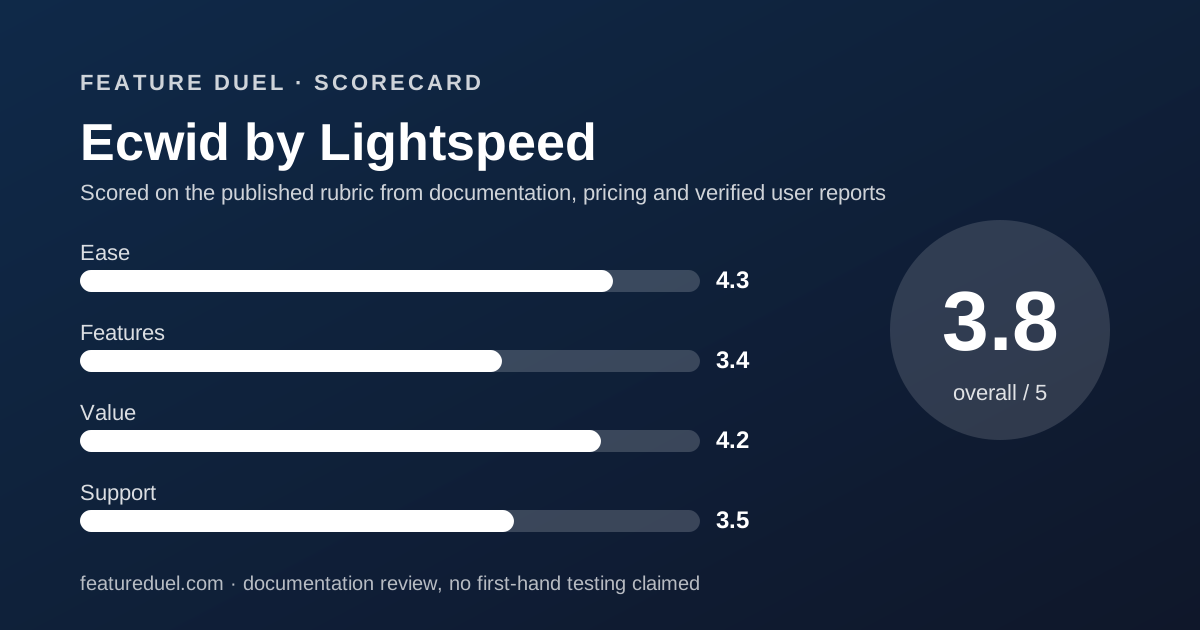
Scored on the published rubric, from documentation, pricing and verified user reports.
Best for: Small sellers who already have a website and want a cart bolted onto it, who will stay under the product ceiling on their tier, and who would rather pay a flat monthly fee than a percentage of every order.
Verdict
Ecwid is the only platform in this cluster whose pricing page prints a zero in the transaction fee row and means it. This is a documentation review: every figure comes from the Ecwid pricing page read on October 22, 2026, not from staged demos. Four plans appear under an Annual (save 16%) toggle. Starter is $5 a month, Venture $29, Business $49 and Unlimited $119, all on annual billing, with monthly rates of $5, $35, $65 and $149. The Transaction fees row reads 0 in all four columns and the FAQ confirms it: no setup or transaction fees on any of our plans. Unlimited bandwidth and storage are included at no extra cost on every tier, and all plans are month-to-month with no long-term commitments. The price of that simplicity is a catalogue ceiling. Products are capped at 10 on Starter, 100 on Venture, 2,500 on Business and unlimited only on the top plan. The caps bite deeper than the headline suggests. Starter cannot connect a domain you already own, so a $5 store lives at a company.site address. Product variations, the row that lets a garment have sizes, is marked absent on both Starter and Venture, so a clothing seller starts at Business. Staff accounts do not exist below Business, where there are 2. Buy it to avoid percentage fees. Read the row for the feature you actually need first.
Visit Ecwid by Lightspeed
We have no affiliate relationship with this vendor. Link goes to the official site.
Where it is strong
- The Transaction fees row reads 0 on all four plans, and the FAQ states there are no setup or transaction fees on any of our plans
- Starter is $5 a month, the cheapest paid entry point in this cluster by a wide margin
- Unlimited bandwidth and storage on every plan at no extra cost, per the page FAQ
- Every plan can add a store to any website and sell simultaneously on multiple sites, so the cart does not require abandoning the site you have
- All plans are month-to-month with no long-term commitments, with plan changes allowed whenever it suits you
- Ecwid is described as a PCI DSS validated Level 1 Service Provider and as working with over 70 payment providers worldwide, including PayPal and Stripe
- Registered nonprofits are offered 6 months of Venture for free
Where it falls short
- Products are capped at 10 on Starter and 100 on Venture, so the catalogue size, not the feature list, usually picks the tier
- Starter cannot connect an existing domain and cannot buy one, leaving the store on a company.site address
- Product variations are marked absent on Starter and Venture, so anything sold in sizes or colours needs Business at $49 a month
- Staff accounts show a dash on Starter and Venture, then 2 on Business and Unlimited on the top plan
- The Annual (save 16%) badge does not match the Starter column, where the monthly and annual rates are both $5, a 0% saving by our arithmetic
- No free plan and no free trial appear anywhere on the pricing page we read
- Abandoned cart emails, product reviews, product filters and multilingual catalogue all start at Business rather than at the two cheaper tiers
- Phone support is call-backs only, available 2PM to 10PM PDT, Monday to Friday, in English, and scheduling via chat is required
At a glance
| Starting price | $5/mo on Starter; Venture $29; Business $49; Unlimited $119, all on annual billing |
|---|---|
| Pricing note | From $5/mo on Starter, $29 on Venture, $49 on Business and $119 on Unlimited, all on annual billing (pricing page, checked October 22, 2026, in US dollars) |
| Monthly rates printed | Starter $5, Venture $35, Business $65, Unlimited $149 |
| Free plan | None printed on the pricing page; no free trial printed either |
| Transaction fees | 0 in all four columns of the fee row |
| Products | 10 on Starter, 100 on Venture, 2,500 on Business, Unlimited on the top plan |
| Staff accounts | None on Starter or Venture, 2 on Business, Unlimited on the top plan |
| Own domain | Starter cannot connect or buy a domain; Venture, Business and Unlimited can |
| Product variations | Absent on Starter and Venture; included on Business and Unlimited |
| Extra site pages | None on Starter, 3 on Venture, 10 on Business, 100 on Unlimited |
| Digital goods | Absent on Starter; 25GB per file on the other three |
| Bandwidth and storage | Unlimited on every plan at no extra cost |
| Support | Email on all plans; chat from Venture, 24 hours Monday to Friday; phone call-backs from Business |
What Ecwid actually is
Ecwid is a cart you add to a site rather than a site you build around a cart. The page footer reads Ecwid by Lightspeed, so the product sits inside the Lightspeed retail group.
The first row of the comparison table is the thesis: Add a store to any website, ticked on all four plans, described as adding an Ecwid store to an existing website built on WordPress, Wix, Squarespace, or any other platform.
The second row, Sell simultaneously on multiple sites, is also ticked everywhere.
A standalone storefront is available too. The Instant Site builder and 70+ site templates appear on every plan, and every plan gets a free company.site domain with a TLS certificate included.
That places Ecwid at the opposite end of the market from the single-vendor platforms, and our all-in-one versus best-of-breed duel is the argument underneath the choice.
This review scores it on the five fixed rounds used across the site: onboarding, core workflow, integrations, pricing and support. The method is set out in how a duel is scored.
Who Ecwid is best for
The published ladder favours a narrow and specific seller. Read the list against your own before the prices.
- Sellers who already have a website they do not want to replace
- Small catalogues that will stay under 10 items on Starter or 100 on Venture
- Sellers who refuse a percentage cut, since the fee row reads 0 on all four plans
- Single operators, because staff accounts do not appear until Business
- Sellers of simple goods with no size or colour variants below Business
- Anyone who wants to cancel in a month, as all plans are month-to-month
Who should skip it
Three profiles will hit a dash in the table before they hit the price.
- Apparel and anything else sold in variants, which needs Business at $49 a month
- Stores with more than 100 products that cannot justify Business, since Venture stops at 100
- Teams, because two cheaper tiers show a dash against staff accounts entirely
What each plan costs as of October 2026
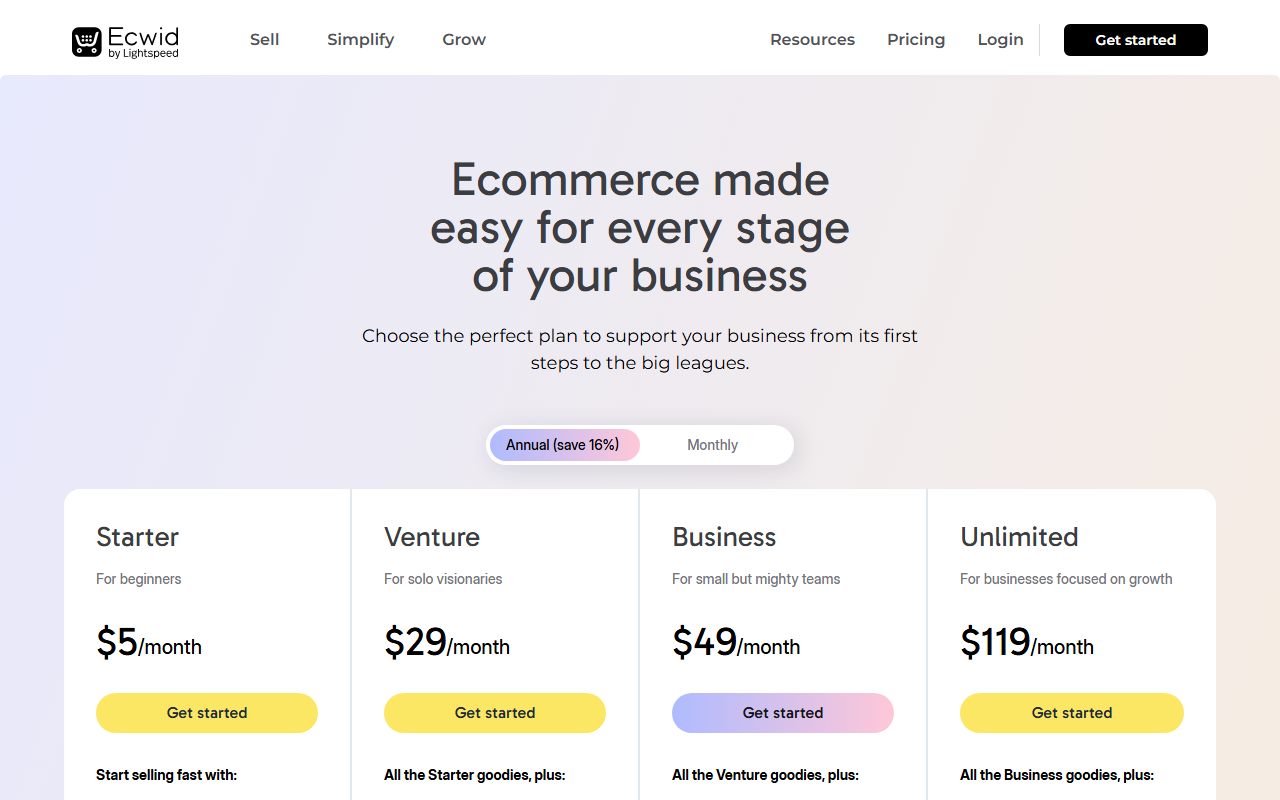
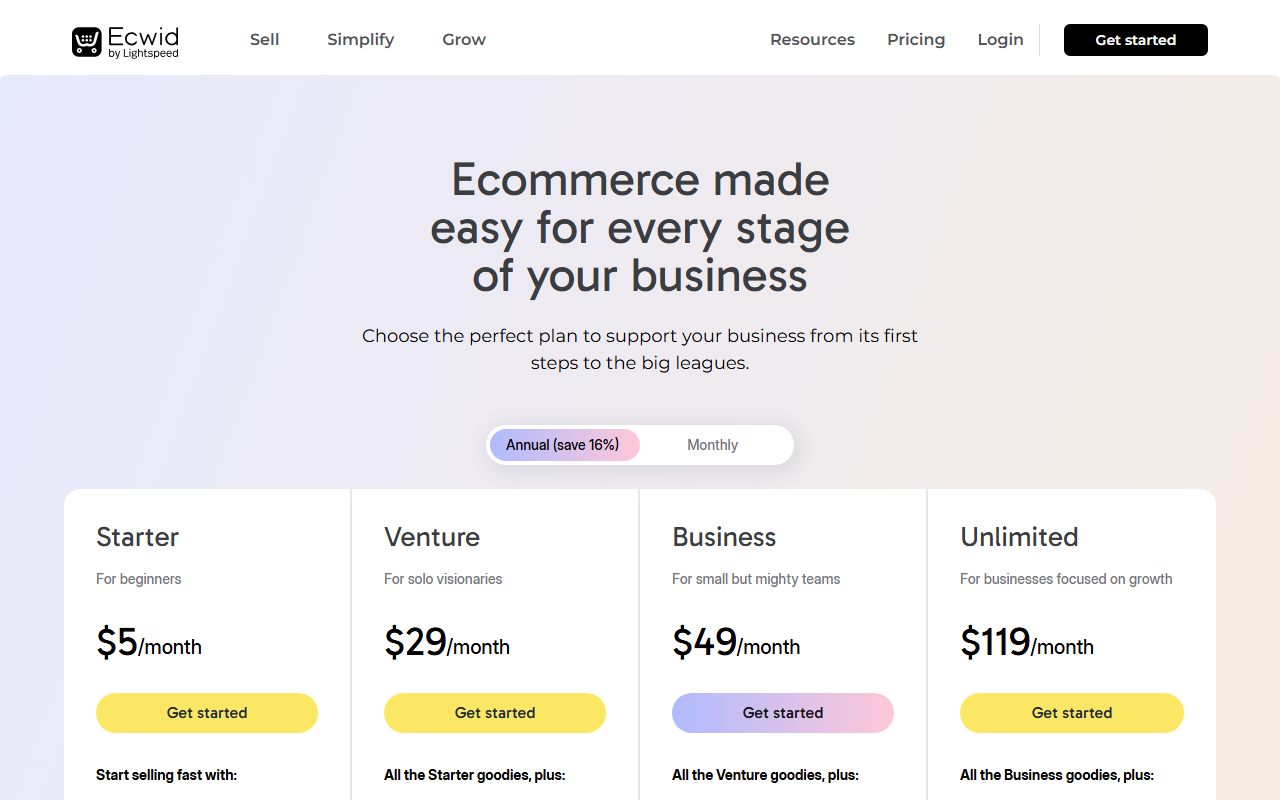
Four cards sit under a toggle labelled Annual (save 16%) and Monthly. On annual billing Starter is $5, Venture $29, Business $49 and Unlimited $119 a month. On monthly billing the same cards read $5, $35, $65 and $149.
The cards describe their audiences plainly: Starter for beginners, Venture for solo visionaries, Business for small but mighty teams, Unlimited for businesses focused on growth.
The discount badge is the one figure on the page that does not survive arithmetic. By our calculation from the two printed rows, Venture saves 17.1%, Business 24.6% and Unlimited 20.1%. Starter is $5 either way, which is a saving of 0%.
So the badge understates two tiers, overstates one, and the plan most likely to be chosen by a first-time seller gets no annual discount at all. Our annual versus monthly billing duel is the relevant reading here, because this is exactly the row buyers skim.
The zero in the fee row is real, and it is the point
The second line of the comparison table reads Transaction fees, with the clarification Fees charged per sale by Ecwid. Each of the four plan columns contains a zero.
The FAQ restates it without hedging: No, we don't charge any setup or transaction fees on any of our plans. The marketing copy higher up adds Plus, there are no transaction fees to worry about.
That is a materially different structure from both rivals in this cluster. One charges 2% on its entry tier for using a third-party payment provider. The other charges 2.0% on Core unless your processor sits on a published list of 21 embedded providers.
The qualifier matters and the page states it correctly. Ecwid takes nothing per sale, but the payment processor does. The page says Ecwid works with over 70 payment providers worldwide, including PayPal and Stripe, and it does not publish any of their rates.
A seller must read that number somewhere else.
Onboarding: cheap to start, with nothing to try first
4.3 out of 5. This round asks how much stands between a new seller and a store taking orders, judged only from what the vendor publishes.
The entry is the lowest in the cluster. Starter is $5 a month, the Instant Site builder and 70+ templates are on every plan, and the store can be embedded in a site that already exists rather than replacing it.
All plans are month-to-month with no long-term commitments, and the page says you are free to change your plan whenever it suits you.
The deductions are two absences. No free plan appears on the page, and neither does a free trial, which both rivals in this cluster publish.
The second is the Starter domain. Connect an existing domain and Buy a custom domain both show a dash in the Starter column. A $5 store is a store at mystore.company.site, which is fine for a test and awkward for a business card.
Core workflow: the caps are the product decision
3.4 out of 5, the lowest round on the card, and the reason is a column of dashes rather than any missing capability.
The Number of products row reads 10, 100, 2500 and Unlimited. That is the row that picks a plan. A seller with 140 items has no choice at $29 and must pay $49, whatever else they need.
Three more rows move the decision up in ways a buyer may not expect. Product variations, which the page defines as combinations of options such as size, colour or material, is absent on Starter and Venture. Inventory tracking is absent on Starter.
Inventory tracking plus, for options and variations, starts at Business.
So a seller of T-shirts in four sizes starts at $49 a month, not $5. The page is honest about it and the card bullets do not advertise it.
Staff accounts follow the same shape: a dash on Starter, a dash on Venture, 2 on Business, Unlimited on the top plan. That makes the two cheaper plans single-operator products by design, which is the live question in our shared-login versus seat-per-person duel.
What Business unlocks, read row by row
Business at $49 a month on annual billing is where the table stops showing dashes. It is worth listing because the gap between Venture and Business is wider than the $20 suggests.
Ticked at Business and absent on both cheaper plans: product variations, product filters, product reviews, product videos, multilingual catalogue, recurring subscriptions, customer groups, wholesale pricing groups, manual order creation, custom URL slugs, inventory tracking for options and variations, and dimensional weight shipping calculation.
Also starting at Business: abandoned cart emails, automated email marketing, the Mailchimp integration, selling on marketplaces through third-party apps, and Lightspeed Retail POS sync.
Unlimited at $119 adds four things by our count of the table: unlimited products, unlimited staff accounts, the Square and Clover POS integration, and 500 promotions in place of 3. For most small sellers that is a narrow upgrade for $70 a month more.
- Starter $5: 10 products, no own domain, no variations, no staff, email support only
- Venture $29: 100 products, own domain, coupons, tax calculations, analytics, chat support
- Business $49: 2,500 products, variations, filters, reviews, abandoned cart, 2 staff, phone call-backs
- Unlimited $119: unlimited products and staff, Square and Clover POS, 500 promotions, priority support
Integrations: broad channels, narrow at the bottom
3.6 out of 5. The channel list is long and most of it is withheld from Starter.
On every plan: Linkup, described as a link-in-bio ecommerce page, plus the Meta pixel, Google advertising, Pinterest advertising and Snapchat advertising tags.
From Venture: Facebook shop, Instagram store, mobile point of sale, Meta advertising, TikTok advertising, access to the App Market with extensions, discount coupons, automated tax calculations and built-in reports.
From Business: selling on marketplaces, which the page marks as via third-party apps, additional fees may apply, and Lightspeed Retail POS. The Square and Clover row is Unlimited only.
The deduction is the dependency chain. Marketplace selling runs through third-party apps at extra cost rather than natively, and one-tap checkout with Apple Pay and Google Pay requires the store to be connected to either Lightspeed Payments or Stripe. Recurring subscriptions carry the same condition.
Pricing: the cheapest honest page in the cluster
4.2 out of 5, the best round on the card.
By our arithmetic from the annual rates displayed on October 22, 2026, twelve months costs $60 on Starter, $348 on Venture, $588 on Business and $1,428 on Unlimited. At the printed monthly rates the same years are $60, $420, $780 and $1,788.
What makes the round win is what is not there. No percentage of sales. No sales ceiling. No automatic plan upgrade. No bandwidth or storage charge, which the FAQ states plainly: all Ecwid plans come with unlimited bandwidth and storage at no extra cost.
No setup fee. No contract.
For a seller taking $40,000 a year, Business at $588 is the whole platform bill. On a rival charging 2% of sales through an outside processor, the same revenue would add roughly $800 by our arithmetic on top of the subscription.
The deduction is the mismatched discount badge and the one line of tax wording: Ecwid collects the US sales tax in states where it's required by law. All prices on this page do not include taxes.
Support: the hours are printed, and they are office hours
3.5 out of 5. The page is specific about support, and the specifics are modest.
Email support is on all four plans. Chat starts at Venture and is described as immediate assistance via chat, available 24 hours, Monday to Friday. So the chat line closes for the weekend, which is when a small shop sells.
Phone starts at Business and is not a phone number. The row reads call-backs are available 2PM-10PM PDT, Monday-Friday in English, and scheduling via chat is required. Priority support, described only as support requests are prioritized higher in the queue, is Unlimited only.
The round still scores mid-range because the limits are published rather than implied. Many pricing pages in our clusters name no hours at all, as recorded in our Help Scout review and the Help Scout versus Freshdesk duel.
No response-time commitment, no uptime figure and no service level agreement appear on the page we read.
What verified users report
This review is built from vendor documentation. We have not yet compiled a dated sample of G2, Capterra, Trustpilot or Reddit reports for Ecwid, and we will not summarise impressions we have not collected. This section will carry sourced, dated findings when that sample exists.
The questions worth putting to other sellers are specific. Whether the product ceiling arrived as a warning or as a blocked upload. Whether weekend chat silence cost a sale. What the processor's rate turned out to be once the platform took nothing.
Limits stated by the vendor
Printed on the page, checked October 22, 2026, in US dollars: Starter $5 on both cycles; Venture $29 annual and $35 monthly; Business $49 and $65; Unlimited $119 and $149. The transaction fee row reads 0 in all four columns.
Also printed: products capped at 10, 100, 2500 and unlimited; staff accounts none, none, 2 and unlimited; extra Instant Site pages none, 3, 10 and 100; promotions none, none, 3 and 500.
Printed too: digital goods 25GB per file on the top three plans; chat 24 hours Monday to Friday; phone call-backs 2PM to 10PM PDT weekdays.
And further down: over 70 payment providers; PCI DSS validated Level 1 Service Provider status; unlimited bandwidth and storage on every plan; month-to-month billing with no long-term commitments; 6 months of Venture free for nonprofits.
Not printed: any free plan, any free trial, any payment processing rate, any response-time commitment, any uptime figure, a product count for the App Market, or the additional fees the marketplace row warns may apply.
Alternatives
Two other platforms were read the same day for this cluster. Both are named here from their own pricing pages, not from any claim of use.
Shopify prints $19, $49 and $299 a month on yearly billing with a top tier from $2,300, sells unlimited products on every tier and states no sales ceiling.
It charges 2% on its entry plan for using a third-party payment provider and prints no card processing rate at all. Choose it if the catalogue will grow past a few hundred items.
BigCommerce prints $29, $79 and $299 a month billed annually, states unlimited products and users on its entry card, and publishes its card rate at 2.89% plus $0.29 per transaction. Every self-service tier carries a trailing twelve-month sales ceiling that upgrades the plan automatically.
Choose it if you want every fee disclosed.
Otherwise choose Ecwid when the site already exists and the catalogue is genuinely small. The same discipline of reading the row rather than the card decided our Pipedrive review and our Asana review.
Bottom line
Ecwid wins pricing in this cluster and loses core workflow on a single column of dashes.
Business at $49 a month on annual billing, $588 a year by our arithmetic, is the cheapest tier here that can sell a shirt in four sizes, recover an abandoned cart and give a second person admin access.
Starter at $5 is real and it is narrow: ten products, no domain of your own, no variations, no staff account, email support only. Shortlist Ecwid if you want a cart inside the site you already have and zero taken off every order.
Read the product and variations rows before the price cards. All figures checked October 22, 2026.
Buy it if
- You already have a website and want a cart inside it, which every tier supports and which no rival in this cluster treats as the normal case
- A percentage of every order is unacceptable, because the fee row reads 0 on all four plans
- Your catalogue is genuinely small and will stay that way, since 10 and 100 products are hard numbers rather than soft limits
- You want to leave whenever you like, as all plans are month-to-month with no long-term commitment
Skip it if
- You sell anything in sizes or colours, since product variations are absent below Business at $49 a month
- You need your own domain on the cheapest plan, which Starter does not allow at either price
- More than one person will work in the admin, because staff accounts do not appear until Business, where the number is 2
- You want to evaluate before paying, as no free plan and no trial appear on the pricing page
Frequently asked
How much does Ecwid cost per month?
Per the pricing page checked October 22, 2026, Starter is $5 a month, Venture $29, Business $49 and Unlimited $119, all on annual billing. The monthly rates are printed as $5, $35, $65 and $149. The page notes that all prices exclude tax and that US sales tax is collected where required by law.
Does Ecwid charge transaction fees?
No, on its own account. The Transaction fees row, described as fees charged per sale by Ecwid, reads 0 in all four plan columns. The FAQ states there are no setup or transaction fees on any plan. Your payment processor still charges its own rate, which Ecwid does not set or publish.
Does Ecwid have a free plan?
No free plan and no free trial appear on the pricing page read on October 22, 2026. The cheapest paid entry is Starter at $5 a month. The page does offer registered nonprofits 6 months of Venture for free after submitting details about the organisation.
How many products can I sell on Ecwid?
The Number of products row reads 10 on Starter, 100 on Venture, 2500 on Business and Unlimited on the top plan. These are catalogue ceilings rather than monthly allowances, so the tier is usually decided by how many items you list rather than by which features you want.
Can I use my own domain with Ecwid?
Not on Starter. The rows for connecting an existing domain and buying a custom domain both show a dash in the Starter column and a tick on Venture, Business and Unlimited. Every plan does include a free company.site domain with a TLS certificate, in the form mystore.company.site.
How much does Ecwid cost for a year on Business?
By our arithmetic from the annual rate displayed on October 22, 2026, Business is $588 for twelve months against $780 at the printed monthly rate. Venture is $348 against $420 and Unlimited $1,428 against $1,788. These are editorial calculations, not quotes, and exclude tax and payment processing.
Does Ecwid include point of sale?
Partly. Mobile point of sale is included from Venture upward and described as accepting cash payments when selling in person. Lightspeed Retail POS sync starts at Business. The Square and Clover integration row shows a tick only in the Unlimited column, and the page notes it is available in limited countries.
Sources
- Ecwid pricing page - checked October 22, 2026
- Shopify pricing page (for cluster comparison figures) - checked October 22, 2026
- BigCommerce pricing page (for cluster comparison figures) - checked October 22, 2026
Update history
- October 22, 2026 - First published from the Ecwid pricing page as read on October 22, 2026 in US dollars via rendered DOM. The page renders six currency symbols per price cell and the US dollar figure was taken from the dollar cell. Every table row was parsed cell by cell so that a dash is reported as a dash rather than inferred. The Annual (save 16%) badge is quoted alongside our own arithmetic on each tier rather than repeated as fact.
Visit Ecwid by Lightspeed
We have no affiliate relationship with this vendor. Link goes to the official site.