 Feature
Best Ecommerce Platform for a Small Store
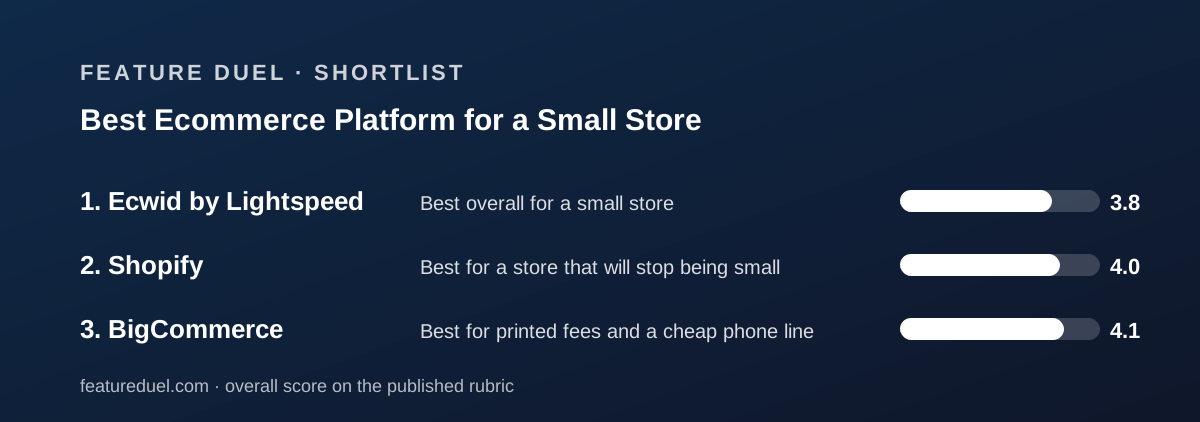
Our top pick for a small store is Ecwid by Lightspeed on its Business tier. At $49 a month on annual billing it is the only platform of the three graded here whose pricing page prints a zero in the transaction fee row. It is also the only one with no sales ceiling and no automatic plan upgrade attached to it. Shopify is the pick if the store will stop being small. BigCommerce is the pick if you want every fee printed and a 24/7 phone line for $79 a month. All three pricing pages were read on October 22, 2026 in US dollars via rendered DOM. Jump to how we chose if you want the rubric before the picks.
Our picks
- Best overall for a small store: Ecwid by Lightspeed
- Best for a store that will stop being small: Shopify
- Best for printed fees and a cheap phone line: BigCommerce
The short version
A small store, for this guide, means one with under roughly $100,000 of annual sales, one or two people in the admin, and a catalogue in the hundreds rather than the thousands. The ranking changes above that line and we say where.
Ecwid by Lightspeed takes the top spot on Business at $49 a month on annual billing, because nothing is taken off each order and nothing on the page caps how much you sell.
Shopify takes second on Basic at $19 a month paid yearly, the cheapest subscription here, with no catalogue cap and no sales cap, and with a card rate the page refuses to print.
BigCommerce takes third on Growth at $79 a month billed annually, which is the most expensive pick and the only one that publishes its card rate and includes a 24/7 phone line.
- Cheapest subscription: Shopify Basic, $228 a year by our arithmetic
- Cheapest total cost at $60,000 of sales through Stripe: Ecwid Business, $588 a year by our arithmetic
- Only platform with a printed card rate: BigCommerce, from 2.89% plus $0.29 per transaction
- Only platform with sales ceilings and automatic plan upgrades: BigCommerce
- Only platform with a catalogue ceiling below the top tier: Ecwid, at 10, 100 and 2,500 products
- Cheapest 24/7 phone line: BigCommerce Growth at $79 a month
Read the fee structure before the price card
Three platforms, three different ways of charging. The subscription is the smallest of the three numbers for most small stores, which is why the price cards are the least useful part of each page.
Ecwid charges a flat monthly fee and nothing per sale. Its fee row reads 0 in all four columns and its FAQ says there are no setup or transaction fees on any of our plans.
The payment processor still charges its own rate, which Ecwid does not publish.
Shopify charges a flat fee plus a card rate it does not print, plus a 2% surcharge on Basic if you use a payment provider other than its own. That surcharge drops to 1% on Grow, 0.6% on Advanced and 0.2% on Plus.
BigCommerce charges a flat fee, prints its card rate at 2.89% plus $0.29 per transaction, and adds a platform fee of 2.0% on Core that falls to $0 if your processor is one of 21 it names.
Stripe, PayPal, Adyen, Klarna, Worldpay and Amazon Pay are all on that list.
So the question that decides your bill is not which plan you want. It is which processor you already use, and whether the platform charges you for using it.
The arithmetic at three sales volumes
Editorial calculations from the rates all three pages displayed on October 22, 2026, for twelve months, excluding tax and the processor's own card fee. They are not quotes.
Each assumes payments run through Stripe, which is on the BigCommerce embedded list and is a third-party provider on Shopify.
- $20,000 of annual sales: Ecwid Business $588 · BigCommerce Core $348 · Shopify Basic $628
- $60,000 of annual sales: Ecwid Business $588 · BigCommerce Growth $948 · Shopify Basic $1,428
- $150,000 of annual sales: Ecwid Business $588 · BigCommerce Scale $3,588 · Shopify Basic $3,228
- $60,000 on Ecwid Venture instead, if the catalogue fits in 100 products: $348
- $60,000 on Shopify Basic using Shopify Payments: $228 plus a card rate the page does not print
At the smallest volume BigCommerce Core wins on $348, because $18,000 of GMV sits inside its $30K ceiling and Stripe costs nothing on its platform. That is the one row where the cheapest answer is BigCommerce.
At $60,000 the picture flips. BigCommerce reduces gross order value by 10% to get GMV, so $54,000 crosses the Core ceiling and the account upgrades itself to Growth at $79 a month. Ecwid Business stays at $588 and wins.
At $150,000 Ecwid still charges $588 and the two platform fees have overtaken both subscriptions. This is where a flat fee and no cap stop being a budget choice and start being the only sensible one.
The row we cannot complete is Shopify on its own payment product. Remove the 2% and Basic is $228, which would win every line above. The page does not print the card rate that replaces it, so we will not finish the sum.
The full note is in our Shopify review.
What the entry tiers actually leave out
Every one of these platforms sells a cheap first tier that is missing something a real store needs. The specific omissions are more useful than the prices.
Shopify Basic at $19 leaves out staff accounts. The additional staff accounts row shows 5 on Grow, 15 on Advanced and Unlimited on Plus, with no number at all in the Basic column. It is a single-operator plan that does not say so.
BigCommerce Core at $29 leaves out four things at once: abandoned cart saver, persistent cart, stored credit cards and customer groups. All four start at Growth. Inventory locations on Core read Up to 4.
Ecwid Starter at $5 leaves out the most. The table shows a dash against connecting an existing domain, buying a domain, product variations, inventory tracking, staff accounts, gift cards, the App Market, automated tax calculations and built-in analytics.
Ecwid Venture at $29 still shows a dash against product variations, so a store selling anything in sizes or colours needs Business. That single row is the reason our pick is $49 and not $29. The detail is in our Ecwid review.
Sales ceilings are the trap a small store should check first
Only one of the three platforms here charges you more for selling more, and it is explicit about it, which is to its credit.
BigCommerce Core reads Up to $30K TTM GMV; plan auto-upgrades to Growth. Growth reads Up to $100K TTM GMV; plan auto-upgrades to Scale. Scale covers $33,333 a month and charges 0.9% on GMV above the cap. Reaching $2 million moves the account to Performance.
The measure is not your revenue. The page defines GMV as gross order value minus 10% and warns that this number may differ from what you track in your own records, adding that the difference is expected, not an error.
Shopify states no ceiling on any tier and sells unlimited products everywhere. Ecwid states no sales ceiling either, but caps the catalogue instead at 10, 100 and 2,500 products. A ceiling on items is easier to plan around than a ceiling on turnover.
The two structures are compared round by round in our Shopify versus BigCommerce duel, including the sales figure at which the verdict flips.
Seats, logins and who is allowed in the admin
This is the row small stores discover last and regret first. Two of the three platforms ration admin access at the entry tier, and the third does not mention it as a limit at all.
Shopify shows no number against additional staff accounts in the Basic column, then 5 on Grow, 15 on Advanced and Unlimited on Plus. The Grow card phrases it as Up to 5 staff accounts.
So a two-person shop on Basic is sharing one login unless it pays $49 a month.
Ecwid is blunter. Staff accounts show a dash on both Starter and Venture, then 2 on Business and Unlimited on the top plan. The two cheapest plans are single-operator products by design.
BigCommerce is the outlier and it is the better answer. The Core card states unlimited products and users, and the staff accounts row carries a tick in every column with no number attached.
A $29 plan with unrationed admin seats is unusual in any software category.
Sharing one login to avoid a seat charge is a habit worth pricing properly rather than drifting into, which is the argument in our shared-login versus seat-per-person duel.
Every headline price here is the annual one
All three pages open on their discounted cycle and print the monthly rate lower down or in a footnote. That is normal and it is still worth separating before you budget.
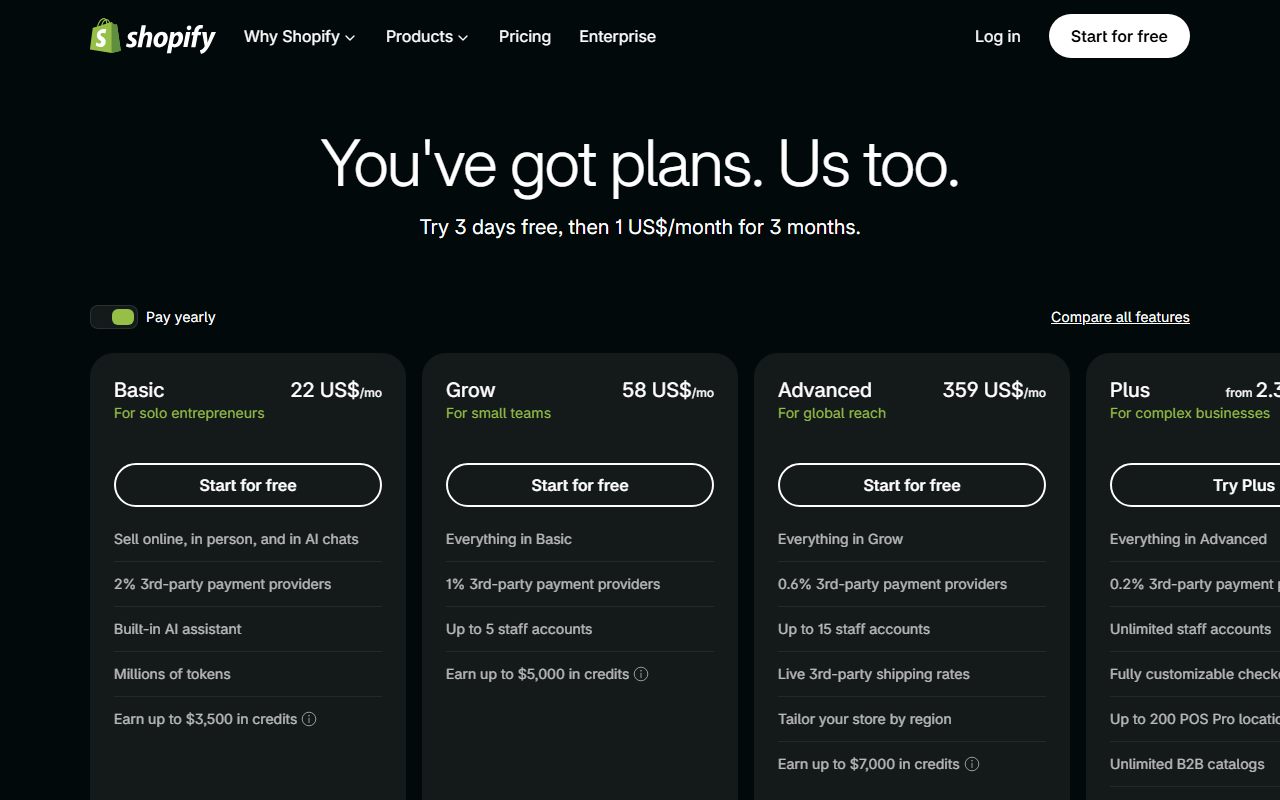
Shopify opens on Pay yearly at $19, $49 and $299, with monthly rates of $25, $65 and $399 in the comparison table.
By our arithmetic the annual saving is 24% on Basic and 25% on the other two, and the page prints no discount percentage of its own.
BigCommerce opens on Pay Annually at $29, $79 and $299 with a Save 25% badge, and prints $39, $105 and $399 in two separate places. Our arithmetic gives 25.6%, 24.8% and 25.1%, so the badge holds.
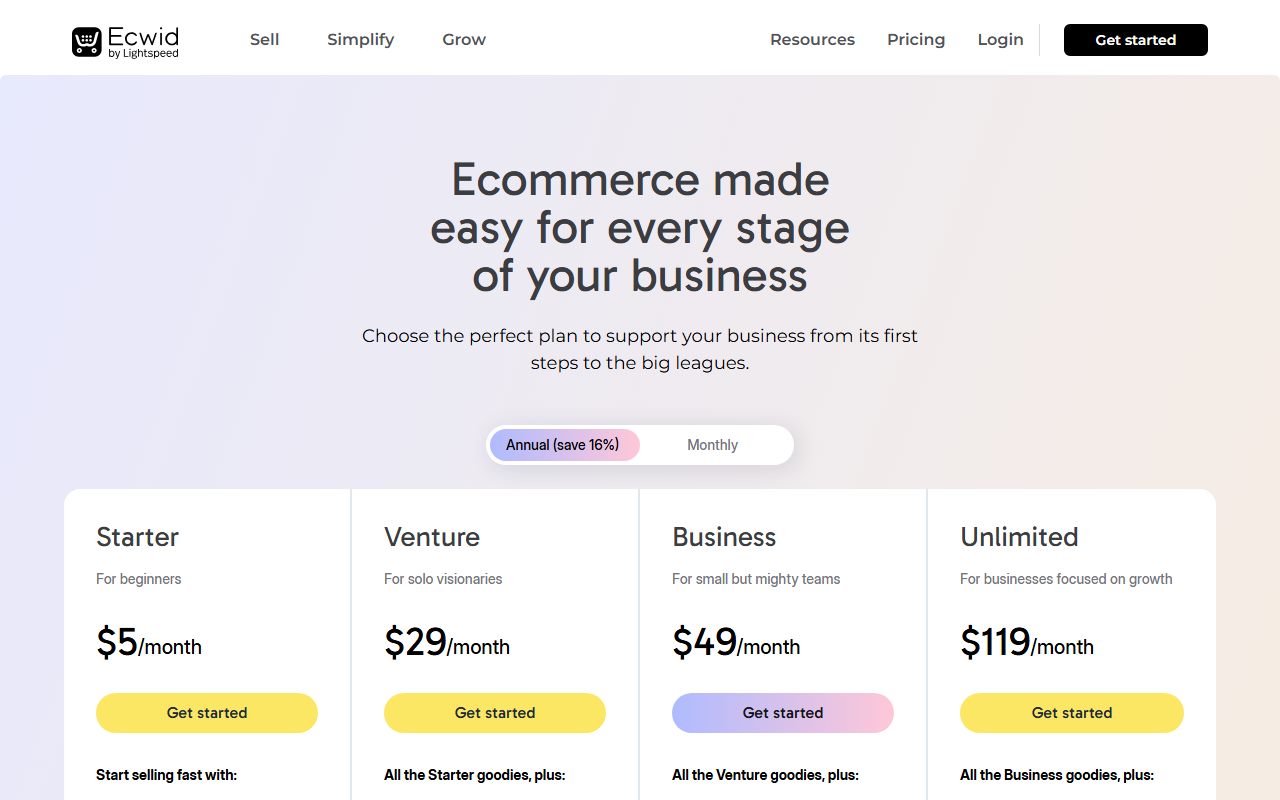
Ecwid opens on Annual (save 16%) at $5, $29, $49 and $119 against monthly rates of $5, $35, $65 and $149.
Our arithmetic gives 0% on Starter, 17.1% on Venture, 24.6% on Business and 20.1% on Unlimited, so the badge is wrong in three of four columns.
The trade in every case is twelve months of commitment for roughly a quarter off, and the detail of that trade is in our annual versus monthly billing duel.
One platform or a stack of parts
There is a structural choice hiding behind these three names, and it is not really about price. Shopify and BigCommerce sell you the whole store. Ecwid sells you the part you are missing.
Every Ecwid tier can add a store to any website and sell simultaneously on multiple sites. If you already run a site on WordPress, Wix or anything else, that keeps your content, your SEO history and your design and adds a cart to them.
The single-vendor platforms replace all of that, which is cleaner and more expensive to reverse. For a store that has no site yet, replacing nothing is an advantage. For a store with five years of blog traffic, it is a migration.
The general version of this argument, with the costs on both sides, is in our all-in-one versus best-of-breed duel. The same reasoning decided the picks in our best CRM for a small sales team guide, where the narrower tool also won on total cost.
Support: one phone line costs $79 and the other costs $2,300
All three pages name support by tier, which is better than most categories we grade. The hours and the channels are where they diverge.
BigCommerce includes 24/7 chat and email on every plan and a 24/7 phone line from Growth at $79 a month.
The footnote says a phone add-on for Core is coming soon with pricing and timing to be shared separately, which is an announcement rather than a feature.
Shopify prints 24/7 live chat on Basic and Grow, enhanced live chat on Advanced and priority support on Plus, where a 24/7 phone line also appears. Plus starts at $2,300 a month. The page does not define enhanced or priority.
Ecwid is the most specific and the most limited. Email on all plans. Chat from Venture, available 24 hours Monday to Friday, so closed at weekends.
Phone from Business, and it is call-backs only between 2PM and 10PM PDT on weekdays, in English, with scheduling via chat required.
None of the three prints a response-time commitment, an uptime figure or a service level agreement. That is normal in this category and it is still worth knowing before you sign. The round-by-round support notes sit in our BigCommerce review.
How to choose in four questions
Which processor do you already use? If it is Stripe, PayPal, Adyen, Klarna or Worldpay, BigCommerce charges nothing for it and Shopify Basic charges 2% of every order.
If you are happy to switch to Shopify Payments, that surcharge disappears and the card rate becomes unknowable from the page.
How many products will you list? Ecwid stops at 10, 100 and 2,500 by tier. Both rivals sell unlimited products on every tier. If the catalogue is in the thousands and growing, the Ecwid ladder ends.
Do you sell variants? If anything you sell comes in sizes, colours or materials, the Ecwid floor is Business at $49, because the product variations row is blank below it.
Will your sales cross $30,000 this year? If yes, BigCommerce Core is a twelve-month plan, not a long-term one, and the upgrade to Growth nearly triples the subscription. Budget for $79 from the start.
The reasoning behind the five rounds is set out in how a duel is scored.
Where this guide will change
Three things would move the ranking and none of them has happened yet as of October 22, 2026.
If Shopify publishes a card processing rate, its Basic tier becomes directly comparable and would likely take the top spot on subscription cost alone.
If Ecwid publishes a free plan or a trial, its onboarding round improves, since neither appears on the pricing page we read.
If BigCommerce prices the Core phone support add-on it has announced, its cheapest tier becomes a serious small-store option rather than a stepping stone to Growth.
We have not yet compiled a dated sample of G2, Capterra, Trustpilot or Reddit reports for any of the three, so none of the scores above carries a user-reported component.
That section will appear in each review when the sample exists, and the grades will be revised in place rather than republished.
Bottom line
For a small store on published figures, Ecwid by Lightspeed on Business at $49 a month annual, $588 a year by our arithmetic, is the pick.
Nothing is taken per sale, nothing caps your turnover, and the 2,500-product ceiling sits far above what a small store lists.
Choose Shopify Basic at $19 a month instead if the catalogue will grow past a few thousand items or the sales will pass $100,000, and accept that the card rate is a question for a second page.
Choose BigCommerce Growth at $79 a month if you want every fee printed before you sign and a 24/7 phone line included, and if a sales ceiling you have to forecast is an acceptable trade. All figures checked October 22, 2026.
Also compared
Dropped from this guide for a reason worth recording. The Squarespace pricing page was loaded in a headless browser from our location on October 22, 2026 and rendered its plans in Vietnamese dong, not US dollars.
The page's own structured data confirmed it, listing priceCurrency VND with an eligible region of VN, alongside a note that Squarespace prices its plans per billing country. No currency switch available in the markup produced a US dollar figure.
We will not convert a regional price into dollars and present it as the US price, so the platform is excluded rather than estimated.
Priced and excluded as a small-store pick. The card reads Starts at $2,300 USD/mo with no yearly rate shown, which is $27,600 a year at the monthly figure by our arithmetic. It belongs in an enterprise comparison, not here.
Excluded on the same grounds. Custom pricing starting at $1,499 per month, billed annually, and it is the only BigCommerce tier that unlocks Price Lists, advanced promotions management, API support and a Customer Success Manager.
Named rather than recommended.
At $5 a month it is the cheapest paid plan in the guide, but the table shows a dash against connecting your own domain, product variations, inventory tracking, staff accounts, gift cards and the App Market, with the catalogue capped at 10 products.
Best overall for a small store: Ecwid by Lightspeed
Four plans printed in US dollars on annual billing: Starter $5, Venture $29, Business $49, Unlimited $119, per the pricing page checked October 22, 2026.
Business is the tier that matters, because it is where product variations, abandoned cart emails, product filters, product reviews, customer groups, 2 staff accounts and a 2,500-product catalogue all arrive together.
The Transaction fees row reads 0 in all four columns, and the FAQ confirms there are no setup or transaction fees on any of our plans. There is no sales ceiling anywhere on the page and no automatic plan upgrade.
Unlimited bandwidth and storage are included on every tier, and all plans are month-to-month.
The catch is the bottom of the ladder. Starter at $5 cannot connect a domain you already own, caps the catalogue at 10 items, and shows a dash against product variations and staff accounts.
A seller of shirts in four sizes starts at $49, not $5, and the page does not say so on the cards.
It sits at number one because a small store's largest controllable cost is the percentage taken off each order, and this is the only one of the three that takes none.
At $60,000 of annual sales through Stripe, Business is $588 for the year by our arithmetic, against $948 on BigCommerce Growth and $1,428 on Shopify Basic once the 2% third-party provider fee is counted.
Visit Ecwid by Lightspeed
We have no affiliate relationship with this vendor. Link goes to the official site.
Best for a store that will stop being small: Shopify
Four cards on yearly billing: Basic $19, Grow $49, Advanced $299, and Plus from $2,300 a month, per the pricing page checked October 22, 2026. The monthly equivalents are printed as $25, $65 and $399.
By our arithmetic Basic is $228 for twelve months, the cheapest subscription in this guide.
What that $228 buys is unusual at the price: unlimited products, abandoned checkout recovery, customer segments, email campaigns, marketing automations, discount codes, gift cards, 10 inventory locations and 24/7 live chat. No tier on the page states a sales ceiling or an automatic upgrade.
Two gaps keep it off the top spot for a small store. The page prints no credit card processing rate at any tier, saying only that these fees vary depending on the plan that you choose.
And the third-party payment provider fee is 2% on Basic, so keeping your own processor costs 2% of every order on top of whatever that processor charges.
It sits at number two because it is the only platform here with neither a catalogue cap nor a sales cap, which makes it the right answer the moment a small store stops being small.
It loses the top spot on a missing number: a page that will not print a card rate cannot be used to forecast a year.
And for a store under $100,000 of sales the 2% surcharge on an outside processor is larger than the whole subscription.
Visit Shopify
We have no affiliate relationship with this vendor. Link goes to the official site.
Best for printed fees and a cheap phone line: BigCommerce
Four plans: Core $29 a month billed annually, Growth $79, Scale $299, and Performance custom from $1,499, with monthly rates printed as $39, $105 and $399 and a footnote confirming US dollars excluding tax, per the pricing page checked October 22, 2026.
This is the only page in the guide that prints its card rate. Debit and credit card processing begins at 2.89% plus $0.29 per transaction on all plans, with American Express at 3.50% and no fixed fee.
The platform fee is avoidable: orders through any of 21 named embedded providers, including Stripe, PayPal, Adyen, Klarna and Worldpay, carry a $0 fee.
Support is the other win. 24/7 chat and email are on every plan and a 24/7 phone line is included from Growth at $79 a month, which is $948 a year by our arithmetic.
The cheapest Shopify tier with a phone channel is $2,300 a month.
The ceiling is the reason it is third. Core is capped at $30K trailing twelve-month GMV and auto-upgrades to Growth. Growth is capped at $100K and auto-upgrades to Scale at $299.
It sits at number three for a small store and would move up for a larger one.
The disclosure is the best in the guide and the entry tier is the weakest: the Core column shows a dash against abandoned cart saver, persistent cart, stored credit cards and customer groups.
So the cheapest working BigCommerce store is $79 a month rather than $29, which is $948 a year against Ecwid Business at $588.
Visit BigCommerce
We have no affiliate relationship with this vendor. Link goes to the official site.
How we chose
We did not run tests of our own; grades come from documentation, pricing pages and public vendor FAQs checked on October 22, 2026. Every platform is scored on the same five rounds used across this site: onboarding, core workflow, integrations, pricing and support.
Each pricing page was loaded in a headless browser and the rendered DOM was parsed cell by cell, so a dash in a feature table is reported as a dash rather than inferred from a summary.
Prices are taken from the US dollar figure printed on the page. Where a page displayed two different values for the same quota, both were recorded and both are printed.
Where a page omitted a figure entirely, such as Shopify's card processing rate, the omission is reported as an omission and not as a zero.
One candidate was dropped because no US dollar price could be read from our location at all; the reason is set out under Also considered.
Frequently asked
What is the best ecommerce platform for a small store?
Ecwid by Lightspeed on its Business tier, on the five rounds scored here. It is $49 a month on annual billing, $588 a year by our arithmetic from the pricing page checked October 22, 2026, and its transaction fee row reads 0 in every column with no sales ceiling anywhere on the page.
Which is cheapest for a store doing $60,000 a year?
Ecwid Business, at $588 for twelve months by our arithmetic. BigCommerce reaches Growth at that volume, which is $948, because $54,000 of GMV crosses the Core ceiling. Shopify Basic is $228 plus a 2% third-party provider fee of roughly $1,200, for about $1,428 if you keep an outside processor.
Do any of these platforms have a free plan?
None of the three showed a free tier on October 22, 2026. BigCommerce offers a fully functional 15-day trial with no credit card required. Shopify offers 3 days free followed by $1 a month for 3 months. The Ecwid pricing page printed no free plan and no trial at all.
Which platform charges the lowest transaction fees?
Ecwid, which charges none of its own. BigCommerce charges $0 if your processor is on its list of 21 embedded providers, otherwise 2.0% on Core. Shopify charges 2% on Basic for any third-party payment provider. Your card processor's rate applies on top in every case.
Can I sell clothing in different sizes on the cheapest plans?
Not on Ecwid Starter or Venture, where the product variations row is blank; that needs Business at $49 a month. Shopify Basic and BigCommerce Core both sell unlimited products without a variations restriction printed on their pricing pages.
Why is Squarespace not in this guide?
Because we could not read a US dollar price. Loaded from our location on October 22, 2026, the Squarespace pricing page rendered in Vietnamese dong, and its own structured data listed priceCurrency VND for region VN with a note that it prices per billing country. We will not convert a regional figure and call it the US price.
Which platform is best if my store grows quickly?
Shopify, on the published terms. It is the only one of the three with neither a catalogue ceiling nor a sales ceiling on any tier, and no plan on its page upgrades itself. BigCommerce upgrades automatically at $30,000 and again at $100,000 of trailing twelve-month GMV.