 Feature
Lemlist review: the plan outruns your mailboxes
Lemlist takes three of our five rounds. Channel coverage and the integration surface win comfortably, and the published deliverability guidance is unusually candid for a cold-outreach vendor. It loses onboarding and pricing, and both losses are legible on lemlist's own pages.
Every figure below comes from the lemlist pricing page, help centre, developer documentation, sending policy and terms of service, read on October 26, 2026.
No account was opened and no campaign was sent for this piece; the rounds are the fixed five explained in how a duel is scored.
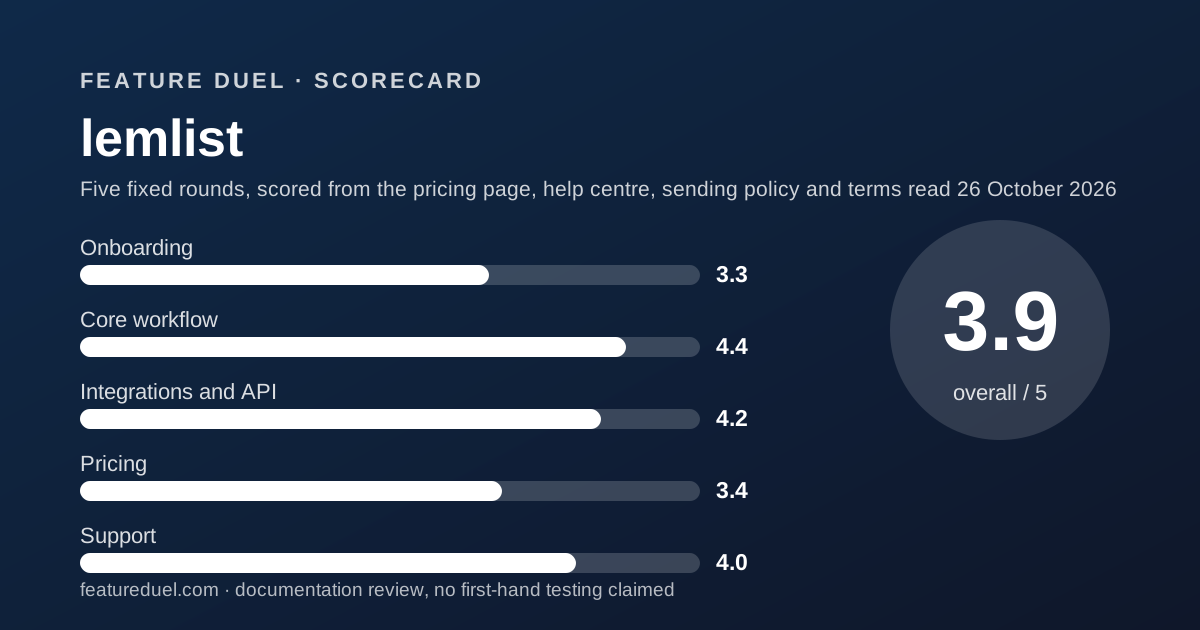
The scorecard: three rounds to lemlist, two against
Overall 3.9 out of 5 on the published rubric. The pattern is clean. Lemlist wins everything about reaching people and loses everything about starting and paying for it.
- Onboarding, 3.3 — a 14-day trial, no free plan, and a documented warm-up of roughly 40 days plus 14 days of holding before a mailbox sends anything cold.
- Core workflow, 4.4 — email, LinkedIn, calls, SMS and WhatsApp in one sequence, a unified inbox, and a changelog that ships most weeks.
- Integrations and API, 4.2 — a public API at 20 requests per 2 seconds, an MCP server and a CLI on every plan, and CRM sync with HubSpot, Salesforce and Pipedrive.
- Pricing, 3.4 — two self-serve plans on two different meters, no free tier, and terms that rule out refunds and proration.
- Support, 4.0 — 4.7 out of 5 across 253 Trustpilot reviews, but priority support and a named account manager start at Enterprise.
See current lemlist plans and limits
Round 1, Onboarding: a 14-day trial in front of a 54-day ramp
The trial is real and the fine print is short. The pricing FAQ puts it at 14 days with Multichannel features except in-app calls, 200 credits for finding emails and phone numbers, and access to lemAgent.
There is no free plan. Every published tier is paid, so the trial is the only unpaid way to see the product, and it runs for two weeks whatever your sending plan looks like.
The slower constraint is deliverability, and lemlist publishes it plainly. Its help centre tells a new mailbox to send zero cold emails until lemwarm has ramped at plus one a day for about 40 days, then held at target for 14.
That is roughly 54 days before a fresh mailbox sends its first campaign, by our arithmetic from the vendor's own ramp. The same page blocks any campaign start below a Warmup Score of 90.
After warm-up the guidance stays conservative: 10 to 15 emails a day per mailbox, rising 5 a week, capped at 25 to 30. Warm-up and campaigns together must stay at or below 50 a day per mailbox.
Domains under a month old are held under 100 emails a day across every mailbox on them. Limits are counted on a rolling 24 hours rather than by calendar day, which catches teams who launch in the afternoon.
The sending policy draws the other boundary, and it publishes thresholds as numbers rather than adjectives. Read on October 26, 2026, accounts are expected to stay at or below these levels:
- Bounces at or below 8%, calculated on the number of messages that have bounced.
- Unsubscribes at or below 8.4%, or 6% if unsubscribes outnumber clicks.
- Blocks at or below 30%.
- Spam complaints at or below 0.08%, and never more than 50 complaints a day when sending over 1,000.
- Spamtrap hits and unjustified abuse complaints at or below 1%.
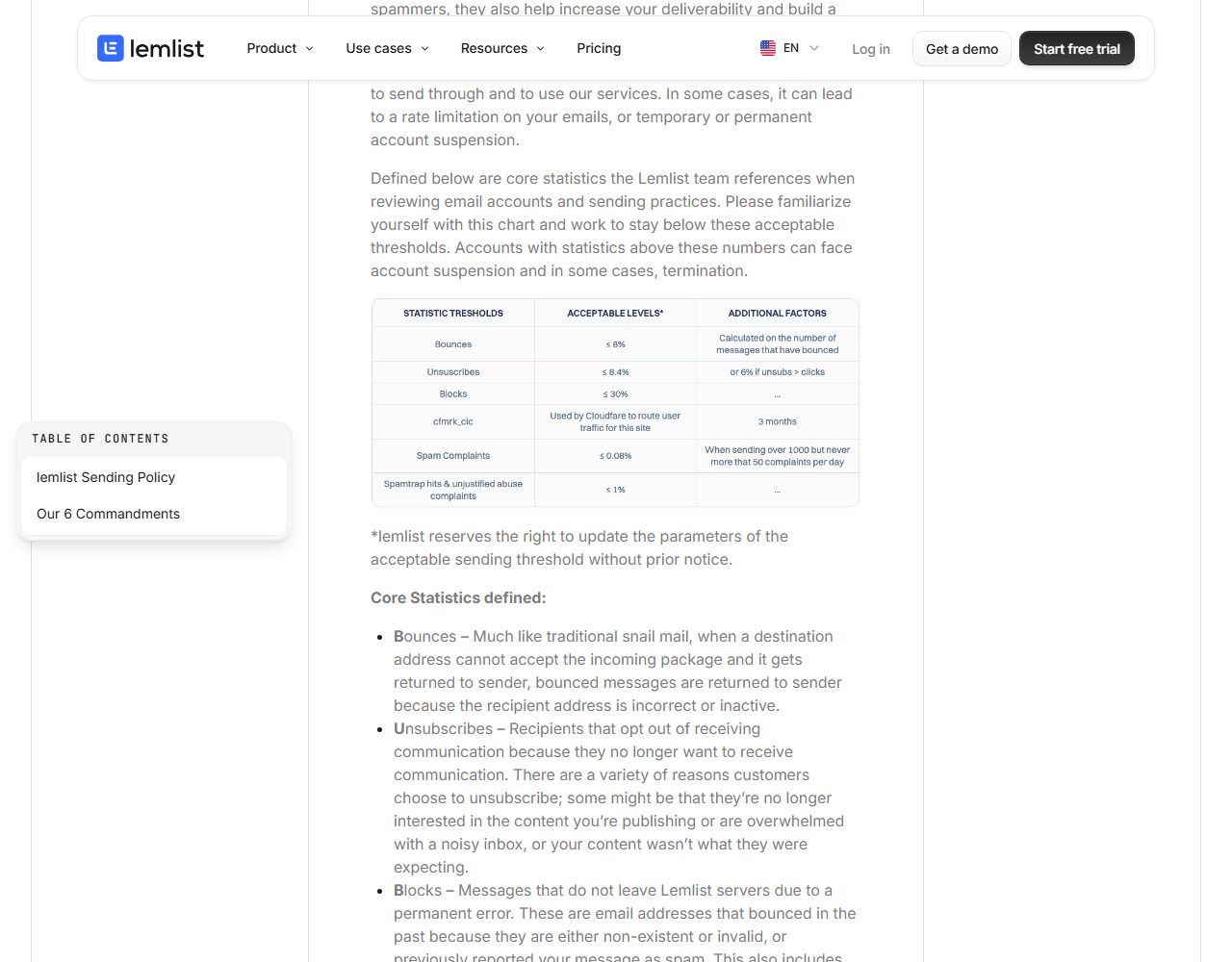
Credit where it is due: most outreach vendors leave these figures to a blog post. The round scores low on the calendar, not on the candour. A team that needs pipeline this month will not get it from a fresh domain.
Round 2, Core workflow: five channels on one sequence
This is the round lemlist is built to win. A single campaign can mix email, LinkedIn visits and invites, LinkedIn text and voice messages, in-app calls, SMS and WhatsApp, with replies landing in one unified inbox.
Prospecting sits in the same product. The homepage advertises a 650M+ lead database with an email finder, a phone number finder and LinkedIn enrichment, so sourcing and sending do not need two contracts — the trade we weigh in one suite against several specialists.
AI runs across both halves. lemAgent, intent signal agents, enrichment agents and smart messaging are listed on the cheapest plan as well as the dearest, which is unusual; most vendors fence AI behind an upgrade.
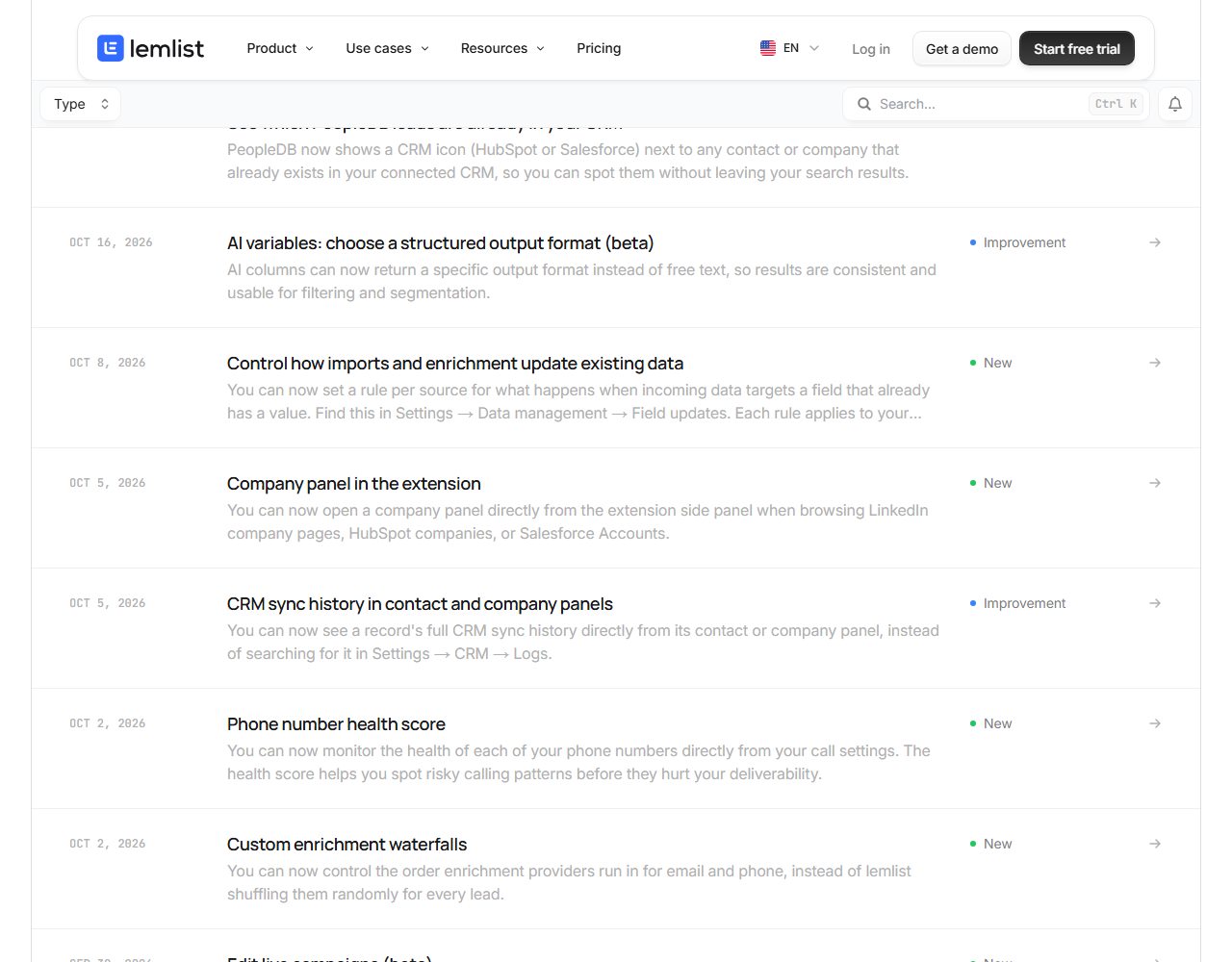
The product also moves. The public changelog lists dated releases through October 2026, which is the clearest evidence available that the roadmap is not a screenshot:
- October 16, 2026 — the lead database marks contacts that already exist in a connected HubSpot or Salesforce.
- October 8, 2026 — per-source rules for what happens when an import or enrichment overwrites a field that already has a value.
- October 2, 2026 — a phone number health score, and custom enrichment waterfalls instead of a randomised provider order.
- September 30, 2026 — live campaigns can be edited after launch, in beta.
- September 23, 2026 — sending pauses for bank holidays and for a sender's own time off.
Two caveats stop a clean sweep. The Email plan carries no LinkedIn, SMS or calling at all, and WhatsApp is an add-on even after you have paid for Multichannel.
Round 3, Integrations and API: the CRM lock sits at Enterprise
The API is genuinely public and the limit is published. The developer documentation states 20 requests per 2 seconds, returned on X-RateLimit headers with a human-readable reset time, which is enough to build against without a sales call.
An MCP server and a command-line interface are listed on every plan, so lemlist can be driven from an AI assistant at the $55 tier. That is still rare at this price, and it is the main reason this round clears 4.
CRM sync covers HubSpot, Salesforce and Pipedrive, with Zapier, Make, n8n and Clay for everything else and Aircall and Ringover for voice. Teams already on Pipedrive will find lemlist named on its integration list.
The pipeline half of this job belongs elsewhere. HubSpot Sales Hub and Zoho CRM are scored on our small-team CRM shortlist, and the two leaders meet in Pipedrive against HubSpot Sales Hub.
One line costs the round its remaining points. Working inside the CRM, rather than syncing to it, is listed only on Enterprise, alongside custom roles and permissions and SSO or SAML login.
Round 4, Pricing: two plans, two different meters
The page defaults to yearly billing, so the large number is the discounted one. Both figures, read on October 26, 2026:
- Email — $69 a month, or $55 on yearly billing. Unlimited users and email senders, with a volume selector starting at 50,000 emails a month.
- Multichannel — $109 a month per user, or $87 on yearly billing. Five senders per user, unlimited emails and messages, LinkedIn, SMS and a built-in dialer.
- Enterprise — custom. Five or more senders per user, CRM-side working, custom roles, a dedicated account manager, SSO or SAML and priority support.
- Lead data enrichment add-on — $20 a month, or $16 yearly, for 2,000 credits: 400 emails or 100 phone numbers.
- Buying intent signals add-on — $29 a month, or $21 yearly, for 100 signals.
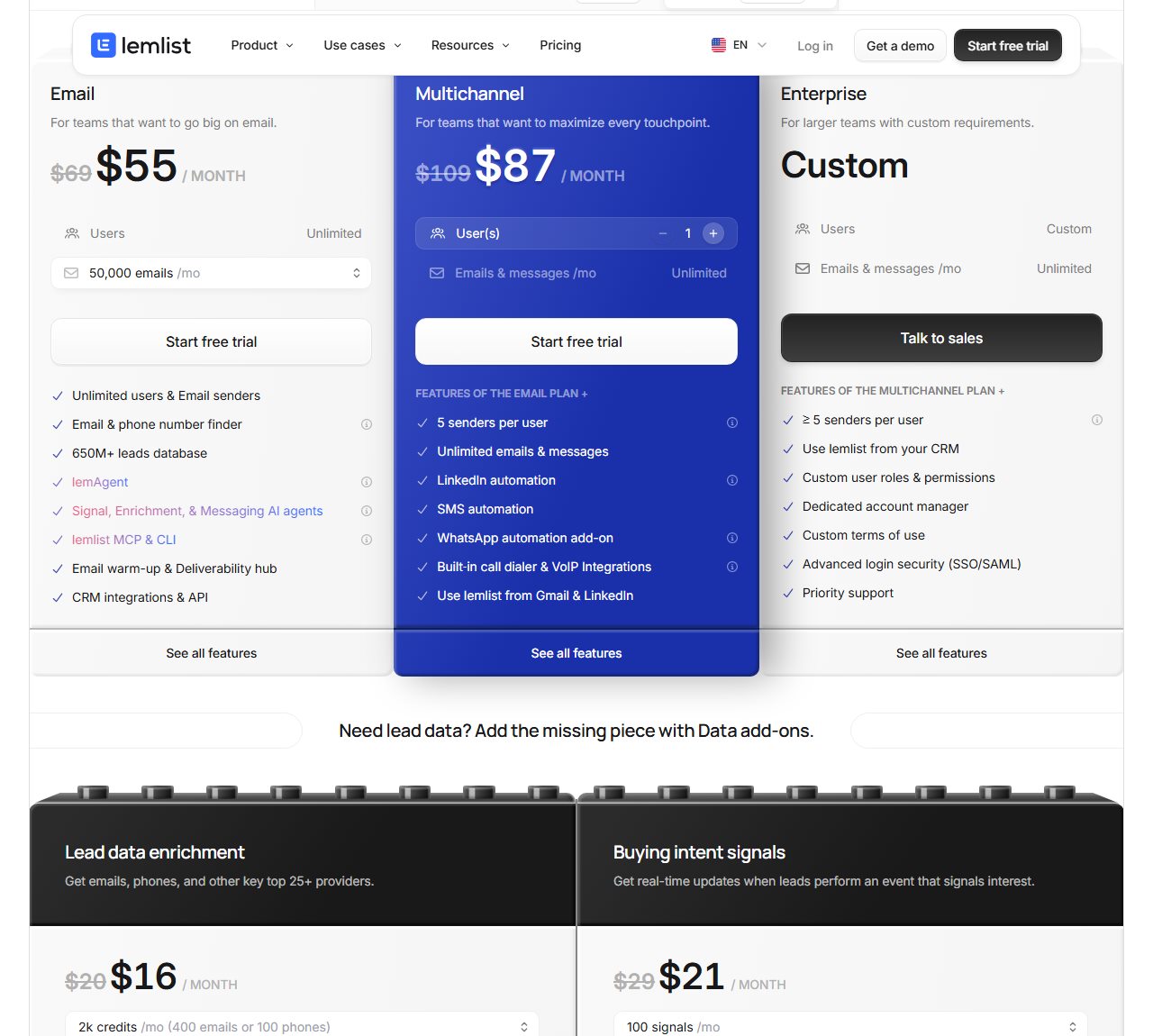
The two plans are not a ladder, they are different shapes. Email gives unlimited people and caps volume; Multichannel gives unlimited volume and meters people — the choice we set out in shared logins against a seat per person.
Ten named users on Multichannel is $870 a month on yearly billing, or $10,440 a year, by our arithmetic from the listed per-user price. The same team billed monthly is $1,090 a month.
Quarterly billing is offered at 10% off and yearly at 20%, which is the commitment question we work through in annual against monthly billing.
The credit arithmetic is worth doing before the card goes in. 2,000 credits buying 400 emails is 5 credits an email; the same 2,000 buying 100 phone numbers is 20 credits each, by our reading of the add-on card.
The 50,000-email allowance is the figure most likely to mislead. Spread across a 30-day month it is about 1,667 emails a day, which at lemlist's own 30-a-day ceiling needs roughly 56 warmed mailboxes — our arithmetic, from two of the vendor's pages.
Then the terms, which are stricter than the marketing. The minimum annual fee is described as non-cancelable and non-refundable, subscriptions renew automatically, and ending a plan refunds nothing for a month or year already begun, even on a prorated basis.
Prices are quoted excluding tax, fee changes arrive with 30 days of notice, and credits accumulate from month to month but are lost without refund or compensation once the credit subscription ends.
Check today's lemlist pricing and plan limits
Round 5, Support: reviewers rate it higher than the plan page does
Published evidence and plan copy disagree here, and the reviewers win. Lemlist holds 4.7 out of 5 across 253 Trustpilot reviews, read October 26, 2026, where the most praised theme is the support team itself.
Trustpilot's own panel supplies the qualifiers. Lemlist has replied to 25% of negative reviews, typically within 48 hours, and the platform notes no recent history of the company soliciting reviews.
The platform's summary of 172 recent reviews is not uniform praise. It records slow response times, a steep learning curve on advanced multichannel workflows, and missing features among the complaints.
For scale, the same source rated Apollo 3.1 across about 1,400 reviews and Smartlead 2.8 across 137 on the day this was read. Among those three, lemlist is the best rated by a wide margin.
G2 could not be read on October 26, 2026; the page returned a bot challenge. Lemlist's pricing page cites G2 at 4.6 out of 5 from more than 2,240 reviews, a vendor-published figure we could not verify at source.
What the plans promise is thinner than what reviewers describe. In-app live support appears across the tiers, but 1:1 onboarding sessions, a dedicated account manager and priority support sit on Enterprise, and no response time is published below it.
Vendors we score on the help-desk side, Zendesk and Help Scout, publish firmer response commitments on their own plan pages than lemlist does on its.
One clause belongs in this round rather than the pricing one. Breach the sending policy and lemlist may impose a temporary sending limit or close the account, with no refund, while the fees for that period remain payable.
Who should buy lemlist, and who should skip it
- Buy it if you already have warmed mailboxes and need channels rather than a first domain, because the ramp is the slow part, not the software.
- Buy it if your sequences need LinkedIn, calls or SMS alongside email, and you would otherwise pay two vendors for one motion.
- Buy it if your team is large but your volume is modest: the Email plan carries unlimited users at $55 a month on yearly billing.
- Buy it if you want to drive outreach from an API, a CLI or an MCP client without buying an Enterprise contract first.
- Skip it if you need pipeline inside a fortnight, because the published warm-up alone is about 54 days per new mailbox.
- Skip it if finance needs refunds, proration or a written response time; the terms rule out the first two and the plan pages do not state the third.
- Skip it if you want sending to live inside the CRM, or need SSO and custom roles, since all three are Enterprise-only.
Every tool scored on these same five rounds sits in the Fighters index, and the sales CRM topic page collects the systems lemlist is most often bolted onto.
Frequently asked
Is lemlist free?
No. There is no free plan on the pricing page as of October 26, 2026. The 14-day trial gives Multichannel features except in-app calls, plus 200 credits for finding emails and phone numbers and access to lemAgent.
How much does lemlist cost for a team of ten?
Multichannel is priced per user at $87 a month on yearly billing, so ten named users is $870 a month, or $10,440 a year by our arithmetic. The Email plan takes unlimited users at $55 but caps sending at 50,000 emails.
How many emails can you actually send per mailbox?
Lemlist's help centre caps campaign sending at 25 to 30 emails a day per mailbox after warm-up, starting at 10 to 15 and adding 5 a week. Campaigns plus warm-up must stay at or below 50 a day, counted on a rolling 24 hours.
Does lemlist give refunds?
Not as a right. The terms describe the minimum annual fee as non-cancelable and non-refundable, and state that ending a plan refunds nothing for a month or year already begun, even on a prorated basis.
Is email warm-up included, or does it cost extra?
Included. The pricing FAQ states that lemwarm and built-in deliverability protections come with all plans. The ramp runs at plus one email a day for about 40 days, then holds at target for 14 days before cold sending starts.
What happens if a campaign goes over the spam thresholds?
The sending policy lets lemlist rate-limit or suspend the account, and the terms add that fees stay payable during a sending limit with no refund. The published ceilings are 8% bounces, 0.08% spam complaints and 1% spamtrap hits.
Bottom line
Lemlist wins the rounds about reaching people and loses the rounds about starting and paying: 3.9 overall, with onboarding weakest at 3.3. For a team whose mailboxes are already warm, Multichannel at $87 a user is the honest entry point.
Before buying, count the mailboxes your volume target actually needs and the days each one must warm for. Plans, limits and terms here were checked on October 26, 2026 and the vendor changes them without notice.
- Sources — lemlist pricing page and pricing FAQ, lemlist.com/pricing, checked October 26, 2026.
- Understand sending limits in lemlist, help.lemlist.com, checked October 26, 2026.
- Sending policy and threshold chart, lemlist.com/legal/sending-policy, checked October 26, 2026.
- Terms of service, the fees, renewal, refund and credit clauses, lemlist.com/legal/terms, checked October 26, 2026.
- API rate limits, developer.lemlist.com, checked October 26, 2026.
- Product changelog, lemlist.com/changelog, checked October 26, 2026.
- Public customer reviews on Trustpilot, trustpilot.com/review/lemlist.com, read October 26, 2026.