 Feature
Asana vs monday.com (2026): five rounds, one close call
Asana and monday.com are the two project managers most teams shortlist together, and they are built on opposite ideas. Asana is a task with one owner and one date. monday.com is a board with coloured columns. This duel scores them over the five fixed rounds used on every page here: onboarding, core workflow, integrations, pricing and support. monday.com takes three rounds, Asana takes two, and the two Asana wins are the ones that matter most to teams that automate. Everything below comes from the two vendors' pricing pages, help resources and integration directories, checked October 10, 2026. No staged demos, no claims of testing we did not do.
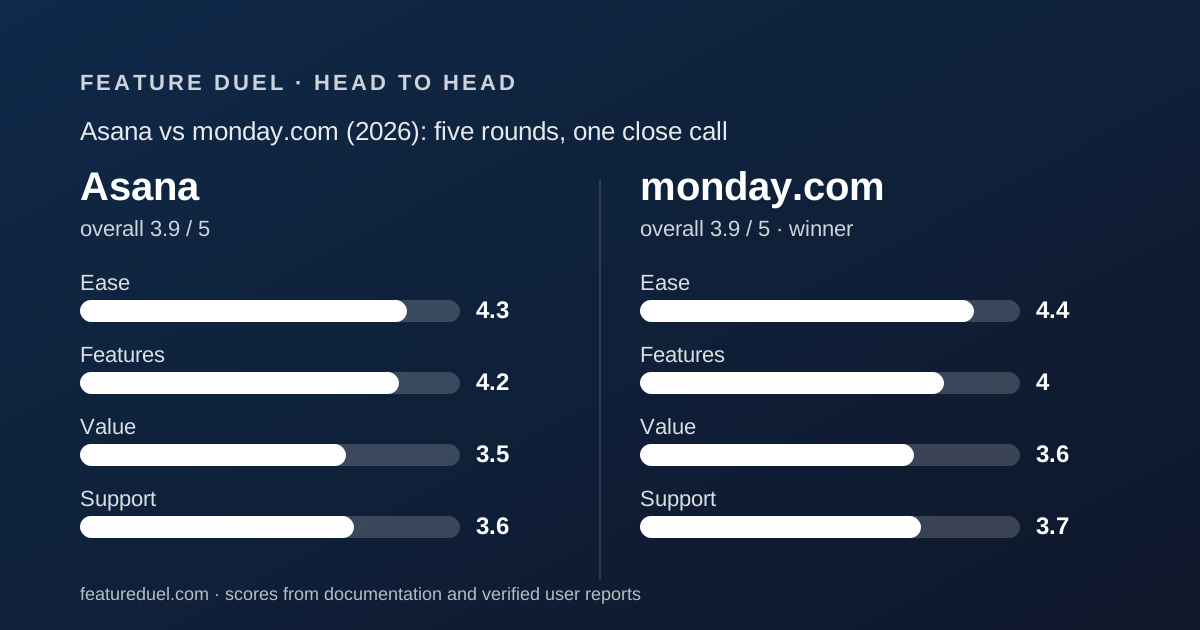
 3.9Asana
 3.9monday.com
Specification by specification
| Spec | Asana | monday.com |
|---|---|---|
| Cheapest paid tier (annual) | Starter $10.99/user/mo | Basic $9/seat/mo |
| Tier with automations and Gantt | Starter $10.99 | Standard $12 |
| Monthly billing | Starter $13.49, Advanced $30.49 | Not discounted; figures not readable on page |
| Free plan | 2 users, unlimited projects | 2 seats, 3 boards, 3 Docs |
| Seat minimum | None; blocks of 5 from 6 to 30 users | 3 users on paid plans |
| Automation quota | Unlimited from Starter | 250/mo Standard, 25,000/mo Pro |
| Integration count | Hundreds listed; no total printed | 850+ claimed |
| Free trial | Not mentioned | 14-day Pro trial |
| Portfolio and resource management | Advanced $24.99 | Enterprise only |
| Published support by tier | Not published | 24/7 stated on Enterprise only |
| Team of 10, comparable tier | $109.90/mo (Starter) | $120/mo (Standard) or $190 (Pro) |
| Ease / Features / Value / Support | 4.3 / 4.2 / 3.5 / 3.6 | 4.4 / 4.0 / 3.6 / 3.7 |
The short answer
monday.com wins this duel 3 rounds to 2, and it is the closest result in the project management cluster. The overall winner is whoever takes the rounds that matter for your team, so read the two bullets before the scorecard.
- Asana is best for teams whose work is tasks with one owner and a due date, who automate heavily and do not want a monthly action quota, and who expect to need portfolios and goals before they need an enterprise contract
- monday.com is best for teams of 3 to 40 who think in boards and status columns, want a dashboard a manager can read in week one, and will budget for Pro rather than Standard
- Winner on rounds: monday.com takes onboarding, integrations and support; Asana takes core workflow and pricing
- Disclaimer: this is a documentation review. Scores come from pricing pages, help centers and integration directories checked October 10, 2026, not from staged demos
Round 1, onboarding: monday.com gets a team working sooner
monday.com takes the first round because its mental model is already in every spreadsheet user's head. A board is rows and typed columns. The pricing page lists 200+ templates on every plan, including Free, so a team starts from something rather than nothing.
The 14-day free trial of the Pro plan, stated in monday.com's pricing FAQ, is the other decider. A team evaluates the full product with real work. Asana's pricing page does not mention a trial at all.
Asana is not slow to learn. Task, owner, date, project is a simple rule and the Help Center's 3:41 getting-started video and 25-minute Academy paths are public. But custom fields and rules, the things that make Asana feel like Asana, are behind the Starter paywall.
monday.com's weakness here is the plan ladder. Timeline, Gantt and calendar views do not appear until Standard. Round to monday.com, by a little. Ease scores: monday.com 4.4, Asana 4.3. Full reasoning is in the monday.com review and the Asana review.
Round 2, core workflow: Asana wins on structure and unmetered automations
Asana takes the core workflow round decisively. Two documented facts settle it.
First, Asana's pricing page lists unlimited automations from Starter upward, with no monthly action quota. monday.com's Standard tier caps automation actions at 250 per month and integration actions at another 250. Pro lifts both to 25,000.
Editorial calculation: a 10-person team changing 3 statuses each per working day generates about 660 status changes a month. One monday.com rule on that trigger exhausts Standard's quota before day 9. On Asana the same rule runs all month on the cheapest paid tier.
Second, the roll-up layer. Asana's Advanced tier at $24.99 includes unlimited portfolios, goals, workload and resource management. monday.com puts portfolio and resource management on Enterprise, which is quoted by sales.
monday.com's board engine is excellent for status-driven work, and dashboards arrive earlier in its ladder. But a project manager's core workflow is dependencies, ownership and automation, and Asana prices those lower. Features scores: Asana 4.2, monday.com 4.0.
Round 3, integrations: monday.com claims more and prints the number
monday.com takes the integrations round on breadth and transparency. Its marketplace page states 850+ integrations and apps, naming Slack, Microsoft Teams, Gmail, Outlook, Zoom, Salesforce, HubSpot, Zendesk, GitHub, GitLab, Jira, QuickBooks, Mailchimp, Zapier and Make.
It also lists official connectors for Claude, Copilot and ChatGPT through the monday MCP, which matters to teams wiring AI assistants into their boards, per the page checked October 10, 2026.
Asana's apps directory is deep, covering communication, files, connectors, AI, development, sales, finance, security, reporting and time tracking, with Salesforce, Tableau and Power BI connectors on Advanced. But the directory prints no total, and Asana's free plan advertises 100+ integrations without a higher figure elsewhere.
The asterisk on monday.com's win is the same quota from round 2: integration actions are metered at 250 per month on Standard. Breadth you cannot afford to run is breadth on paper. Round to monday.com, with that warning attached.
Round 4, pricing: Asana costs less at tier parity and has no seat minimum
Asana takes the pricing round once you compare like with like. The tier that includes automations and Gantt is Starter on Asana at $10.99 per user per month billed annually, and Standard on monday.com at $12, per both pricing pages checked October 10, 2026.
For a team of 10, editorial calculation: Asana Starter $109.90 per month, monday.com Standard $120. If the team automates, monday.com's realistic tier is Pro at $19, or $190 per month, because of the 250-action cap. Asana stays at $109.90.
monday.com has two counters. Basic at $9 is the cheapest sticker in the duel, though it lists no automations and no Gantt. And monday.com's seat rules are simpler: a 3-user minimum and nothing else.
Asana's seat blocks are its weak spot. From 6 to 30 users, seats are added in fives. A 7-person team buys 10 Starter seats, $109.90 instead of $76.93. A 12-person team buys 15. monday.com charges for 7 or 12.
Below 3 users the picture flips again: monday.com's paid floor is 3 seats, so a pair pays $27 on Basic. Asana sells 2 seats. Free plans are a wash at 2 users each, with monday.com adding a 3-board cap.
Net: Asana wins for teams of 5, 10, 15, 20 or any multiple of 5, and for anyone who automates. monday.com wins for odd team sizes that sit on Basic or Standard and barely automate.
Value scores: monday.com 3.6, Asana 3.5, which reflects how close this is. Annual billing vs monthly billing covers the commitment question for both.
Round 5, support: monday.com publishes a little; Asana publishes less
This is the thinnest round in the duel, because neither vendor prints a per-tier support table. monday.com takes it narrowly on two published facts.
monday.com's pricing page states 24/7 expert support, tailored onboarding and extensive training on Enterprise. It lists nothing for Basic, Standard or Pro. The 14-day Pro trial counts here too, as a commitment to let buyers see the product before paying.
Asana's pricing page lists a Help Center, direct Asana Support and Customer Success options with eligibility requirements, but attaches no tier to any of them.
The Asana Help Center, Academy and community forum are public and well organised, and the forum runs in English and Japanese.
We attempted to read support.monday.com on October 10, 2026 and it blocked automated reads. We score what we could read. Support scores: monday.com 3.7, Asana 3.6. ClickUp, which prints support against every tier, beats both; see ClickUp vs Asana.
The seat maths at 2, 7, 12 and 25 people
The sticker prices hide the real gap, so here is the editorial arithmetic for four team sizes, using the annual per-seat prices on both pricing pages checked October 10, 2026. Asana figures use Starter and apply the seat blocks. monday.com figures show Standard and Pro.
At 2 people both are free, with monday.com capped at 3 boards. If the pair needs automations, Asana Starter is $21.98 and monday.com's 3-seat minimum makes Standard $36 or Pro $57.
At 7 people Asana charges for 10 seats: $109.90. monday.com charges for 7: $84 on Standard or $133 on Pro. Asana overpays here unless the team automates, in which case Standard's 250 actions will not last and Pro's $133 beats Asana by only $23.
At 12 people Asana charges for 15 seats: $164.85. monday.com Standard is $144, Pro $228. The same pattern: monday.com wins on Standard, loses on Pro.
At 25 people Asana's block is exactly 25: $274.75. monday.com Standard is $300 and Pro $475. Asana wins outright at this size, and by a wide margin against the tier a 25-person team would actually need.
- 2 people: both free; with automations, Asana $21.98 vs monday.com $36 to $57
- 7 people: Asana $109.90 (10 seats) vs monday.com $84 Standard or $133 Pro
- 12 people: Asana $164.85 (15 seats) vs monday.com $144 Standard or $228 Pro
- 25 people: Asana $274.75 vs monday.com $300 Standard or $475 Pro
Where AI sits in each plan
Both vendors meter AI, and the meters are shaped differently. Asana's pricing page lists 5 AI requests per user per month on paid tiers, capped at 50 per account on Starter and Advanced and 250 on Enterprise.
Asana adds AI Studio credits of 50K, 75K and 200K per billing account per month on the three paid tiers.
monday.com's pricing page lists AI credits per month per tier: 1,000 on Basic, 2,000 on Standard, 3,000 on Pro, custom on Enterprise.
Basic includes limited AI agents, Sidekick and the Vibe app builder; Standard adds the Notetaker and AI columns; Pro adds the AI workflow builder.
Neither page defines what one request or one credit buys in plain terms, so we do not compare them as equivalent units. The practical difference is that monday.com's allowance grows with the tier and Asana's is a flat per-user ration with an account ceiling.
If AI features are the reason you are buying, neither vendor's page gives enough to decide. Ask for the credit consumption table before you sign.
How the five rounds weigh for three kinds of team
The fixed scorecard says monday.com by 3 to 2. The overall winner for you depends on which rounds carry weight, so here is how the duel reads for three common teams.
A 6-person operations team tracking requests and vendors. Onboarding and integrations dominate. The team wants a board this week and a dashboard for the manager. monday.com on Standard, with Pro budgeted if automations grow. Asana's seat block would charge for 10.
A 15-person product team with dependencies and quarterly goals. Core workflow and pricing dominate. The team needs dependencies, unmetered rules and a roll-up to goals. Asana on Starter, moving to Advanced for portfolios. monday.com's equivalent roll-up is Enterprise.
A 10-person agency with many client guests. Pricing dominates and guests decide it. Asana Starter includes unlimited free guests at $109.90.
monday.com includes unlimited free viewers from Basic and guest access from Standard at $120, but the 250-action cap pushes an automating agency to Pro at $190.
In two of the three cases Asana's two rounds outweigh monday.com's three. That is why the headline tally should be read with the bullets in the short answer, not instead of them.
What users report
G2, Capterra and TrustRadius blocked automated reads of both products' pages on October 10, 2026. This duel therefore quotes no aggregate ratings and no review counts for either tool.
The public forum.asana.com is a usable proxy for Asana's community responsiveness. monday.com's equivalent community sits behind the support domain we could not read. When the aggregator pages open up, the figures will be added here with the date checked.
Choose Asana if
Asana is the right pick when the following describe your team.
- Your work is tasks with one owner and one due date, with dependencies between them
- You automate a lot and refuse to count actions every month
- You will need portfolios, goals and workload before you need an enterprise contract; Advanced at $24.99 has them
- Your headcount sits on a multiple of 5, so the seat blocks cost nothing extra
- You have many client or stakeholder guests; Starter includes unlimited free guests
Choose monday.com if
monday.com is the right pick when these fit better.
- Your team pictures work as a board with status columns, not a task list
- A manager needs a dashboard in week one without a consultant
- You want to try before you buy; the 14-day Pro trial is the only published trial in this cluster
- You can budget for Pro at $19 per seat, because Standard's 250-action cap will not survive real use
- Your headcount is an awkward number like 7 or 12, where Asana's seat blocks would overcharge you
Bottom line
monday.com wins 3 rounds to 2 on the fixed scorecard: onboarding, integrations and support. Asana wins core workflow and pricing, and those two rounds decide it for any team that automates or expects to grow into portfolios.
If your team is visual and operational, buy monday.com, start on the Pro trial and budget for Pro. If your team is task-driven and growing, buy Asana and round your headcount up to the next block of 5 before you compare invoices.
If the real question is whether to buy a platform at all, settle all-in-one suite vs best-of-breed stack first. If the seat maths tempts anyone toward a shared account, read shared login vs a seat per person.
The scoring rules for every duel are in how a duel is scored and the editorial policy. The third fighter in this cluster is scored in ClickUp vs Asana and the ClickUp review.
Frequently asked
Which is cheaper for a 10-person team, Asana or monday.com?
Asana, at tier parity. Starter is $109.90 per month billed annually against monday.com Standard at $120, by editorial calculation from both pricing pages on October 10, 2026. If the team automates, monday.com's realistic tier is Pro at $190.
Does monday.com limit automations more than Asana?
Yes. monday.com Standard allows 250 automation actions and 250 integration actions per month, Pro allows 25,000 each. Asana lists unlimited automations from Starter upward with no quota, per both pricing pages checked October 10, 2026.
Can I switch from Asana to monday.com, or back?
Both vendors document import paths for common tools, and monday.com's marketplace lists an Asana connector. Field mapping and automation rules do not transfer cleanly on either side, so plan to rebuild rules and test with a copy of one project first.
Which has the better free plan?
They are close. Asana's Personal plan is 2 users with unlimited projects and tasks. monday.com's Free plan is 2 seats with 3 boards and 3 Docs. Neither is a team trial; monday.com's 14-day Pro trial is the better evaluation route.
Which is easier to learn, Asana or monday.com?
By the vendors' own documentation, monday.com. Its board model mirrors a spreadsheet and 200+ templates ship on every plan. Asana's task model is also simple, but custom fields and rules sit behind the Starter paywall. Ease scores are 4.4 and 4.3.
Visit Asana
We have no affiliate relationship with this vendor. Link goes to the official site.
Visit monday.com
We have no affiliate relationship with this vendor. Link goes to the official site.