 Feature
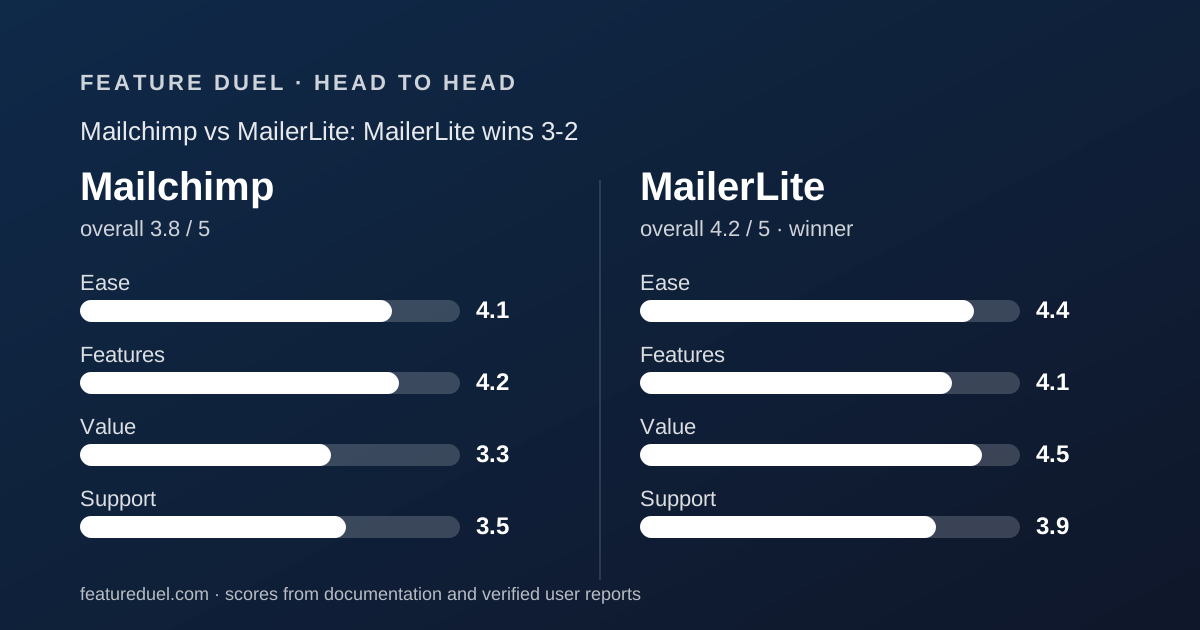
Mailchimp vs MailerLite: MailerLite wins 3-2
Mailchimp and MailerLite meter the same thing, contacts, and disclose it on opposite principles. MailerLite prints thirty subscriber rungs in two currencies, with monthly and annual rates side by side, before you create an account. Mailchimp prints a richer feature grid, no annual price below 10,000 contacts, and a clause saying it will bill overages automatically rather than pause a campaign. Both pages were read on October 28, 2026, from rendered markup and from each vendor's published pricing file where one exists. MailerLite takes three rounds to two. The two rounds it loses are the two that matter most to an ecommerce team.
 3.8Mailchimp
 4.2MailerLite
Specification by specification
| Spec | Mailchimp | MailerLite |
|---|---|---|
| Entry paid price | Essentials $13/mo at the included 500 contacts | Comfort $12/mo at 500 subscribers |
| Second paid plan | Standard $20/mo, 5 seats | Power $25/mo, unlimited seats |
| Top published plan | Premium $350/mo at the included 10,000 contacts | Power $1,119/mo at 200,000 subscribers |
| Annual price published | No. Annual plans are Premium, or Standard at 10,000-plus contacts, by sales quote | Yes. $10.80/mo on Comfort and $22.50 on Power |
| Published price rungs | Contact tiers set by an on-page selector | Thirty, from 500 to 200,000 subscribers, in USD and EUR |
| Free plan sends | 500 a month, with a maximum of 250 a day | 2,500 a month |
| Free plan contacts | 250, in a single audience | 250 active subscribers |
| Free plan seats | 1 | 2 |
| Automation on the free plan | Not included | 3 active automations, up to 5 steps |
| Seats on the entry paid plan | 3 | 3 |
| Automation depth | 4 steps on Essentials; up to 200 steps with branching on Standard | 100 steps on both paid plans |
| Send allowance | 10 times contacts on Essentials, 12 on Standard, 15 on Premium | 10 times the subscriber tier ceiling on Comfort; unlimited on Power |
| Going over the limit | Billed automatically as an overage after the trial | Paid accounts move up a rung automatically; free accounts lock sending |
| Duplicate contacts | Counted once for every audience they appear in | Counted once, by active status |
| Transactional email | A separate transactional product, not priced on the marketing page | A separate product, MailerSend, with its own pricing |
| Trial | 14 days on Standard or Essentials | 14 days of premium features, no credit card |
| Support on the free plan | Email for the first 30 days | Knowledge base |
| Published service level | None on the pricing page | None on the pricing page |
The short answer
Two sentences, then five rounds of evidence.
- MailerLite is best for a newsletter, a small business list or any buyer who wants the price of their next three growth rungs printed before signing
- Mailchimp is best for an online store that needs branching lifecycle automation, more than five seats, or integrations with software MailerLite has never heard of
The scorecard, round by round
Rounds fixed before either page was read. The rubric is in how a duel is scored.
- Round 1, the free plan: MailerLite
- Round 2, what the entry paid plan includes: MailerLite
- Round 3, automation depth: Mailchimp
- Round 4, price disclosure and bill predictability: MailerLite
- Round 5, ceilings at the top end: Mailchimp
MailerLite's free plan is a working account; Mailchimp's is a sampler
Round 1 goes to MailerLite, and the margin is wide.
Both free tiers stop at 250 contacts. Everything after that diverges.
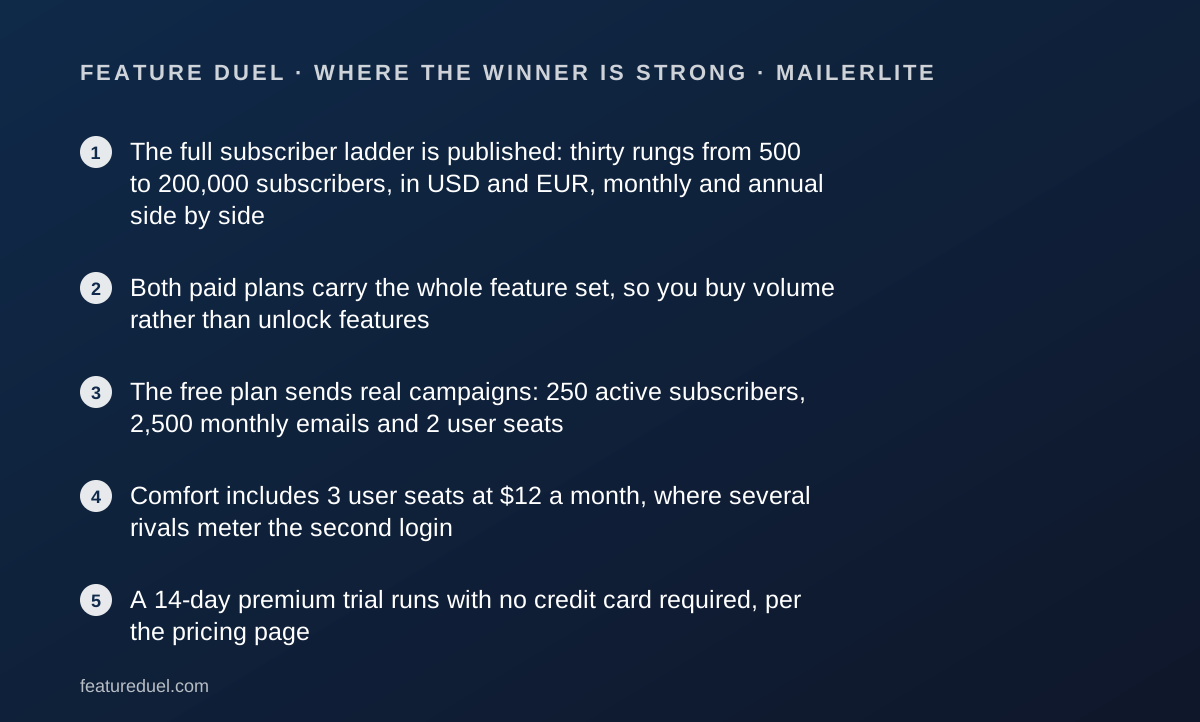
MailerLite gives 2,500 emails a month, 2 user seats, 3 active automations, 1 website, 1 landing page, 3 signup forms and all three email editors, including custom HTML.
Mailchimp gives 1 seat, 1 audience and up to 500 sends a month with a hard cap of 250 in a day. Marketing automation flows read Not included. Role-based access reads Not included. Custom-coded templates read Create, upgrade to send.
Five hundred sends a month is two campaigns to a 250-person list. MailerLite allows ten.
Support differs too. Mailchimp offers email support for the first 30 days of a free account. MailerLite offers the knowledge base, permanently.
Neither free tier is where you run a business. Only one is where you can genuinely test the product.
At the entry price the seats tie and the feature sets do not
Round 2 goes to MailerLite on a dollar and a principle.
Mailchimp Essentials is $13 a month with 500 contacts included. MailerLite Comfort is $12 a month at 500 subscribers. Both include 3 user seats.
The send allowances also land close. Essentials gives ten times your contact count, which is 5,000 at the included tier. Comfort gives ten times the ceiling of your subscriber tier, which is also 5,000 there. Both figures are our arithmetic on the vendors' stated multipliers.
The difference is what is withheld. Essentials caps automation flows at 4 steps, allows 3 audiences and 2 roles, and marks generative AI as Not included.
Comfort carries the entire MailerLite feature set. There is nothing a Power subscriber can build that a Comfort subscriber cannot, only more of it.
That is two philosophies, not two prices. One sells capability by tier, the other sells volume by tier.
The full workings are in our Mailchimp review and our MailerLite review.
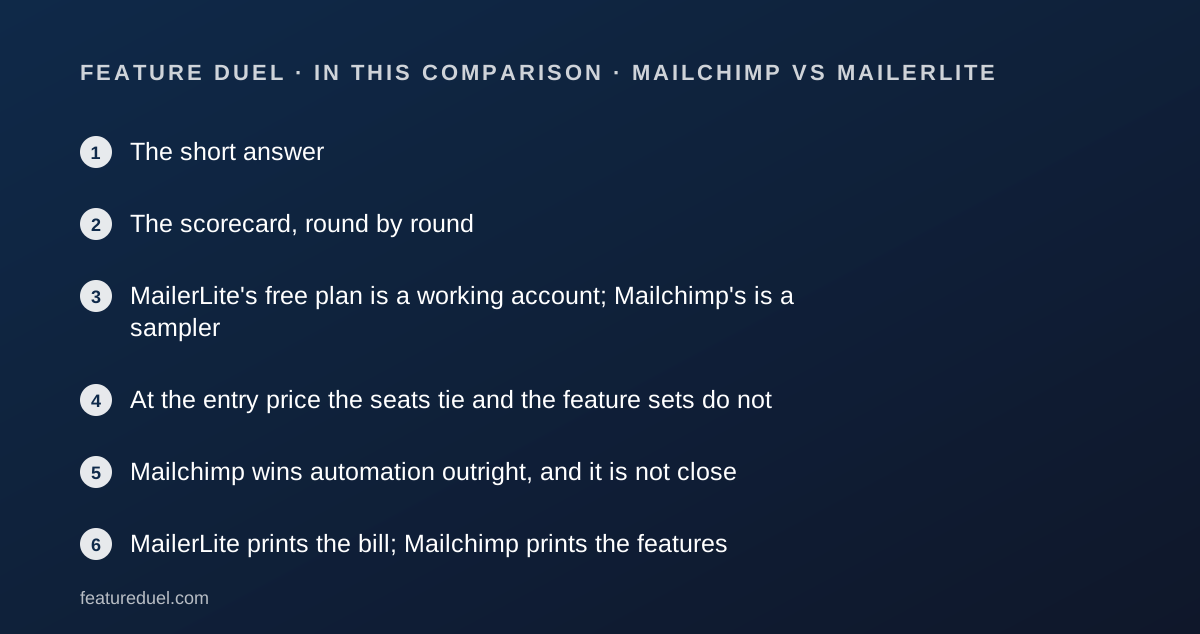
Mailchimp wins automation outright, and it is not close
Round 3 goes to Mailchimp, and for many buyers this round ends the argument.
Mailchimp Standard and Premium include automation flows of up to 200 steps per flow, with multiple branching points, and up to 200 flows.
MailerLite caps automation steps at 100 on both paid plans. Comfort allows 50 active automations and Power allows unlimited.
So MailerLite will run more journeys. Mailchimp will run deeper ones.
Branching is the real divide. A flow that asks did they open, did they buy, what did they buy, and sends a different message down each path, is a Standard-plan structure at $20 a month.
If your marketing is a weekly newsletter plus a welcome series, you will never touch the ceiling at either vendor. If it is abandoned carts, win-backs and post-purchase sequences, Mailchimp is built for that and MailerLite is not.
Note also that Essentials is excluded from this win. Four steps per flow is a welcome email, not a programme.
MailerLite prints the bill; Mailchimp prints the features
Round 4 goes to MailerLite, and it is the round we weight most heavily.
Three specific disclosures separate them.
First, the ladder. MailerLite publishes thirty subscriber rungs from 500 to 200,000, in USD and EUR, monthly and annual together. The 10,000-subscriber rung reads $89 on Comfort and $129 on Power.
Second, annual billing. MailerLite prints a 10 percent annual rate on both paid plans. Mailchimp's disclaimer limits annual plans to Premium and to Standard lists of 10,000 or more contacts, and routes buyers to sales for pricing and eligibility.
What Mailchimp offers instead is a 15 percent discount on the first twelve months. The cards print $11.05, $17 and $297.50, each exactly 15 percent below the monthly rate by our arithmetic. The banner above restricts the offer to businesses with 10,000 or more contacts.
So the discounted figure appears beside a 500-contact price while the offer text describes a much larger list. Confirm which applies at checkout.
Why that distinction matters is the subject of annual billing versus monthly billing.
Two clauses decide what your Mailchimp bill actually is
Still inside round 4, because disclosure is also about what happens after signup.
Mailchimp states that after the free trial, if you hit your contact or sending limit, it will automatically bill you for the overages. Campaigns are not stopped and the account is not paused as long as those charges are paid on time.
That is a genuine service for a business mid-launch. It is also a bill with no ceiling that the customer sets.
The second clause is quieter. Adding a contact to more than one audience counts them toward the plan's contact count as many times as they appear.
A company holding the same person on a customer list, a newsletter list and an event list is billed for three contacts.
MailerLite counts active subscribers once, by status, and excludes unsubscribed and bounced addresses. Its own trap is different: counting is cumulative within a billing cycle, so deleting an address mid-cycle does not reduce that cycle's count.
Both vendors raise your tier automatically. Only one of them also bills for overage on top.
At the top end Mailchimp removes ceilings MailerLite keeps
Round 5 goes to Mailchimp.
Mailchimp Premium is $350 a month at its included 10,000 contacts. For that it removes two limits entirely: unlimited seats and unlimited audiences, plus 5 roles and a send allowance of 15 times contacts.
MailerLite Power gives unlimited seats from $25 a month, which is cheaper, but its published ladder stops at 200,000 subscribers. Above that, Enterprise is quoted by sales.
Where Mailchimp pulls ahead is the surrounding ecosystem. The page advertises more than 300 integrations, with Shopify, WooCommerce, Square, Stripe, Salesforce and the rest named on the card.
For a store, that list is the product. If your platform is Shopify, the connector depth often decides the purchase before any price does. Our guide to ecommerce platforms for a small store covers what each platform already sends on its own.
Mailchimp also publishes a high-volume path: more than 200,000 contacts goes to sales, and above 250,000 there are several plan options.
Neither vendor publishes a price in that territory, so both rounds end on a quote.
Seats: identical at the entry, divergent at the second rung
This row deserves separating out because it is where mid-sized teams get caught.
Mailchimp runs 1 seat on Free, 3 on Essentials, 5 on Standard and unlimited on Premium. Roles run 2, 4 and 5 across the paid plans, with role-based access absent from Free.
MailerLite runs 2 seats on Free, 3 on Comfort and unlimited on Power.
So the sixth person in a Mailchimp account costs $350 a month, while the fourth person in a MailerLite account costs $25.
That is a 14-fold difference for the same requirement, and it has nothing to do with list size.
Teams respond to seat caps by sharing a login, which is the worst available answer. We explain why in shared login versus a seat per person.
Support: more channels at Mailchimp, no commitment at either
A draw, and a familiar one in this category.
Mailchimp gives email support for the first 30 days on Free, email and chat on Essentials and Standard, and priority email and chat plus English-language phone support on Premium.
MailerLite gives the knowledge base on Free, 24/7 email on Comfort, and 24/7 live chat plus priority email on Power.
Neither pricing page printed a response time target or an uptime figure we could read on October 28, 2026.
On channels alone Mailchimp is broader. On price per channel MailerLite is better, because live chat arrives at $25 rather than $350.
We grade what a vendor puts in writing, so neither earns credit for a commitment that is not published.
The claims we excluded from the score
Mailchimp's pricing page carries marketing claims that a buyer should discount, and we did.
The number one email marketing platform badge is footnoted to December 2023 publicly available data on competitors' customer numbers. That is a nearly three-year-old comparison still printed in 2026.
The 27 times return figure is attributed to Standard plan users' ecommerce revenue measured by the vendor between December 2024 and November 2025. It is a vendor measurement of vendor customers.
MailerLite's page carries its own: more than 1 million creators and businesses, with no method note attached.
None of these entered either score. Our rubric uses published prices, published limits and published commitments only.
One vendor claim did change our reading, because it worked against the vendor. MailerLite's llms.txt states that its own rendered pricing page understates most subscriber tiers and points readers to the markdown file instead.
That is the opposite of marketing, and we took it at face value.
Choose Mailchimp if
Four conditions, any one of which outweighs the price difference.
- Your automations need branching, which Standard provides at up to 200 steps per flow
- You run an online store and the 300-plus integration list is doing real work for you
- You need more than five logins and can absorb the Premium price to remove the cap
- You would rather be billed for an overage than have a campaign paused in the middle of a launch
Choose MailerLite if
Four conditions pointing the other way.
- You want a free plan you can actually evaluate on, with 2,500 sends rather than 500
- You want an annual price without a sales call, published at $10.80 and $22.50 a month
- You keep the same people in several lists, because duplicates are not billed twice here
- You want to model growth on a spreadsheet tonight, using thirty published subscriber rungs
Bottom line
MailerLite takes the duel 3-2 on the free plan, the entry plan and the honesty of its price list.
For a newsletter, a consultancy, a charity or a small business list, there is no good reason to pay more for less disclosure.
Mailchimp wins the two rounds that an ecommerce team will care about most: branching automation from $20 a month, and an integration catalogue nothing in this price bracket matches.
The decision therefore is not which tool is better. It is whether your email is a newsletter or a lifecycle programme.
If it is a newsletter, take MailerLite and read MailerLite versus Brevo before you finalise, because a large quiet list changes that answer again.
If it is a lifecycle programme, budget for Mailchimp Standard rather than Essentials, and model the overage clause before you commit.
Frequently asked
Is MailerLite cheaper than Mailchimp?
At the entry tier, marginally: Comfort is $12 a month against Essentials at $13, both at 500 contacts. The larger saving is at the second rung, where unlimited seats cost $25 on MailerLite and $350 on Mailchimp Premium.
Which has the better free plan?
MailerLite, clearly. Both stop at 250 contacts, but MailerLite allows 2,500 sends a month, 2 seats and 3 automations. Mailchimp allows 500 sends a month, 1 seat, and no marketing automation flows at all.
Can I move my list from Mailchimp to MailerLite?
Contact imports are supported by both and neither pricing page publishes a lock-in clause. Automations and templates do not transfer, so plan rebuild time. De-duplicate first: Mailchimp bills a contact once per audience, MailerLite once by active status.
Does Mailchimp offer annual billing?
Not as a published price for small accounts. The disclaimer limits annual plans to Premium and to Standard plans of 10,000 or more contacts, through sales. MailerLite publishes annual rates of $10.80 and $22.50 a month on its two paid plans.
Which is better for an online store?
Mailchimp, on the published evidence. It advertises more than 300 integrations, branching automation of up to 200 steps from the $20 Standard plan, and commerce-specific flows. MailerLite's advantage is price transparency, not connector depth.
What happens if I exceed my plan limits?
Mailchimp states it bills overages automatically after the trial and does not pause campaigns if those charges are paid. MailerLite raises paid accounts to the next subscriber rung automatically, and locks sending on free accounts above 250 subscribers.
Visit Mailchimp
We have no affiliate relationship with this vendor. Link goes to the official site.
Visit MailerLite
We have no affiliate relationship with this vendor. Link goes to the official site.