 Feature

MailerLite
Four plans, a free tier at 250 subscribers, and the only price ladder in this category that prints all thirty subscriber rungs in USD before you sign up
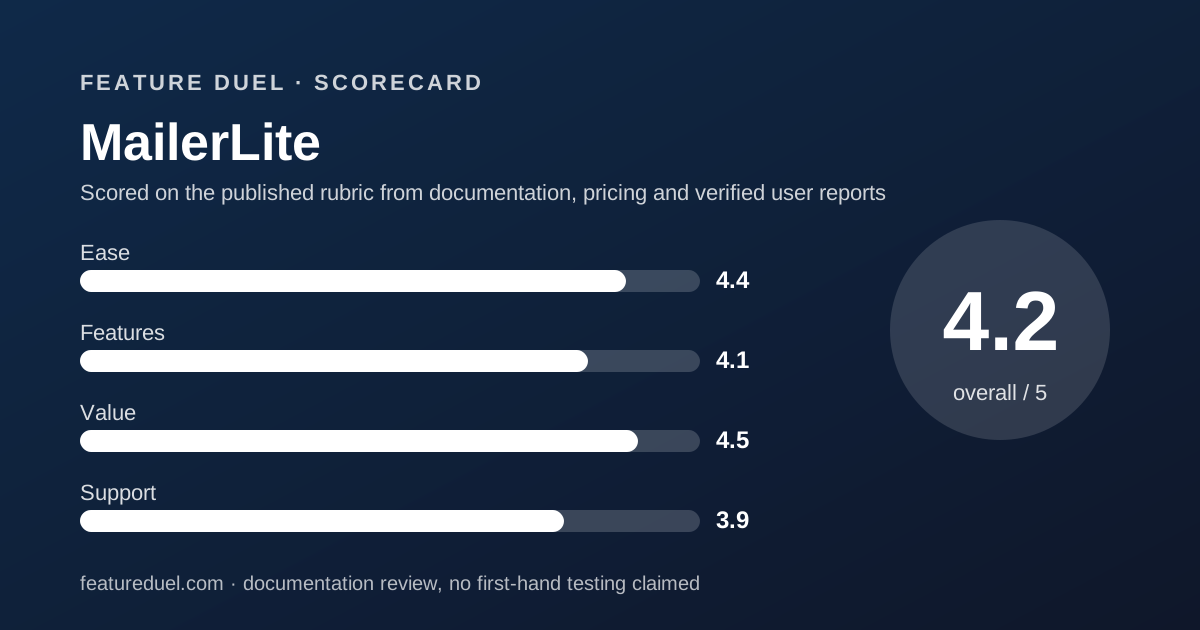
Scored on the published rubric, from documentation, pricing and verified user reports.
Best for: A newsletter or small business list that wants the price of its tenth subscriber rung printed before signing, three seats on the entry paid plan, and no interest in putting transactional email on the same invoice.
Verdict
MailerLite publishes more of its price ladder than anything else in this category, and it also tells you which of its own pages not to read. This is a documentation review. Every figure here comes from the MailerLite pricing markdown file and the rendered pricing page, both read on October 28, 2026, not from staged demos. Four plans exist: Free, Comfort, Power and Enterprise. Comfort starts at $12 a month and Power at $25 a month, both quoted at 500 subscribers, with annual billing cutting 10 percent to $10.80 and $22.50. Free covers 250 active subscribers, 2,500 monthly emails and 2 seats. The useful part is the table underneath: thirty subscriber rungs from 500 to 200,000, in USD and EUR, monthly and annual rates side by side. Almost nobody in this category prints that. The catch is the counting rule. Subscribers are counted cumulatively inside a billing cycle, so an address you delete mid-cycle still counts until your billing anniversary.
Visit MailerLite
We have no affiliate relationship with this vendor. Link goes to the official site.
Where it is strong
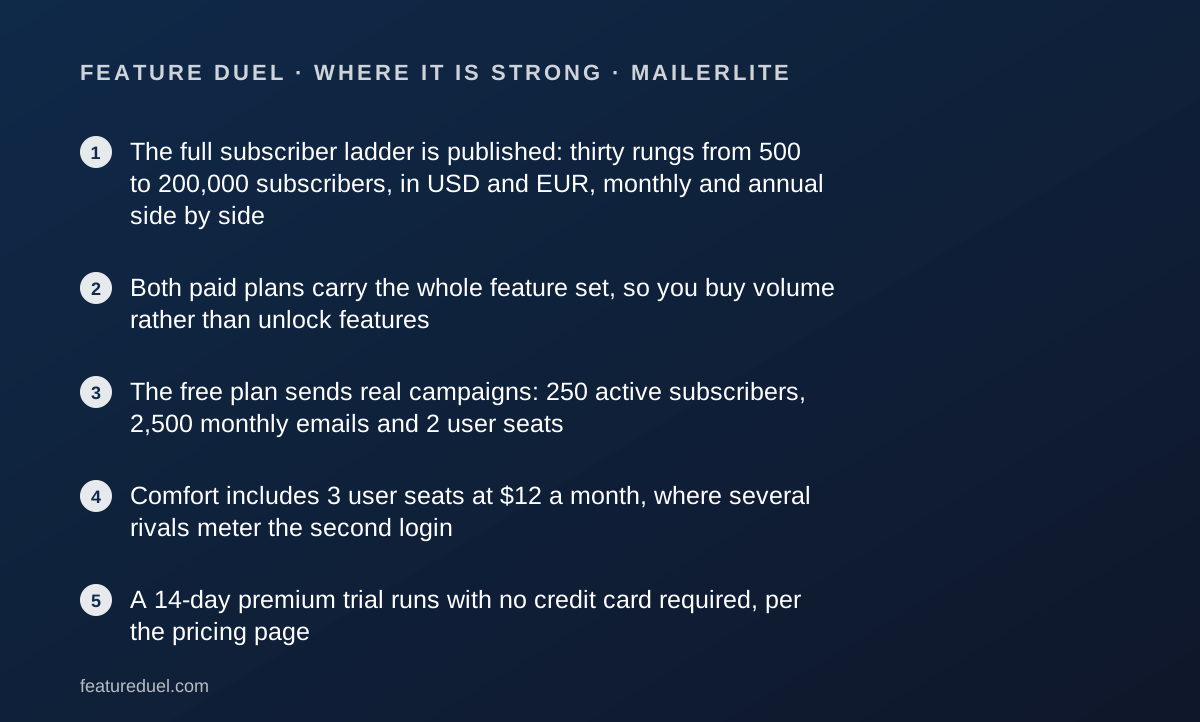
- The full subscriber ladder is published: thirty rungs from 500 to 200,000 subscribers, in USD and EUR, monthly and annual side by side
- Both paid plans carry the whole feature set, so you buy volume rather than unlock features
- The free plan sends real campaigns: 250 active subscribers, 2,500 monthly emails and 2 user seats
- Comfort includes 3 user seats at $12 a month, where several rivals meter the second login
- A 14-day premium trial runs with no credit card required, per the pricing page
- The vendor ships a machine-readable pricing file and states outright which page to trust
Where it falls short
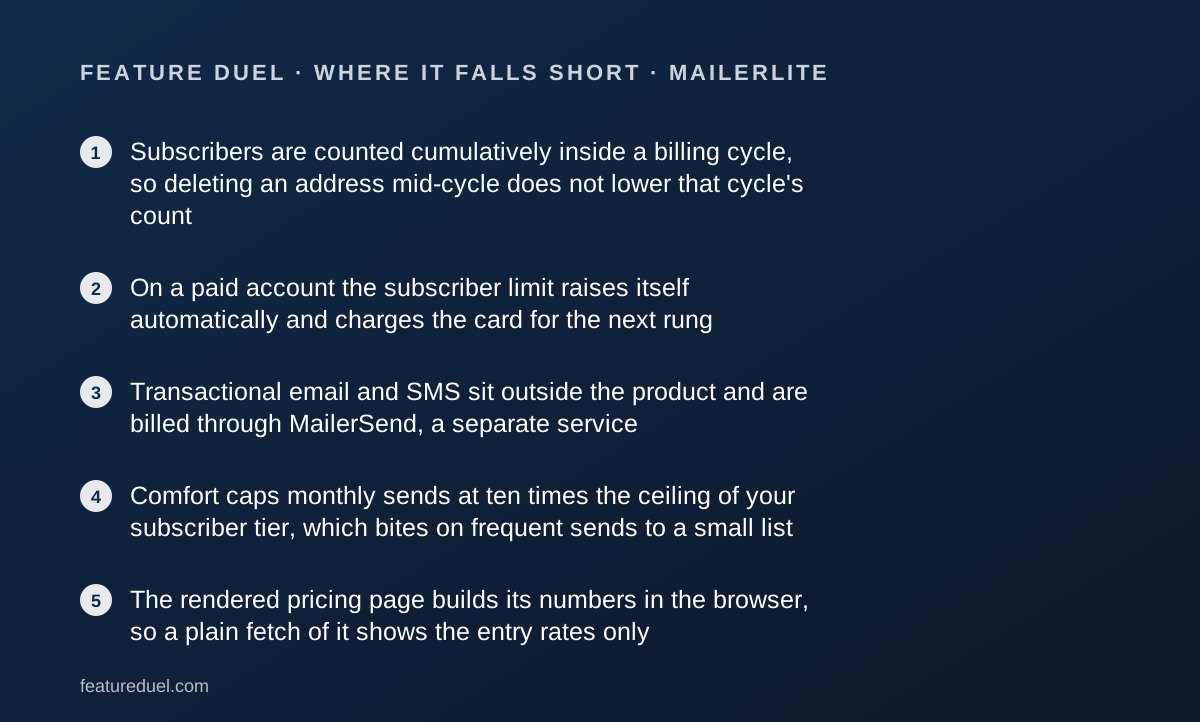
- Subscribers are counted cumulatively inside a billing cycle, so deleting an address mid-cycle does not lower that cycle's count
- On a paid account the subscriber limit raises itself automatically and charges the card for the next rung
- Transactional email and SMS sit outside the product and are billed through MailerSend, a separate service
- Comfort caps monthly sends at ten times the ceiling of your subscriber tier, which bites on frequent sends to a small list
- The rendered pricing page builds its numbers in the browser, so a plain fetch of it shows the entry rates only
At a glance
| Starting price | Comfort $12/mo and Power $25/mo, both quoted at 500 subscribers |
|---|---|
| Pricing note | From $12/mo on Comfort at 500 subscribers, or $10.80/mo billed annually, with Power at $25 and $22.50 (pricing markdown file and rendered pricing page, checked October 28, 2026) |
| Annual rate | $10.80 and $22.50 per month, a 10 percent cut, per the pricing markdown file |
| Free plan | 250 active subscribers, 2,500 monthly emails, 2 user seats |
| Trial | 14 days of premium features, no credit card required |
| Seats | Free 2, Comfort 3, Power unlimited |
| Monthly send limit | Free 2,500; Comfort ten times the ceiling of your subscriber tier; Power unlimited, subject to fair use |
| Active automations | Free 3, Comfort 50, Power unlimited |
| Automation steps | Free 5, Comfort 100, Power 100 |
| Sites and landing pages | Free 1 website and 1 landing page, Comfort 10, Power unlimited |
| Signup forms | Free 3, Comfort 10, Power unlimited |
| Published ladder | Thirty subscriber rungs from 500 to 200,000, in USD and EUR |
| Top published rung | 200,000 subscribers at $819 Comfort and $1,119 Power, monthly |
| Support | Free knowledge base only, Comfort 24/7 email, Power 24/7 live chat and email |
| Transactional email | Not included. Handled by MailerSend, a separate product with separate pricing |
What MailerLite actually is
MailerLite is an email marketing platform priced by active subscriber count, not by feature tier.
That sentence does more work than any feature list. Both paid plans carry the full toolset. What changes between them is volume, seats, and how many automations, sites and forms you may keep switched on.
The platform also builds landing pages, websites, signup forms, pop-ups and paid newsletter subscriptions. Transactional email and SMS are not part of it. Those run through MailerSend, a separate product with its own price list.
So a buyer weighing this against a marketing suite is weighing two different shapes. Our note on all-in-one suites versus best-of-breed stacks sets out that trade in general terms.
Who MailerLite is best for
The published ladder favours a particular shape of sender. Read this list before the prices.
- Newsletter writers and small lists, where the free plan's 250 subscribers and 2,500 monthly emails are enough to start
- Buyers who want to see the cost of their fifth and tenth growth rung before committing, since all thirty rungs are printed
- Small teams of two or three, because Comfort includes 3 seats rather than charging for the second login
- Creators selling digital products or paid subscriptions, which the product handles natively from the Comfort plan
- Anyone who already sends transactional mail elsewhere and does not want it bundled into a marketing bill
Who should skip it
Three groups will find the model works against them.
- Senders who need receipts, password resets and newsletters on one invoice, since transactional mail lives in MailerSend
- Teams that clean lists mid-cycle and expect the bill to drop, which the cumulative counting rule prevents
- Lists above 200,000 subscribers, where the published table stops and Enterprise pricing is quoted by sales
What the free plan includes as of October 2026
The free plan is a working account, not a crippled demo.
It carries 250 active subscribers, 2,500 monthly emails and 2 user seats. Support on that tier is the knowledge base alone.
Feature-wise it includes campaigns, all three email editors, 3 automations, 1 website, 1 landing page, 1 digital product or booking, 3 signup forms and more than 100 integrations.
One limit is worth reading twice. Pass 250 active subscribers on a free account and sending locks for both campaigns and automations. You either upgrade or remove active subscribers to start sending again.
API and MCP access on Free is described as limited and does not include sending. That is a real constraint for anyone wiring a signup flow together before paying.
What each paid plan costs at 500 subscribers
Both paid rates are quoted at the entry rung of 500 subscribers.
Comfort is $12 a month, or $10.80 a month billed annually. Power is $25 a month, or $22.50 billed annually.
The discount label on the rendered page reads Save 10%. Ten percent off $12 is $10.80 and ten percent off $25 is $22.50, so the printed annual rates and the advertised discount agree exactly. That check is ours, run on the vendor's own figures.
Annual billing at this size saves $14.40 a year on Comfort and $30 on Power, by the same arithmetic. Whether that is worth a year of commitment is the question our note on annual billing versus monthly billing is built around.
The subscriber ladder is the real price, and it is published in full
The headline rate is almost irrelevant. What you will actually pay depends on which rung your list lands on.
MailerLite prints all thirty rungs in USD and EUR. A sample from the USD table, read October 28, 2026:
- 1,000 subscribers: Comfort $19, Power $39 monthly
- 5,000 subscribers: Comfort $49, Power $69 monthly
- 10,000 subscribers: Comfort $89, Power $129 monthly
- 50,000 subscribers: Comfort $319, Power $389 monthly
- 100,000 subscribers: Comfort $439, Power $489 monthly
- 200,000 subscribers: Comfort $819, Power $1,119 monthly
Why that table is the finding, not the footnote
A buyer is not choosing a price. A buyer is choosing a curve.
From 500 to 10,000 subscribers the Comfort rate moves from $12 to $89. That is roughly seven and a half times the money for twenty times the list, which is our arithmetic on the vendor's published rows.
The gap between the two paid plans also narrows as lists grow. At 500 subscribers Power costs more than twice Comfort. At 100,000 it is about 11 percent more.
That shape matters when you pick a plan on day one. Choosing Comfort to save $13 a month at launch is a different decision from choosing it to save $50 at 100,000 subscribers.
The vendor tells machine readers not to trust its own pricing page
This is unusual enough to record.
The MailerLite llms.txt file states that the HTML pricing page renders its prices with JavaScript, that a fetched copy therefore contains the starting prices only, and that quoting from it will understate what most subscriber tiers cost.
It then points readers at the markdown file as the only source listing every tier.
That warning is accurate. A plain fetch of the rendered page does return the entry figures and the feature comparison grid, but the per-rung table is assembled in the browser from a script array.
For a buyer the practical lesson is simple. If a third-party article quotes a MailerLite price for a list your size, check it against the markdown file before believing it.
Ease of use: three editors and a trial that does not ask for a card
The onboarding story is clean on paper.
Every new account gets 14 days of premium features, and the pricing page prints No credit card required next to the free signup.
After the trial, premium features become unavailable unless you upgrade. The vendor states that nothing is deleted: subscribers, automations, forms and sites stay in the account.
Three editors ship on every plan, including the free one: a drag and drop editor, a stripped-back Simple editor and a custom HTML editor.
That last one being free is the detail worth noting. Several competitors treat custom HTML as a paid-tier feature. We score ease at 4.4 on documentation evidence, not on hands-off impressions.
Features: the whole set on every paid plan, metered by volume
The feature grid is unusual in that the differences are nearly all numbers.
Active automations run 3 on Free, 50 on Comfort and unlimited on Power. Automation steps run 5, 100 and 100. Websites and landing pages run 1 and 1, then 10, then unlimited.
Signup forms run 3, 10 and unlimited. Digital products and bookings run 1, 5 and unlimited.
Notice that automation steps are identical on the two paid plans. A buyer upgrading for more complex journeys gets more journeys, not deeper ones.
Multivariate testing, the AI writing assistant, dynamic content, auto-resend and the preference centre all arrive at Comfort. Power adds multiple automation triggers and partner discounts rather than new building blocks.
How subscribers are counted, which is where bills surprise people
This is the clause we would read first if we were buying.
Billing counts active subscribers, meaning anyone with an active status. Unsubscribed and bounced addresses do not count.
Counting is cumulative within each billing cycle. Any address active at any point during the cycle counts toward the limit even if you delete it later.
The vendor's own worked example is blunt. Delete subscribers on April 1 with a billing date of April 5, and those subscribers count toward your limit until April 4.
On a paid account the limit then raises itself automatically and the card is charged for the next rung. You are notified before you reach it, but the upgrade is not a decision you are asked to make.
Send limits are a second meter running behind the first
Subscriber count sets the price. Send volume sets a separate ceiling.
Free includes 2,500 emails a month. Comfort gives ten times the ceiling of your subscriber tier. Power is unlimited, subject to fair use.
The multiplier uses the top of your tier rather than your actual list. On the up-to-1,000 rung you get 10,000 emails a month whether you have 200 subscribers or 900.
One send to one subscriber counts as one email, so a campaign to 500 people spends 500 of the allowance.
A weekly newsletter plus two automations is comfortably inside that. A daily sender on a 900-person list is not, and will hit the Comfort ceiling before the month resets.
Seats: three on the entry paid plan, which is not the norm
Seat counts are where email tools quietly diverge.
MailerLite publishes 2 seats on Free, 3 on Comfort and unlimited on Power. There is no per-seat line item on the price card at any rung.
For a two-person business that difference is the whole comparison. A platform charging per user turns a $12 bill into a $24 bill before any list growth happens.
It also changes behaviour. Teams on seat-metered tools share one login, which is a security problem rather than a saving.
We set out why that trade rarely works in shared login versus a seat per person, and the same reasoning applies here.
Support: knowledge base, then email, then live chat
Support is the one ladder where the free plan is clearly thin.
Free gets the knowledge base. Comfort adds 24/7 email support. Power adds 24/7 live chat and is marked as priority on the email row.
No response time commitment is printed on the pricing page at any tier, and no uptime figure appears there either. We could not read a published service level from the pricing page on October 28, 2026.
That is the standard shape for this price bracket, and it is why our support score sits at 3.9 rather than higher.
Buyers who need a contractual response window will be talking to Enterprise sales, where the vendor lists SLA, NDA and custom DPA agreements.
The plan rename of June 2026 makes older reviews unreliable
A housekeeping point with real consequences for research.
The pricing file states that plan names changed on June 16, 2026. Growing Business became Comfort and Advanced became Power. Prices and limits were updated at the same time.
The vendor adds that any source using the old names is out of date.
That is a useful filter. An article quoting a Growing Business price is quoting a retired list, however recent the page's displayed date looks.
We mention it because this category is thick with affiliate pages that refresh the year in the title and nothing else. Our method note, how a duel is scored, explains why we pin every figure to a read date instead.
Limits stated by the vendor
Collected in one place, from the pricing file and pricing page read October 28, 2026.
- Free sending locks once active subscribers pass 250
- API and MCP access on Free is limited and excludes sending
- Comfort monthly sends are capped at ten times the subscriber tier ceiling
- Power sending is unlimited up to 200,000 subscribers, subject to fair use
- Above 200,000 subscribers, pricing is custom and quoted by sales
- Only one discount applies at a time: annual billing and nonprofit pricing do not stack
- Transactional email and SMS require MailerSend, which is billed separately
Alternatives
Three comparisons are worth running before you decide.
Against a marketing suite inside a CRM, the question is whether you want contacts and campaigns in the same database. HubSpot Sales Hub is the obvious version of that argument, and it prices on a different axis entirely.
Against a store platform's built-in email, the question is volume. If almost all your sending is order-driven, the tools bundled with Shopify may cover it without a second vendor. Our guide to ecommerce platforms for a small store covers what each one includes.
Against a cold outreach tool, the answer is that they are not substitutes. Our lemlist note explains why sequenced one-to-one sending and broadcast newsletters sit in different products.
Bottom line
MailerLite wins this category on disclosure, and disclosure is not a small thing when the price moves with your list.
Thirty published rungs in two currencies, monthly and annual side by side, plus a machine-readable file and an honest warning about which page lies. We have read worse pricing pages from vendors charging ten times as much.
The weaknesses are structural rather than hidden. Transactional mail is a second product. The cumulative counting rule means list hygiene pays off next cycle, not this one. Automatic upgrades happen without a confirmation step.
Buy it if you want to model three years of list growth on a spreadsheet tonight. Skip it if you need one invoice for every email your company sends.
Buy it if
- You want the price of your tenth subscriber rung printed before you sign, not discovered after
- Your team needs three logins and you would rather not pay per seat for them
- You send newsletters and automations and keep transactional mail on another invoice
- Your list will stay under 200,000 subscribers, which is where the published ladder ends
Skip it if
- You need marketing email and transactional email billed as one product
- You prune lists hard and expect deletions to lower the current cycle's bill
- You send very often to a small list, where the Comfort send multiplier runs out before the month does
Frequently asked
Is MailerLite really free?
There is a free plan, not a trial. It covers 250 active subscribers, 2,500 emails a month and 2 user seats, per the pricing page checked October 28, 2026. Pass 250 active subscribers and sending locks for campaigns and automations until you upgrade or remove subscribers.
How much does MailerLite cost for 10,000 subscribers?
The published USD table puts the 10,000-subscriber rung at $89 a month on Comfort and $129 on Power, or $80.10 and $116.10 billed annually. Those figures come from the vendor pricing markdown file, read October 28, 2026.
What is the difference between Comfort and Power?
Volume and ceilings, not features. Comfort gives 3 seats, 50 active automations, 10 sites and ten times your tier ceiling in monthly sends. Power gives unlimited seats, automations, sites and sends, subject to fair use, plus 24/7 live chat.
Did MailerLite rename its plans?
Yes. The pricing file states that on June 16, 2026 Growing Business became Comfort and Advanced became Power, with prices and limits updated at the same time. Any review still using the old names is quoting a retired price list.
Does MailerLite send transactional email?
Not inside the marketing product. The vendor routes transactional email, SMS and inbound routing through MailerSend, which is priced separately. Budget two invoices if you need receipts and newsletters from the same company.
How are subscribers counted for billing?
By active subscribers, cumulatively within each billing cycle. The pricing file states that any address active at any point in the cycle counts toward the limit even if you delete it later. The count resets on your billing anniversary.
Sources
- MailerLite pricing, markdown version with every subscriber tier - checked October 28, 2026
- MailerLite pricing page, rendered - checked October 28, 2026
- MailerLite llms.txt, vendor summary for machine readers - checked October 28, 2026
Update history
- October 28, 2026 - First published. Prices read from the vendor pricing markdown file and rendered pricing page on October 28, 2026.
Visit MailerLite
We have no affiliate relationship with this vendor. Link goes to the official site.