 Feature

Jotform
The deepest set of printed limits in this category, a 30-day money-back guarantee, and a pricing page that gives two different answers about how many people can use the account.
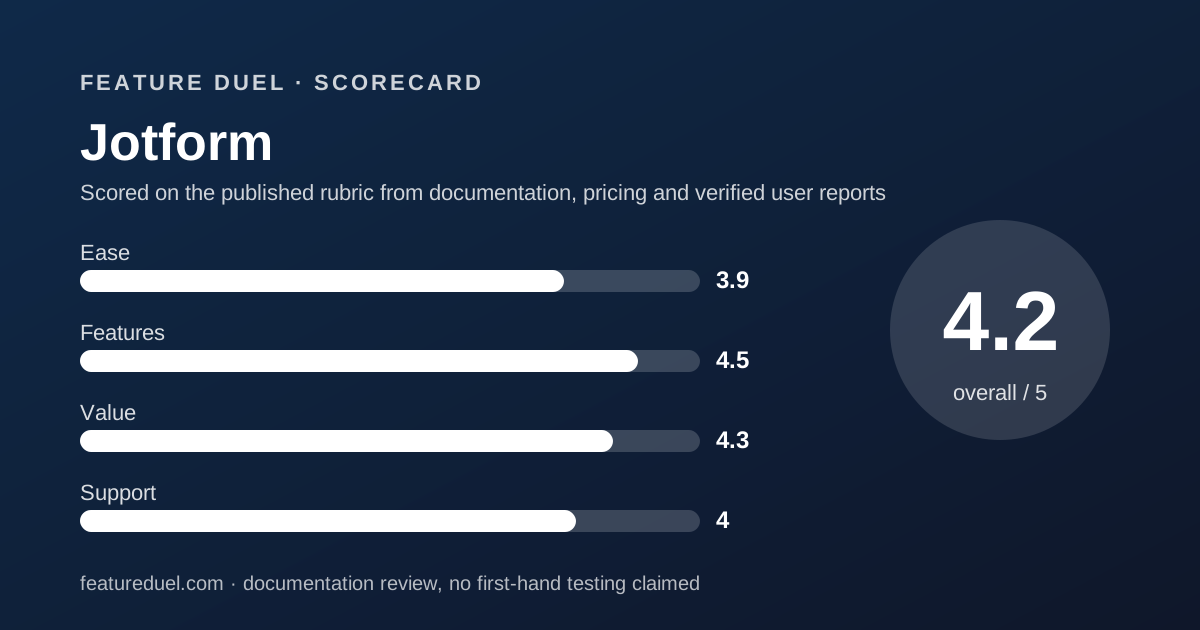
Scored on the published rubric, from documentation, pricing and verified user reports.
Best for: A business that wants every limit printed before it pays, that collects more submissions than it has colleagues, and that can live with one named login until it needs an Enterprise quote.
Verdict
Jotform prints more of its own limits than anything else in this category, and that is the main reason to buy it.
Nine metered figures appear on every plan card: forms, monthly submissions, users, storage, monthly form views, total submission storage, fields per form, monthly payment submissions and monthly signed documents.
The ladder is good value. Bronze is $39 a month or $408 a year and raises monthly submissions from 100 to 1,000. Silver at $468 a year allows 2,500 and Gold at $1,188 allows 10,000.
One number is not safe to rely on. Every card reads 1 User, Individual Plan, and the FAQ states Enterprise is the only multiuser Jotform plan. The plan data embedded in the same page instead carries three, ten and a hundred sub-users for Bronze, Silver and Gold.
This grade comes from a documentation review of the rendered pricing page, its embedded plan data and its FAQ, not from use.
Visit Jotform
We have no affiliate relationship with this vendor. Link goes to the official site.
Where it is strong
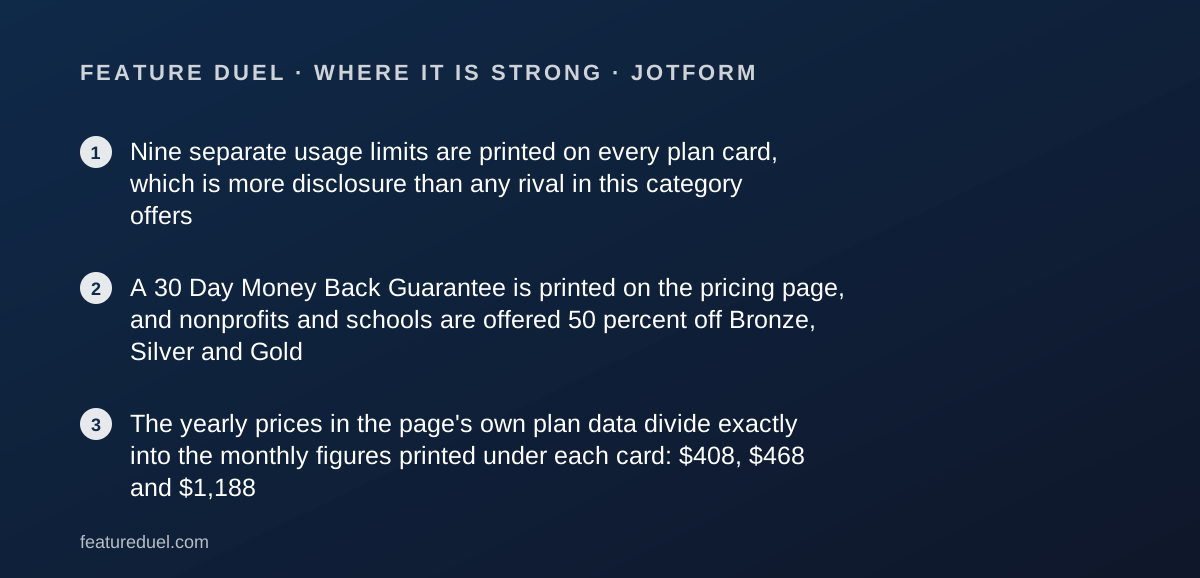
- Nine separate usage limits are printed on every plan card, which is more disclosure than any rival in this category offers
- A 30 Day Money Back Guarantee is printed on the pricing page, and nonprofits and schools are offered 50 percent off Bronze, Silver and Gold
- The yearly prices in the page's own plan data divide exactly into the monthly figures printed under each card: $408, $468 and $1,188
Where it falls short
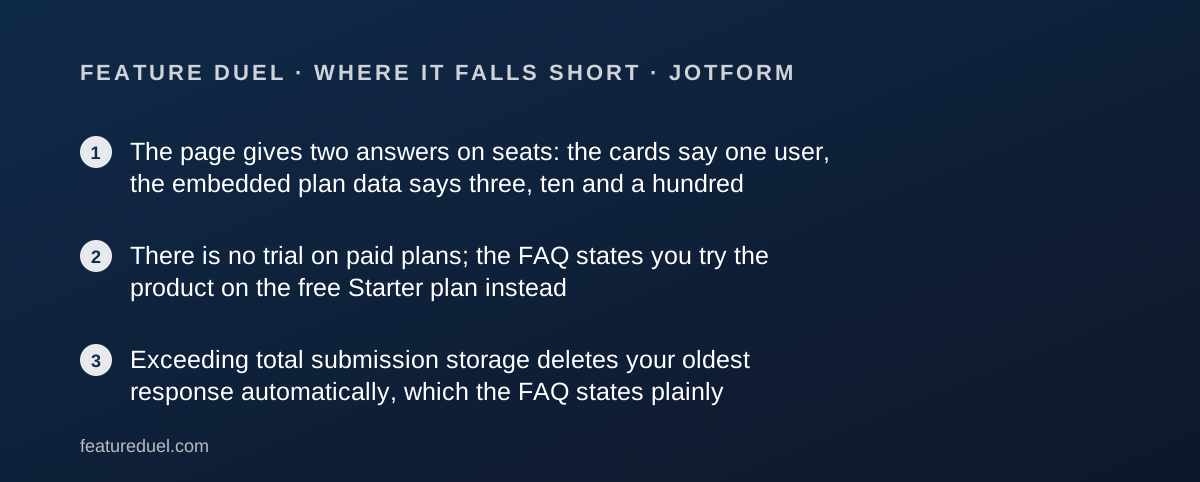
- The page gives two answers on seats: the cards say one user, the embedded plan data says three, ten and a hundred
- There is no trial on paid plans; the FAQ states you try the product on the free Starter plan instead
- Exceeding total submission storage deletes your oldest response automatically, which the FAQ states plainly
At a glance
| Pricing note | Free on the Starter plan with 100 submissions a month, then $39 a month or $408 a year for Bronze, which raises that to 1,000 submissions a month (pricing page, read November 4, 2026) |
|---|---|
| Free plan | Starter: 5 forms, 100 monthly submissions, 100 MB storage, 10,000 monthly form views, 500 total stored submissions, 100 fields per form |
| Plan ladder | Bronze $39 a month or $408 a year, Silver $49 or $468, Gold $129 or $1,188; two-year terms read $816, $936 and $2,376 |
| Monthly submissions | 100 on Starter, 1,000 on Bronze, 2,500 on Silver, 10,000 on Gold |
| Forms | 5 on Starter, 25 on Bronze, 50 on Silver, 100 on Gold |
| Storage | 100 MB, 1 GB, 10 GB and 100 GB; total stored submissions run 500, 10,000, 25,000 and 100,000 |
| Monthly form views | 10,000 on Starter, 100,000 on Bronze, 1,000,000 on Silver, 10,000,000 on Gold |
| Signed documents | 10 a month on Starter, then 100, 250 and 1,000 |
| API calls | 1,000 a day on Starter, 10,000 on Bronze, 50,000 on Silver, 100,000 on Gold, per the embedded plan data |
| HIPAA | Marked unavailable on Starter, Bronze and Silver; available on Gold and Enterprise |
| Refund | 30 Day Money Back Guarantee printed on the pricing page; no trial period on paid plans |
What Jotform actually sells
Jotform sells a metered account, and it is unusually willing to tell you where every meter sits.
Nine figures appear on each plan card: forms, monthly submissions, users, available space, monthly form views, total submission storage, fields per form, monthly payment submissions and monthly signed documents.
Most rivals print two or three of those. Printing nine changes what a buyer can do: you can forecast the renewal instead of finding out.
The product has also grown past forms. The page sells Jotform Sign, Workflows, Tables, Boards, AI Agents and a store builder off the same subscription.
Our five rounds and the evidence each one accepts are set out in how a duel is scored.
Who Jotform suits
The fit follows the meters. Jotform is strongest where the volume is real and the team is small.
- A clinic or a school office collecting hundreds of intake forms a month from one administrator's account
- A nonprofit, which the page offers 50 percent off Bronze, Silver and Gold
- A business that needs HIPAA-enabled forms without a sales call, which Gold marks as available
- An operations lead who wants payment forms and signed documents metered separately and visibly
- Anyone who wants a 30-day money-back guarantee in writing before committing to a year
Who should skip it
Two groups will hit the seat question, and one will hit the storage question.
- A team where five or ten people each need their own login and their own audit trail, because the cards price one user
- An organisation that will not sign without a printed per-seat rate, since the only multiuser plan named on the page is Enterprise
- A business that must retain every response indefinitely, because total submission storage is capped and overflow deletes the oldest record
The seat count is the one number the page contradicts
This is the most important finding in the review, so it is worth stating precisely.
Every plan card, including Gold, prints the line 1 User, Individual Plan. The pricing FAQ reinforces it: Enterprise is described as the only multiuser Jotform plan.
The plan data embedded in the markup of the same page says something else. Bronze carries three sub-users, Silver ten, Gold a hundred.
We will not guess which one governs a bill, and we will not guess what Jotform counts as a sub-user. Both figures were read on November 4, 2026 and both come from the same URL.
The practical advice is to treat the printed card as the promise and confirm the sub-user allowance in writing before you buy for a team. Why that distinction matters at all is the subject of a shared login versus a seat per person.
What each plan includes, as of November 2026
The free plan is more than a demo. Starter allows 5 forms, 100 monthly submissions, 100 MB of space, 10,000 monthly form views, 500 stored submissions and 100 fields per form.
It also permits 10 monthly payment submissions and 10 signed documents, which means a one-person business can take money and signatures without paying anything.
Bronze at $39 a month or $408 a year raises that to 25 forms, 1,000 submissions, 1 GB, 100,000 views, 10,000 stored submissions and 250 fields.
Silver at $49 or $468 gives 50 forms, 2,500 submissions, 10 GB, a million views, 25,000 stored submissions and 500 fields.
Gold at $129 or $1,188 gives 100 forms, 10,000 submissions, 100 GB, ten million views, 100,000 stored submissions and 1,000 fields, plus HIPAA-enabled features.
The embedded plan data adds one figure the cards omit: daily API calls, at 1,000 on Starter rising to 10,000, 50,000 and 100,000.
How the pricing is structured
Three billing periods and one discount pattern, and the arithmetic checks out at every step.
The cards print a monthly rate and an annual-billed monthly rate: $39 and $34, $49 and $39, $129 and $99. The page's plan data prices the yearly subscriptions at $408, $468 and $1,188.
Those divide cleanly by twelve into $34, $39 and $99, which is the test we apply to every price card. The reasoning behind that test is in annual billing versus monthly billing.
Two-year terms are also priced, at $816, $936 and $2,376, which is exactly twice the annual figure. Committing for two years therefore buys no further discount.
The toggle is labelled Save up to 20%. By our arithmetic the real figures are 12.8 percent on Bronze, 20.4 percent on Silver and 23.3 percent on Gold, so the label understates the top plan.
Nonprofit pricing is in the same data: $204, $234 and $594 a year, which matches the printed 50 percent discount.
Value: the best submissions per dollar in this cluster
Our value score is the second highest of the four pillars, and it comes from one comparison.
Bronze costs $408 a year and includes 1,000 submissions a month, so 12,000 a year. That is $0.034 per submission by our arithmetic.
Silver is $468 for 30,000 a year, or $0.016 each. Gold is $1,188 for 120,000, or $0.0099 each.
The free plan is the real value story though. One hundred submissions a month, five forms, payments and signatures, with no time limit, is enough to run a small side business at no cost.
What the ladder does not buy is seats, and that is where the arithmetic stops helping.
Features: the subscription covers more than forms
Jotform sells a suite off one price card, which is either efficient or a reason to look elsewhere depending on what you already own.
Signed documents are metered separately at 10, 100, 250 and 1,000 a month, so e-signature is part of the subscription rather than a separate purchase. Against dedicated tools, compare our reviews of Docusign and PandaDoc.
Payment submissions are metered too, at 10, 100, 250 and 1,000 a month, which makes the form a checkout. For a real storefront, see Shopify and the small-store platform guide.
Jotform Boards turns responses into tasks, which overlaps with what we cover in Asana. The AI Agents limits are metered as well, at 5, 25, 50 and 100 agents.
Whether to buy one suite or stitch specialists together is the trade-off in all-in-one suite versus best-of-breed stack.
Ease of use: the 3.9 is the cost of breadth
Ease is the weakest of our four pillars here, and the reason is visible on the pricing page itself.
The navigation lists ten template families, eight products, a set of AI products and more than two hundred integrations. That is a lot of surface for one administrator to learn.
The nine printed limits cut the other way. A buyer who reads them knows exactly what the account can do, which removes the commonest source of confusion in this category.
We did not run sessions, so this grade is about the documented shape of the product rather than the editor. A suite scores lower on ease than a single-purpose tool almost by definition.
The free Starter plan is the honest answer to the question. It has no time limit, so a buyer can test the interface at length before paying anything.
Support: 24/7 is printed, with a ticket allowance behind it
The pricing page prints 24/7 Customer Support as a flat promise, with no tiering on the cards.
The embedded plan data adds nuance the cards do not. A ticket allowance appears there: zero on Starter, three on Bronze and Silver, ten on Gold.
We do not know whether that figure caps support requests or something narrower, and the page does not define it, so we report it without interpreting it.
Enterprise adds a dedicated support team, service level agreements, data residency and professional services, all of which are listed on the Enterprise card.
No response-time commitment appears for the self-service plans, which is the same gap every rival in this category leaves.
What the limits do when you cross them
Most pricing pages stop at the number. This one explains the consequence, which is rarer and more useful.
The FAQ states that on reaching a usage limit the system sends a notification email and a dashboard warning, and that you can upgrade or purge submissions.
It then states the part worth underlining: if you exceed total submission storage, the system deletes the oldest form response to make room for new submissions.
So the storage cap is not a soft ceiling. On Bronze it is 10,000 stored submissions, which a form collecting 1,000 a month reaches inside a year.
The page also defines each metric it meters, including that only the API call limit resets daily.
What public ratings show, and what they do not
Jotform's aggregate rating on Trustpilot reads 4.2 out of 5 from 1,856 reviews, taken from that page's structured data on November 4, 2026.
That is the strongest pairing of score and sample size in this category, and it is the one external signal we are willing to report.
We do not quote individual reviews, because we cannot verify any of them. The aggregate and the count are the whole of it.
The page's own claim of over 40 million users is a vendor figure, printed in the DOM under the page heading, and we repeat it as that rather than as a measurement.
Alternatives worth pricing first
Two conditions should send you elsewhere, and neither is about features.
If the form itself must be long, check the field cap. Two hundred and fifty fields on Bronze is generous for most forms and a hard stop for a detailed application.
If several people need their own login at a printed price, a flat-fee rival with unlimited collaborators will be cheaper and far less ambiguous than an Enterprise quote.
If the forms are feeding support rather than sales, the receiving end matters more than the sending end, and our reviews of Freshdesk and Zendesk Suite cover what each expects.
Otherwise choose Jotform. No rival in this category tells you as much about what you are buying.
One more comparison is worth running before you sign. Price the yearly figure against the monthly one at your real submission volume, not at the volume you have today.
A form that grows from 300 to 1,200 submissions a month crosses two Jotform tiers in a year. The ladder is cheap at every rung and the steps between rungs are where the surprise lives.
And if the account will mostly move contacts into a mailing list, price that side too. Our reviews of Mailchimp and MailerLite show how differently the two meter the same contacts.
Bottom line
Jotform is the most transparent price card in this category and the best value per submission on it.
Buy Bronze at $408 a year if one person collects a lot of answers. Buy Gold at $1,188 if you need HIPAA features without a sales call.
Stay on Starter longer than you think. Five forms and 100 submissions a month with payments and signatures included is a real product, not a teaser.
And settle the seat question in writing. A page that says one user on the card and three, ten or a hundred in its own plan data is a page to confirm before a team relies on it.
Buy it if
- You want the ceiling in writing. Nine printed limits per plan is the most complete disclosure in this category, and it lets you forecast a renewal rather than discover it.
- Your submission count is high and your headcount is low. Bronze gives 1,000 submissions a month for $408 a year, which is 12,000 answers for less than rivals charge for 1,200.
- You are a nonprofit or a school. Fifty percent off Bronze, Silver and Gold is printed on the page, and 30 percent off Enterprise.
- You need HIPAA features without a sales call. Gold at $1,188 a year marks HIPAA-enabled features as available, which is the only self-service HIPAA plan in this cluster.
Skip it if
- You need several named logins and a printed price for them. The cards say one user and the FAQ says Enterprise is the only multiuser plan, so a real team needs a quote.
- You want to try a paid plan before paying. The FAQ states there is no trial period; the 30-day refund is the fallback.
- You keep every response forever. Total submission storage is capped, and the FAQ states the oldest response is deleted to make room once you exceed it.
- You want one long form. Fields per form run 100, 250, 500 and 1,000, so form length is metered here in a way it is not everywhere.
Frequently asked
How much does Jotform cost?
Starter is free. Paid monthly, Bronze is $39, Silver $49 and Gold $129 a month. The page's own plan data prices the yearly subscriptions at $408, $468 and $1,188, which is $34, $39 and $99 a month. Read November 4, 2026.
How many submissions does Jotform allow?
One hundred a month on the free Starter plan, 1,000 on Bronze, 2,500 on Silver and 10,000 on Gold. Separately, total stored submissions are capped at 500, 10,000, 25,000 and 100,000 across the same four plans.
Can more than one person use a Jotform account?
The page answers twice and the answers differ. Every card reads 1 User, Individual Plan, and the FAQ calls Enterprise the only multiuser Jotform plan. The embedded plan data instead lists three, ten and a hundred sub-users on Bronze, Silver and Gold. Confirm at checkout.
Is Jotform really free?
Yes, with printed limits. The Starter plan allows 5 forms, 100 monthly submissions, 100 MB of storage, 10,000 monthly form views and 500 stored submissions. Forms carry Jotform branding and HIPAA features are unavailable.
Does Jotform offer a refund?
Yes. The pricing page prints a 30 Day Money Back Guarantee and states that a cancellation within 30 days of payment is refunded in full on request to support. There is no trial period on paid plans.
What happens when I hit a Jotform limit?
The FAQ states the system emails you and warns you on the dashboard, and that you can upgrade or purge submissions. It adds that exceeding total submission storage deletes the oldest response to make room for new ones.
Which Jotform plan includes HIPAA features?
Gold and Enterprise. The cards mark HIPAA-Enabled Features Unavailable on Starter, Bronze and Silver, and Available on Gold, which is $129 a month or $1,188 a year.
Sources
- Jotform features and pricing page, rendered DOM including the five plan cards and all nine printed limit rows - checked November 4, 2026
- Jotform plan data embedded in the markup of the same page, carrying the yearly and two-year prices and the sub-user counts - checked November 4, 2026
- Jotform Pricing FAQ on the same page, covering the free plan, trials, refunds, limit behaviour and the definition of each metric - checked November 4, 2026
- Trustpilot aggregate rating for jotform.com, read from the page's structured data - checked November 4, 2026
Visit Jotform
We have no affiliate relationship with this vendor. Link goes to the official site.